

How to Build Ads That Win Pre-Launch AI Tests
TL;DR:
- Building ads effectively requires a strategy-driven brief, high-quality creative elements, and pre-launch simulation testing.
- Using strong hooks that quickly capture attention and ensuring captions are burned in are essential for mobile video success.
The fastest way to build ads that actually scale: write a strategy-first brief, generate rapid creative variants, run them through synthetic-persona simulation, and map results to your KPIs before you spend a dollar on live traffic. Creative quality explains up to 50% of campaign performance variance, which means your creative decisions matter more than your targeting choices. Get the creative right first.
Every winning ad contains five elements:
- Hook: A pattern interrupt that lands in the first 1.5–3 seconds
- Value: A specific, benefit-led statement (not clever, not vague)
- Proof: A micro-moment of social proof, a stat, or a result
- CTA: One clear next step, matched to funnel stage
- Silent-view-ready text: Captions or overlays that carry the message without audio
Test before you scale. POPJAM is built exactly for this workflow.
Table of Contents
- How do you build ads from brief to launch-ready test variants?
- What design rules actually stop the scroll?
- What are the platform specs for Meta, TikTok, YouTube, LinkedIn, and Reddit?
- How do pre-launch testing methods actually validate creative winners?
- What does a realistic production timeline and budget look like?
- What does a production checklist and naming convention look like?
- Why does AI persona simulation move the needle before you go live?
- Key Takeaways
- The thing most teams get wrong about pre-launch testing
- POPJAM turns your brief into tested, launch-ready creatives
- Useful sources and further reading
- FAQ
How do you build ads from brief to launch-ready test variants?
Follow this sequence every time your team creates online ads:
- Strategy brief: Define the campaign objective, one primary KPI, audience segment, and message angle. Stakeholder alignment here prevents wasted production cycles.
- Persona selection: Choose 2–3 psychographic profiles that represent your buyer. These feed your pre-launch simulation.
- Hook ideation: Write 3 distinct hooks per angle. Hooks are your highest-leverage variable, so spend disproportionate time here.
- Format selection: Match creative format to platform placement priorities (covered in the specs section below).
- Rapid production: Generate variants using AI creative tools or ad design tools built for multi-format output.
- Asset naming and packing: Use a consistent naming convention (Campaign_Angle_Hook_Format_v1) so variants stay trackable through testing.
- Pre-launch simulation: Run your packed variants through synthetic-persona simulation to score relative performance before live spend.
- Live micro-tests and ramp: Launch your top-scored variants with a structured micro-budget, gather real signals, then scale winners.
A compact creative brief template your team can drop into any project management tool:
| Field | Input |
|---|---|
| Campaign objective | e.g., Lead gen, app install, purchase |
| Primary KPI | e.g., CTR, CVR, cost per lead |
| Audience / persona | e.g., SaaS growth lead, 28+, US |
| Message angle | e.g., Speed benefit, social proof, fear of loss |
| Hook (3 options) | Write all three before production starts |
| Formats required | e.g., 9:16 video, 1:1 static, 16:9 banner |
| Mandatory assets | Logo, product shot, offer copy |
| Measurement events | e.g., Form submit, add to cart, sign-up |
Pro Tip: Spend 60% of your ideation time on hooks. A weak hook with a great offer still loses. A strong hook with a mediocre offer can still pull a click.
What design rules actually stop the scroll?
Hooks must land very quickly within a short attention span. That’s not a guideline; it’s the window you have before a thumb moves. Your first frame needs to do the heavy lifting visually and verbally, simultaneously.

85% of users watch video ads without sound. That single stat rewrites your entire production checklist. If your message only works with audio, you don’t have an ad yet.
Visual and copy principles that work within the attention window:
- High-contrast first frame: Use color contrast to separate your subject from the feed background immediately
- Text overlays on every video: Burn captions or benefit statements into the video, not just as an accessibility layer but as the primary message carrier
- Specificity over cleverness: “Cut your reporting time by 40%” outperforms “Work smarter, not harder” every time
- Social-proof micro-moments: A logo wall, a star rating, or a single customer result in the first 3 seconds adds instant credibility
- Face gaze and framing: Human faces looking toward the CTA or product direct viewer attention; center-frame faces on mobile vertical formats
- Mobile-first composition: Keep key visual elements in the center third of a 9:16 frame to avoid platform UI overlap
Check out social media ad examples that apply these principles across real campaigns.
What are the platform specs for Meta, TikTok, YouTube, LinkedIn, and Reddit?
Platform constraints determine format selection, and format selection shapes every creative decision that follows. Build your brief around placement first.
Primary placement priorities per platform:
- Meta: Reels and Stories (9:16) dominate mobile delivery; Feed (1:1 or 4:5) for static and carousel
- TikTok: 9:16 vertical video only; native-feel UGC style outperforms polished production
- YouTube/Google: 16:9 skippable in-stream; 6-second bumpers for awareness; Performance Max accepts multiple asset types for automated creative combinations
- LinkedIn: 1:1 or 4:5 for feed video; single-image sponsored content at 1.91:1 for awareness
- Reddit: 4:5 or 1:1 for promoted posts; static and short video both perform; community-native tone required
| Platform | Aspect Ratio | Recommended Length | Captions | Max File Size |
|---|---|---|---|---|
| Meta (Reels/Stories) | 9:16 | 15 sec | Burned-in or auto | 4 GB (video) |
| TikTok | 9:16 | 15–60 sec | Burned-in preferred | — |
| YouTube (in-stream) | 16:9 | 15 sec skippable | SRT or burned-in | — |
| LinkedIn (video) | 1:1 or 4:5 | 15 sec | SRT required | 5 GB |
| Reddit (promoted) | 4:5 or 1:1 | 15 sec | Burned-in | 1 GB |
Silent-view defaults vary: Meta and TikTok autoplay muted by default, making burned-in captions non-negotiable. LinkedIn and YouTube often play with sound in-feed but muted in Stories placements, so captions still protect reach. For static ad best practices across these placements, the same visual hierarchy rules apply.
How do pre-launch testing methods actually validate creative winners?
Combining synthetic-persona simulation with structured micro-tests gives you the fastest signal on which variants will scale. Simulation surfaces relative performance across persona segments before you commit live budget. Micro-tests confirm the signal with real audience data.
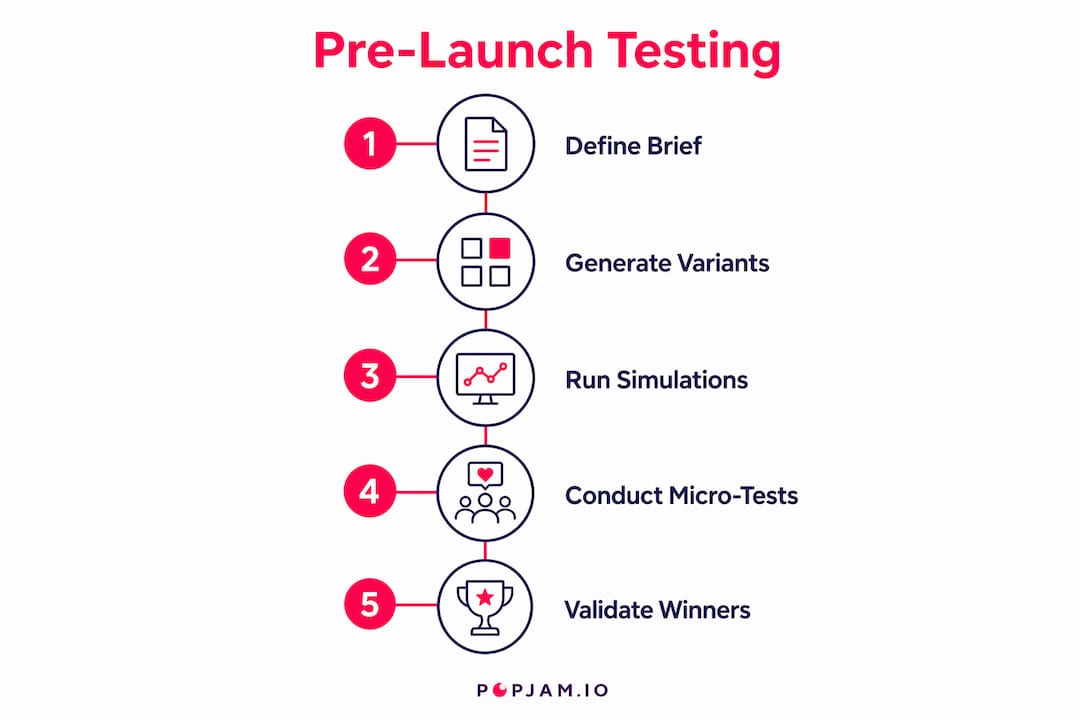
The 3-2-2 testing discipline keeps your budget focused: run 3 distinct creative concepts, 2 variations of each, against 2 audience signals. That’s 12 variants with clean separation between variables. Test hooks first, then angles, then CTAs. Changing all three at once makes it impossible to know what moved the needle.
Metric mapping for simulation signals to live KPIs:
- Simulated engagement score maps to predicted CTR
- Persona resonance rating maps to CVR and lead quality
- Message clarity score maps to landing page bounce rate
- Emotional response index maps to brand lift and LTV prediction
For a minimal viable pre-launch test: run your top 3 simulation-scored variants against a warm lookalike audience with a $150–$300 micro-budget per variant. Allow 2–3 weeks for the platform’s learning phase before drawing conclusions. Pulling creative too early invalidates the data. Pair this with data-driven creative testing frameworks to sharpen your hypothesis before spend.
What does a realistic production timeline and budget look like?
Most teams should plan for 2–4 weeks from brief to first validated winners, depending on platform scope and production complexity. Here’s where the time actually goes:
- Days 1–3: Brief writing, stakeholder alignment, persona definition
- Days 4–7: Hook ideation, concept development, asset sourcing
- Days 8–12: Production (AI generation, UGC capture, or studio shoot)
- Days 13–15: Curation, captioning, QC, and simulation run
- Days 16–28: Live micro-tests, learning phase, and winner identification
Cost concentrates in four areas: talent and creative direction, shoot production (studio vs. UGC), editing and localization, and live testing spend. UGC-style production typically runs at a fraction of studio costs and often outperforms on early engagement metrics for discovery placements. Studio production holds its value for retargeting and brand-perception campaigns.
Pro Tip: Use UGC-style creative for top-of-funnel discovery to keep production costs low while you find your winning angle. Once you have a validated concept, invest studio budget in a polished version for retargeting.
For a broader view of ad creative services and when to bring in outside production, the tradeoffs between in-house and managed creative are worth mapping before you commit a budget.
What does a production checklist and naming convention look like?
A reusable brief and consistent naming system are what separate teams that scale from teams that scramble.
Creative brief fields (copy into Notion, Asana, or Linear):
- Audience segment and persona name
- Campaign KPI and success threshold
- Message angle and hook (3 options)
- Required formats and aspect ratios
- Mandatory brand assets (logo, color codes, product shots)
- Measurement events and UTM parameters
Asset production and QC checklist:
- [ ] Hook lands before 3 seconds
- [ ] Captions burned in or SRT file attached
- [ ] Text readable at mobile size (minimum 24pt equivalent)
- [ ] CTA visible in final 3 seconds of video or bottom-right of static
- [ ] Accessibility: sufficient color contrast (WCAG AA minimum)
- [ ] File size within platform limits
- [ ] Naming convention applied:
Campaign_Angle_Hook_Format_v1 - [ ] Variants uploaded to shared folder with version control
A folder structure that works: /Campaign Name/Platform/Format/v1, v2, v3. Keep simulation scores and live test results in the same folder as a notes file so the next creative sprint starts with context, not guesswork. Template-driven tools can accelerate multi-format production significantly, cutting turnaround from weeks to days for standard ad types.
Why does AI persona simulation move the needle before you go live?
AI simulation compresses early discovery by predicting relative creative performance across persona segments before a single dollar of live spend. Instead of running 12 variants blind and waiting 3 weeks for data, you enter the live phase with a ranked shortlist.
The practical effect: simulation reduces the number of live micro-tests required to find a winner. Teams that pre-test ad creatives before launch consistently report fewer wasted test cycles and faster iteration. The simulation doesn’t replace live data, but it filters out the obvious losers before they consume budget.
On major platforms, creative quality now functions as a targeting mechanism. Better creative surfaces the right audience through AI-driven delivery rather than manual segmenting. That means the quality of your creative brief directly affects your delivery efficiency, not just your click rate.
Pro Tip: Blend simulated persona scores with your organic content performance signals. If a hook concept is already resonating in organic posts, that’s a strong prior for simulation. Weight those variants higher in your live test queue.
For a deeper look at AI advertising campaigns and how simulation fits into a full-funnel strategy, the workflow extends well beyond pre-launch.
Key Takeaways
Building ads that win pre-launch AI tests requires a strategy-first brief, hooks that land in 1.5–3 seconds, platform-ready specs, and the 3-2-2 testing discipline before any live spend.
| Point | Details |
|---|---|
| Creative quality drives performance | Creative quality explains up to 50% of campaign performance variance across platforms. |
| Hooks must land very quickly within a short attention span | The attention window is 1.5–3 seconds; your first frame must interrupt the scroll visually and verbally. |
| Captions are non-negotiable | 85% of users watch video ads without sound; burned-in captions carry your message when audio is off. |
| Use the 3-2-2 testing method | Run 3 concepts, 2 variations each, against 2 audience signals to find winners without fragmenting budget. |
| POPJAM accelerates the full workflow | POPJAM combines AI ad generation, synthetic-persona simulation, and pre-launch testing to cut wasted spend. |
The thing most teams get wrong about pre-launch testing
Most teams treat pre-launch testing as a nice-to-have, something they’ll do when they have more time or a bigger budget. That’s backwards. The teams burning the most ad spend are usually the ones skipping the simulation step, not the ones running it.
What surprises people when they first introduce synthetic-persona simulation isn’t the technology. It’s the stakeholder conversation. Creative directors and brand managers sometimes push back because simulation feels like it’s replacing human judgment. It isn’t. It’s giving human judgment better inputs. The simulation tells you which hooks are likely to resonate with a specific psychographic profile. The creative team still decides what to make. That reframe usually resolves the friction fast.
The practical tip for change management: run one campaign with simulation and one without, using the same brief and budget. Let the results make the argument. You won’t need to have the conversation twice.
POPJAM turns your brief into tested, launch-ready creatives
Skip the “post and pray” cycle. POPJAM generates on-brand ad creatives across Meta, Google, TikTok, LinkedIn, and Reddit, then runs them through Synthetic Personas before you spend. You get qualitative and quantitative feedback mapped to your KPIs, so your team enters the live phase with ranked variants, not a coin flip.
Agencies use POPJAM for campaign preflight and creative refreshes. In-house teams use it to generate cross-platform format packs from a single brief. The workflow is the same: brief in, simulation scores out, winners to live testing.
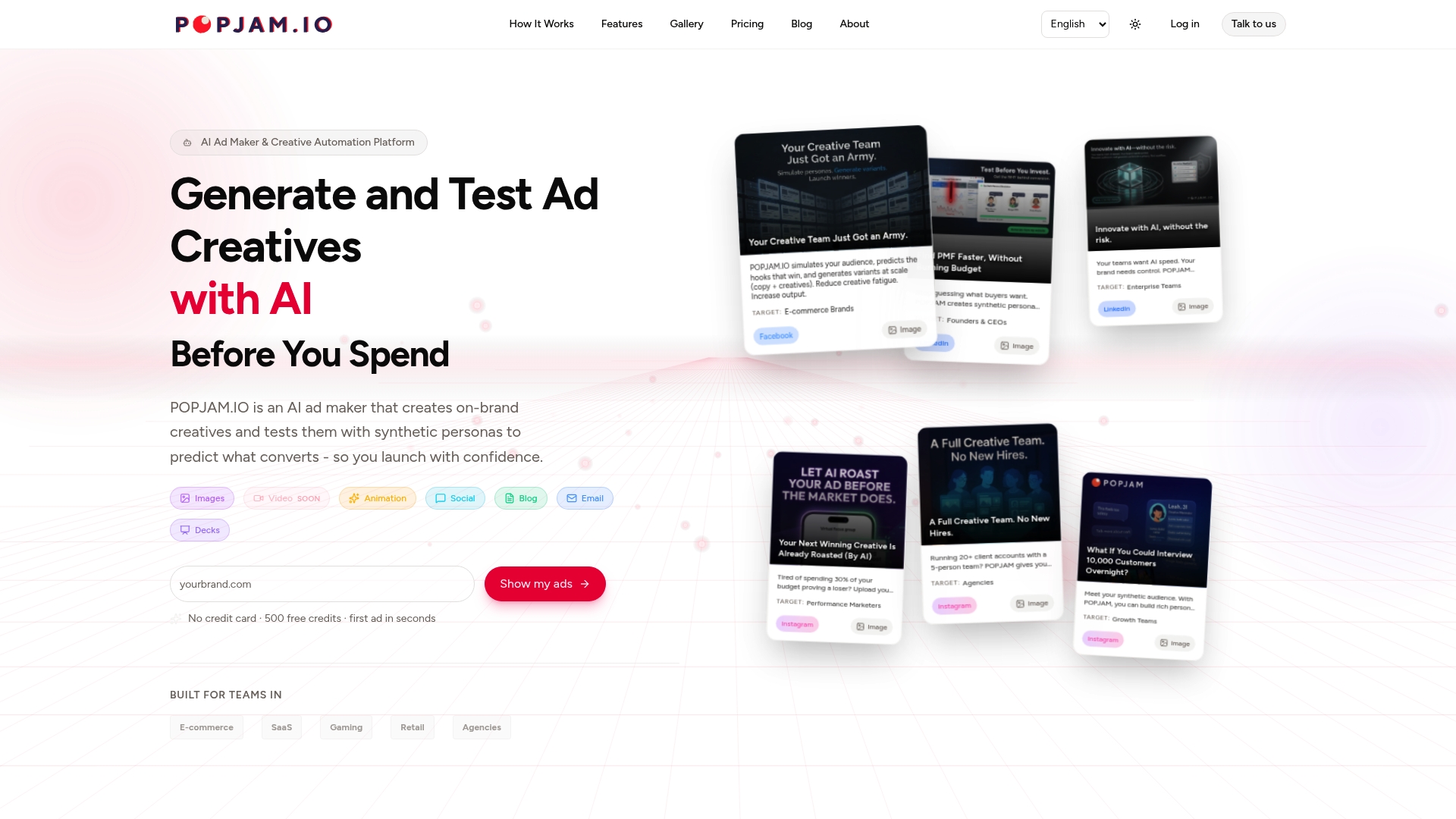
Ready to test before you spend? Explore the AI ad maker and run your first synthetic-persona simulation, or check out the agency-specific workflow if you’re managing multiple client campaigns.
Useful sources and further reading
- Nielsen: Creative quality and ad effectiveness
- Think with Google: Build better creative for performance marketing
- Redclawey: Ad creative design principles
- Vizup: The 2026 guide to high-converting ad creatives
- MYCONTENTLAB: Hook design and pattern interrupt techniques
- POPJAM: How to create high-impact ad creatives
- POPJAM: Why pre-test ad creatives
- POPJAM: AI advertising campaigns guide
FAQ
What is the most important element when you build ads?
The hook is the single highest-leverage element. Creative quality explains up to 50% of performance variance, and the hook determines whether the rest of your ad gets seen at all.
How long should a pre-launch testing phase take?
Plan for a few weeks from brief to first validated winners. Platforms need a minimum of 2–3 weeks of live data before their optimization algorithms stabilize, so pulling creative early invalidates your results.
What is the 3-2-2 testing method?
The 3-2-2 method runs 3 distinct creative concepts, 2 variations of each, against 2 audience signals. It keeps variables separated so you can identify what actually drove performance.
Why do captions matter so much in video ads?
85% of users watch video ads without sound, so captions and text overlays carry your message for the majority of your audience. Burned-in captions are the most reliable format across Meta and TikTok placements.
How does POPJAM fit into a pre-launch testing workflow?
POPJAM generates ad creatives from your brief, then simulates audience reactions using Synthetic Personas before live spend. Teams use it to rank variants by predicted performance and enter live micro-tests with a shortlist rather than a blind batch.