

Creative Brief Examples: 5 Copy-and-Paste Templates
A creative brief is a one- to two-page working document that tells your creative team what to make, who it’s for, and the single thing it must communicate. Every effective brief covers the same core fields:
- Project name and purpose — what this is and why it exists
- Objective — the one measurable outcome the work must drive
- Target audience — who you’re speaking to, with a behavioral or psychographic detail
- Audience insight — the tension or truth that makes the message land
- Single-minded proposition (SMP) — one sentence, 10–12 words max
- Desired response — what the audience should feel, think, or do
- Tone — two or three descriptive words, with a reference example
- Deliverables and specs — file formats, sizes, quantities
- Timeline and approvals — key dates and who signs off
- KPIs and success criteria — how you’ll know it worked
- Mandatories and constraints — legal copy, brand guidelines, logo rules
The copyable template is in Section 7. If you’re in a hurry, jump there now and come back for the field-by-field prompts and real-world examples.
Key Takeaways
A creative brief’s single-minded proposition is the hardest field to write and the most important: teams that lock it first produce fewer revision rounds and clearer creative outcomes.
| Point | Details |
|---|---|
| Write the SMP first | The single-minded proposition (10–12 words) drives every other field; write it before tone or deliverables. |
| One page or two | Single-asset projects need one page; multi-asset campaigns cap at two pages to stay scannable and usable. |
| Assign one owner | Every brief needs a named author who versions the file and owns updates after sign-off. |
| Validate before production | Generate rapid mockups and run synthetic persona reactions to catch a misaligned message before shoot costs begin. |
| POPJAM for brief validation | POPJAM generates on-brand ad variations from your brief and tests them against Synthetic Personas before you spend on production. |
Table of Contents
- What is a creative brief, and how does it differ from a project brief?
- Why creative briefs matter to marketing teams
- When should you create a creative brief?
- How do you write a creative brief field by field?
- Five copyable creative brief examples for common projects
- A copy-and-paste creative brief template
- Best practices and common pitfalls
- Who writes, reviews, and signs off on a creative brief?
- How to validate a brief before full production
- How to tailor a creative brief to different industries and project scales
- Tips for reviewing and iterating the creative brief with stakeholders
- How to measure the effectiveness of a creative brief post-project
- The brief is the strategy, not the paperwork
- POPJAM helps you validate your brief before production starts
- Sources
- FAQ
What is a creative brief, and how does it differ from a project brief?
A creative brief is a strategic alignment document. It answers the creative question: what should this work say and feel like? A project brief answers the operational question: what tasks need to happen, by when, and at what cost?
Both documents matter. They just live at different stages. The project brief comes first, setting scope, budget, and timeline. The creative brief comes second, translating that scope into a creative direction the team can actually execute.
Adobe notes that creative briefs work best when they impose direction and constraints rather than prescribing creative outcomes. That distinction is worth holding onto: your job as the brief-writer is to define the problem clearly, not to solve it for the creative team.
| Dimension | Creative brief | Project brief |
|---|---|---|
| Primary question | What should this say and feel like? | What needs to be done, by when, and for how much? |
| Core content | Objective, SMP, audience, tone, deliverables | Scope, tasks, milestones, budget, resources |
| Who authors it | Strategist or account lead | Project manager or account manager |
| When it’s written | After scope is agreed, before concepting | At project kickoff |
| Who approves it | Creative lead + client stakeholder | Client stakeholder + finance |
Why creative briefs matter to marketing teams
A good brief is the cheapest risk-reduction tool in your creative workflow. It aligns stakeholders before a single pixel is moved, and it gives the creative team a clear target to aim at rather than a vague direction to interpret.
The practical benefits are real:
- Fewer revision rounds. When the SMP is agreed upfront, creative teams aren’t guessing at the message.
- Faster time to first draft. Designers and copywriters can start producing the moment the brief is signed off.
- Clearer KPIs. Briefs that name success metrics prevent the post-campaign argument about whether the work “worked.”
- Reduced scope creep. Explicit deliverables and specs, paired with a clear approval flow, keep scope from expanding after production starts.
Bynder’s analysis of real-world briefs shows that the same core fields repeat across every effective brief, whether it’s an agency brief for a global brand or an in-house brief for a landing page update. Objective, audience, messaging, tone, and deliverables are non-negotiable.
The brief also protects the creative team. When a stakeholder asks for a last-minute change in tone or adds a new deliverable mid-production, a signed brief gives the project manager a documented baseline to push back against.
When should you create a creative brief?
Not every creative task needs a full brief. A one-off social post or a quick banner swap probably doesn’t. But if any of the following triggers apply, write one before you start:
- New campaign launch — any multi-channel effort with more than two asset types
- Brand repositioning or refresh — when tone, visual identity, or messaging is changing
- Multi-asset shoots — video, photography, or illustration sessions that produce a bank of content
- Cross-functional launches — product launches where marketing, product, and sales all need aligned messaging
- Major landing page or website updates — when the page’s purpose or audience is shifting, not just its design
For a single asset (one social video, one email header), a one-page brief is enough. For a multi-asset campaign, Rock capping the brief at two pages and using a 9-section structure that keeps it scannable rather than exhaustive.
The rule of thumb: if more than two people need to agree on what the work should say, write a brief.
How do you write a creative brief field by field?
Writing a brief gets faster once you have a prompt for each field. Here are the ten fields with a one-sentence prompt and a sample fill-in for each.
-
Project name and purpose — What is this project and why does it exist now? Example: “Q3 awareness push for the new Zapier integration — timed to the product launch in August.”
-
Objective — What single measurable outcome must this work drive?
-
Target audience — Who is this for, and what do they believe or do today? Example: “Marketing ops managers at 50–500-person SaaS companies who currently use spreadsheets to track campaign performance.”
-
Audience insight — What tension or truth makes the message relevant to them? Example: “They know their reporting is broken but assume fixing it requires an engineer.”
-
Single-minded proposition — One sentence, 10–12 words, that captures the core promise. Example: “HubSpot connects your data so your team stops chasing reports.”
-
Desired response — What should the audience feel, think, or do after seeing this? Example: “Think: ‘This solves the exact problem I have.’ Do: click to start a free trial.”
-
Tone — Two or three words, plus one reference example. Example: “Confident, clear, human. Reference: Mailchimp’s onboarding copy.”
-
Mandatories and constraints — What must appear or must never appear? Example: “Logo in top-left, legal disclaimer on all paid placements, no competitor mentions.”
-
Deliverables and specs — What exactly needs to be produced? Example: “3 × static Meta ads (1080×1080 and 1080×1920), 1 × 15-second video, 1 × email header.”
-
Timeline and KPIs — When is each milestone due, and how will you measure success? *Example: "First drafts August 5, client review August 10, live August 17.
Pro Tip: Convert your business objective into an audience behavior before you write the SMP. “Increase revenue” is a business goal. “Get ops managers to start a free trial this week” is an audience behavior — and it’s the one that should drive the brief.
The SMP is the hardest field to write and the most important. Reforge’s operator examples show that tech teams who nail the proposition first write shorter, sharper briefs across every other field. Write it first, not last.
Five copyable creative brief examples for common projects
These five short briefs are ready to paste and adapt. Each uses a well-known brand as an illustrative placeholder, not an endorsement.
1. Website redesign brief (Google)
| Field | Content |
|---|---|
| Project | Google Search homepage accessibility refresh |
| Objective | Increase task completion rate for first-time users by 15% |
| Audience | Adults using Search for the first time on mobile |
| SMP | Search should feel instant and effortless for everyone |
| Mandatory | WCAG compliance; no removal of core search bar |
| Deliverables | New homepage wireframes (mobile + desktop), 2 concept directions |
| Success metric | 15% improvement in task completion in usability testing |
2. Multi-channel product launch (PayPal)
3. Short social video (Coca-Cola)
4. In-house landing page update (Mailchimp)
5. Freelance logo and identity (HubSpot spinoff product)
Vaiz’s ready-to-copy brief formats confirm that short, scannable briefs like these get adopted faster than detailed multi-page documents.
A copy-and-paste creative brief template
Paste this into Google Docs, Notion, or your project management tool and fill in each field. Suggested word limits are in brackets.
CREATIVE BRIEF
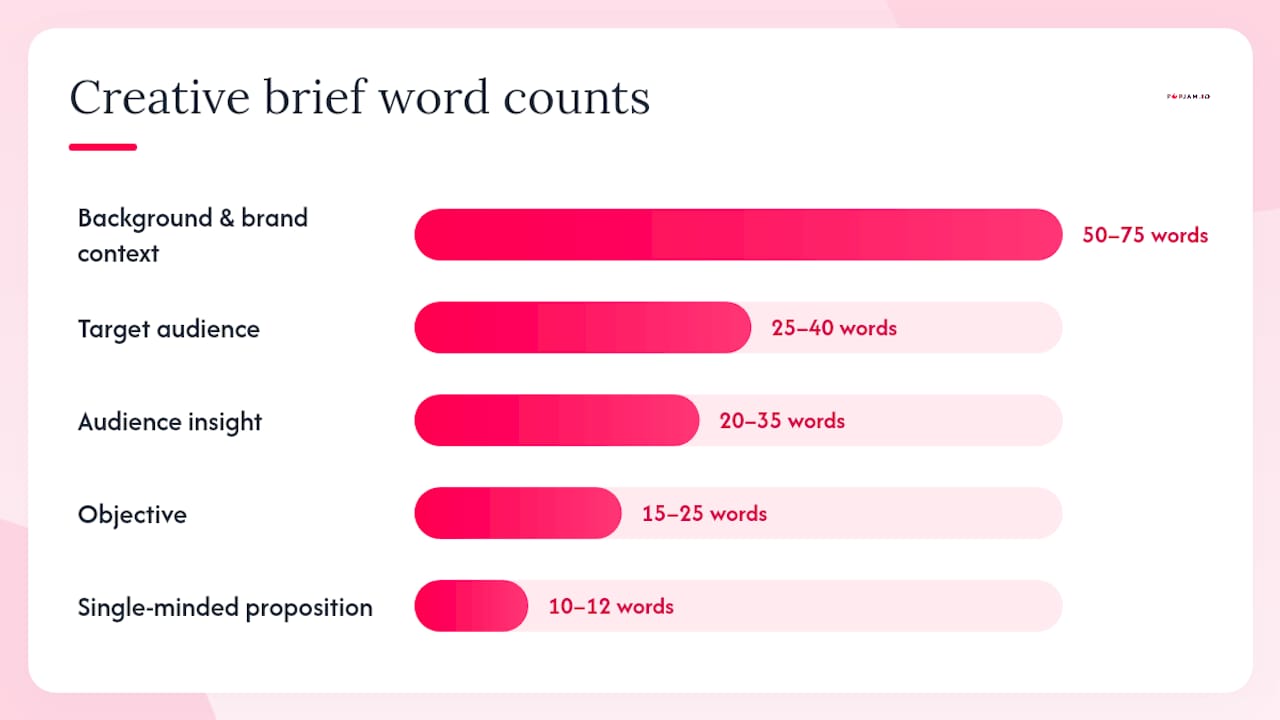
Project name and purpose [10–20 words] What is this project and why does it exist now?
Objective [15–25 words] One measurable outcome. Start with a verb: “Increase,” “Drive,” “Generate.”
Target audience [25–40 words] Who they are, what they believe, and what they do today.
Audience insight [20–35 words] The tension or truth that makes your message relevant.
Single-minded proposition [10–12 words max] One sentence. The one thing this work must say.
Desired response [15–25 words] What should the audience feel, think, or do?
Tone [3–6 words + one reference] Two or three descriptors and one example of the right voice.
Mandatories and constraints [bullet list] Legal copy, logo rules, brand guidelines, anything that cannot change.
Deliverables and specs [bullet list] Every asset, with dimensions, file format, and quantity.
Timeline and approvals [bullet list] Key dates: brief sign-off, first draft, review, final delivery.
KPIs and success criteria [15–25 words] How will you know this worked? Name the metric and the target.
For agency use: Add a “Background and brand context” section above the objective (50–75 words) so external teams have enough context to work without a briefing call.
For single-asset projects: Drop the “Deliverables and specs” to one line and cut the timeline to two dates: draft due and final due.
A copy button will appear on the published version of this page so you can grab the template in one click. Rock.so’s 9-section structure validates this format: two pages is the practical ceiling for multi-asset work, and one page is best for single assets.
Pro Tip: Embed this template directly in your team’s Notion workspace or Asana project template rather than keeping it as a standalone file. Templates that live inside your workflow get used; templates that live in a shared drive get forgotten.
Best practices and common pitfalls
Best practices to follow:
- Assign one owner. The brief has a single author who is accountable for accuracy and updates.
- Version your filename. Use
brief_projectname_v1.docxfrom day one so review comments don’t land on the wrong version. - One primary objective. Two objectives mean no objective. Pick the one that matters most.
- Use references, not adjectives. “Warm and human like Mailchimp’s onboarding copy” is more useful than “warm and human.”
- Keep decision-makers in the approval flow. If someone can kill the work later, they need to sign the brief now.
Common pitfalls to avoid:
- Writing for the client, not the creative team. The brief is a production document, not a client presentation. Keep it direct and task-oriented.
- Burying mandatories. Legal copy and brand constraints belong in their own clearly labeled section, not scattered through the tone or objective fields.
- Tone sections that run too long. Three words and one reference beat three paragraphs of adjectives every time.
- No owner for updates. When the brief changes after sign-off, someone needs to own the new version and notify the team.
When a brief runs long, edit for actionability. Ask: “Does this sentence help the creative team make a decision?” If not, cut it.
Who writes, reviews, and signs off on a creative brief?
Clear ownership prevents the brief from becoming a committee document that says everything and commits to nothing.
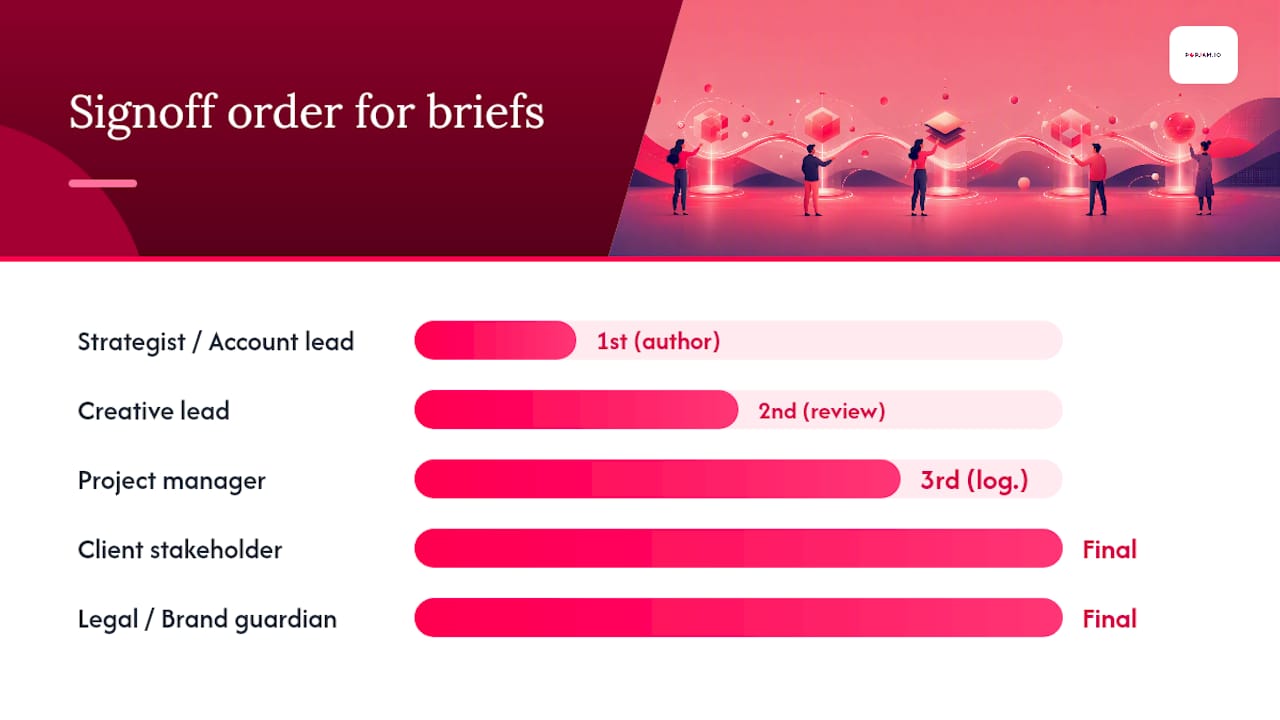
| Role | Responsibility | Signs off? |
|---|---|---|
| Strategist or account lead | Authors the brief; owns the SMP and insight | Yes — first |
| Creative lead | Reviews for feasibility; flags missing specs | Yes — second |
| Project manager | Confirms timeline, deliverables, and budget alignment | Yes — third |
| Client stakeholder | Reviews objective and mandatories | Yes — final |
| Legal or brand guardian | Reviews mandatories and compliance copy | Yes — final (parallel to client) |
The recommended signoff flow is sequential: strategist drafts, creative lead reviews, PM confirms logistics, then client and legal review in parallel. Final sign-off should happen before any concepting begins.
When discovery reveals a scope change or a new audience insight, rebrief. Don’t try to patch the original document with comments. Issue a new version with a clear changelog note at the top.
Pro Tip: Add a “Version history” row at the top of every brief: date, version number, and a one-line note on what changed. It takes 30 seconds and saves hours of confusion when a stakeholder asks why the tone shifted between v1 and v3.
How to validate a brief before full production
Writing a great brief is step one. Validating its assumptions before you spend on production is step two — and most teams skip it.
Here’s a lightweight validation workflow that works even for small teams:
- Generate rapid mockups. Use AI creative generation to produce two or three visual directions based on the brief’s SMP and tone. You’re not looking for final assets; you’re looking for directional signal.
- Run synthetic persona reactions. Simulate how your target audience segments would respond to each direction. Look for emotional tone alignment and message clarity, not polish.
- A/B test the proposition. Write two versions of the SMP and test them as ad copy against a small simulated cohort. The one with higher message recall wins.
- Run a quick qualitative check. Five to ten users (or simulated cohorts) reading the brief cold and describing what they think the ad will say is enough to catch a misaligned message before it goes to production.
- Revise the brief if needed. If the feedback shows a confused message, wrong emotional tone, or misidentified audience, fix the brief now. Changing direction costs nothing at this stage.
This approach is especially useful for high-impact ad creative where the cost of a wrong direction is measured in shoot days and media spend.
Pro Tip: The three signals that mean your brief needs revision: (1) test audiences describe the ad’s message differently than your SMP states it, (2) the emotional tone reads as the wrong register for the audience, or (3) more than one person asks “who is this for?” after reading the brief cold.
How to tailor a creative brief to different industries and project scales
The core fields stay constant. What changes is the depth of each field and the weight you give to mandatories.
For regulated industries (finance, healthcare, legal), the mandatories section is the most critical field in the brief. Legal review happens before concepting, not after. PayPal’s brief example above shows this: the “no hidden fees” claim and legal disclaimer are locked before a single asset is designed.
For e-commerce and DTC brands, the deliverables section gets more specific. You need to name every ad size, every platform, and every format because a missing spec at brief stage becomes a reshooting cost at production stage. A well-organized creative asset bank starts with a brief that lists every asset explicitly.
For B2B SaaS (think HubSpot, Zapier, Mailchimp), the audience insight field carries the most weight. B2B buyers are skeptical and research-driven. The insight needs to name a specific pain point, not a demographic. “Marketing ops managers who assume fixing their reporting requires an engineer” is a useful insight. “B2B decision-makers” is not.
For small teams running single-asset projects, cut the brief to one page. Keep the SMP, audience, tone, deliverables, and one KPI. Drop the background section and the version history. Speed matters more than completeness at this scale.
For agency briefs on large campaigns, add a “Background and brand context” section and a competitive context note. External teams don’t have institutional knowledge, so the brief needs to carry more context than an in-house document would.
Tips for reviewing and iterating the creative brief with stakeholders
The review process is where most briefs go wrong. Stakeholders add objectives, soften the SMP, and expand the audience until the brief says nothing specific. Here’s how to keep the review productive:
Send the brief with a cover note. One paragraph explaining what you need from each reviewer: “Please confirm the objective is accurate and the mandatories are complete. We are not seeking feedback on tone at this stage.” Scoped review requests get scoped feedback.
Use a comment template. Ask reviewers to flag issues in three categories: factual errors, missing constraints, and strategic disagreements. Everything else is a preference, not a brief issue.
Hold the SMP firm. The single-minded proposition is the hardest-won sentence in the brief. When a stakeholder wants to add a second message, explain that two propositions produce creative that says nothing clearly. Offer to capture the second message as a secondary objective instead.
Set a review deadline. Briefs without a review deadline sit in inboxes. Two business days is enough for most stakeholders to read a one-page document.
Issue a clean version after each round. Never send a brief with tracked changes as the working document. The creative team should always have a clean, current version with a version number at the top.
How to measure the effectiveness of a creative brief post-project
Most teams measure campaign performance. Fewer measure brief quality. The two are connected.
After a project wraps, run a short retrospective against these four questions:
- Did the work match the SMP? Ask the creative team whether the brief’s proposition was clear enough to guide their decisions without a briefing call. If they needed clarification, the SMP was underwritten.
- How many revision rounds did it take? A well-written brief typically produces first drafts that need one or two rounds of revisions. Three or more rounds usually trace back to an unclear objective or a missing mandatory.
- Did the KPI get hit? If the campaign underperformed, check whether the KPI in the brief was the right metric. Sometimes the brief names a vanity metric (impressions) when the business needed a conversion metric (sign-ups).
- Were there scope additions after sign-off? Every unplanned asset added after the brief was signed is a brief failure, not a project management failure. Track these as brief quality signals.
Use the answers to improve the next brief. A pre-launch creative scorecard can formalize this loop, giving your team a consistent framework for evaluating brief quality before and after production.
The brief is the strategy, not the paperwork
Here’s the thing most teams get backwards: they treat the brief as a formality to complete before the “real” creative work starts. That framing costs them.
The brief is the strategic work. The single-minded proposition is the hardest sentence in the whole project. Getting the audience insight right requires more thinking than designing the first mockup. When a campaign underperforms, the root cause is almost always a weak brief, not weak execution.
The teams I’ve seen produce consistently strong creative share one habit: they spend more time on the brief than on the first round of concepts. They argue about the SMP in the brief stage, not in the third revision round. They lock the mandatories before concepting starts, not after the client sees the first draft.
There’s also a practical reason to take the brief seriously upfront: it’s the only document in the creative process that everyone touches. The strategist, the creative lead, the PM, the client, and legal all sign it. That makes it the one place where alignment is either built or lost. A brief that everyone signs but nobody believes in is worse than no brief at all, because it creates false confidence.
Write the brief like it matters. It does.
POPJAM helps you validate your brief before production starts
You’ve written the brief. The SMP is sharp, the mandatories are locked, and the team is aligned. Now comes the moment most teams skip: testing whether the brief’s assumptions actually hold before you spend on production.
POPJAM’s AI ad generator lets you generate on-brand creative variations directly from your brief’s SMP and tone fields, then run those variations against Synthetic Personas built from your target audience’s psychographic profile. You get qualitative and quantitative feedback on message clarity, emotional tone, and audience fit before a single shoot day is booked. For agencies managing multiple client briefs, the agency-focused platform supports GDPR-compliant persona simulation across Meta, Google, TikTok, LinkedIn, and Reddit. When you’re ready to test your next brief’s assumptions, start with POPJAM’s free ad testing tool and see which creative direction your audience actually responds to.
Sources
- Creative briefs — how to write, examples, and templates
- Creative brief template, examples, and how to write one that works
- Creative Brief Template: 9 Sections + Builder
- Creative Brief Templates and Examples - Reforge
- Creative brief examples
FAQ
What should a creative brief include?
A creative brief should include the project objective, target audience, audience insight, single-minded proposition, desired audience response, tone, mandatories and constraints, deliverables and specs, timeline, and KPIs. These fields repeat across every effective brief, whether agency or in-house.
What is the best example of a creative brief?
The most useful brief examples are short (one to two pages), include a specific single-minded proposition, and name concrete deliverables with specs. The five examples in this article cover website redesigns, product launches, social video, landing page updates, and identity projects.
What does a good brief look like?
A good brief is scannable, fits on one or two pages, and gives the creative team everything they need to start without a follow-up call. It names one primary objective, one proposition, and a clear list of deliverables with file specs and due dates.
Who should fill out a creative brief?
The strategist or account lead authors the brief and owns the single-minded proposition. The creative lead, project manager, and client stakeholder each review and sign off in sequence before concepting begins.
Recommended
- Ad Creative: A Practical Guide for Marketers | POPJAM.IO Blog
- Pre-Launch Creative Testing: 2026 Playbook for Small Teams | POPJAM | POPJAM.IO Blog
- Pre-Launch Creative Scorecard: 5 Checks Before You Spend | POPJAM | POPJAM.IO Blog
- How to create high-impact ad creatives: steps & testing | POPJAM.IO Blog