

Synthetic Data Marketing: A Practical Guide for Marketers
Use synthetic data when privacy limits, sample size, or timeline stand between you and a real answer. It works best for creative pre-testing, audience simulation, and campaign scenario stress testing, and it works worst as a stand-in for exact individual-level fidelity. The 4As have documented how synthetic populations fill visibility gaps left by panels and platform samples, and researchers testing a privacy-preserving generation pipeline found synthetic campaigns scored 4.1 out of 5 versus 4.2 for real-data campaigns, a gap with no statistical significance. Forrester named synthetic data one of its top emerging technologies for 2025.
Here’s the move: don’t scale synthetic data into production. Pilot it first.
- Pick one narrow use case (creative pre-test or one underrepresented segment)
- Set a decision-alignment threshold before you look at results
- Compare synthetic-driven decisions against a real holdout, not just “does it look realistic.”
Quick stat: In one framework, optimized synthetic populations cut recommendation shift from 11.5% to 1.2% compared with standard synthetic models, a meaningful jump in decision stability for go/no-go screening.
Key Takeaways
Synthetic data works best when it replaces guesswork in privacy-limited or data-sparse marketing decisions, validated against real holdouts before it drives real budget.
| Point | Details |
|---|---|
| Lead with decision-alignment | Validate whether synthetic-driven decisions match real-data decisions, not just distributional similarity. |
| Start with one narrow pilot | Scope creative pre-testing or audience simulation against a real holdout before scaling. |
| Watch for mode collapse | Check embedding-space diversity to catch repetitive, low-variety synthetic outputs early. |
| Build governance into the pipeline | Tag synthetic records, version datasets, and separate staging from production data. |
| POPJAM fits the pre-test use case | POPJAM tests ad creatives against synthetic buyer personas before launch, aligning with the decision-alignment approach this guide recommends. |
Table of Contents
- What Is Synthetic Data in Marketing?
- What Are the Best Marketing Use Cases for Synthetic Data?
- When Should You Use Synthetic Data, and When Should You Avoid It?
- How Is Synthetic Data Generated?
- How Do You Validate Synthetic Data for Marketing Decisions?
- What Privacy and Governance Controls Do You Need?
- How Do You Run a Synthetic Data Pilot?
- What Should You Ask Synthetic Data Vendors?
- How Does POPJAM Fit Into a Synthetic Data Marketing Strategy?
- What Are the Limitations of Synthetic Data in Marketing?
- Should You Use Synthetic Data for Your Next Campaign?
- A Marketing-First Take on Synthetic Data
- Sources
- FAQ
What Is Synthetic Data in Marketing?
Synthetic data is artificially generated information built to mirror the statistical patterns of real consumer or campaign data, without containing any actual person’s records. It’s not fake data in the sense of being random or made up. It’s modeled data, engineered to behave like the real thing on the dimensions that matter for a decision.
Marketers work with several distinct forms, and mixing them up is the fastest way to misapply the technique:
- Structured transaction and session logs: simulated purchase paths, click streams, and funnel behavior for testing analytics pipelines
- Synthetic respondents or personas: modeled individuals with psychographic and demographic traits, used to stand in for focus-group panels at scale
- Image and video creative variants: generated ad assets used to test messaging and visual direction before media spend
- Synthetic queries: generated search or retrieval prompts used to test how well a system surfaces relevant content, a pattern that improves downstream ranking performance when done with careful negative sampling
- Relational schema-driven datasets: full synthetic databases that preserve table relationships, useful for testing infrastructure before real data flows through it
A synthetic persona panel replaces a slow, expensive focus group. A synthetic ad-feedback log lets you stress-test a creative variant against a thousand simulated reactions before a single dollar hits Meta’s ad auction.
What Are the Best Marketing Use Cases for Synthetic Data?
Not every use case delivers equal value, and the ranking below reflects where synthetic data currently earns its keep for marketing teams.
-
Creative pre-testing. The question: will this ad concept resonate before it goes live? Inputs are draft creatives and target segment definitions; outputs are predicted engagement and sentiment scores across simulated audience slices. Downstream measurement ties back to actual CTR and conversion once the winning variant launches. One privacy-focused study found synthetic-driven campaign outputs performed within a fraction of a point of real-data campaigns on relevance scoring, providing evidence that the simulation layer doesn’t have to sacrifice quality for privacy.
-
Audience simulation for media planning. The question: how will different segments respond to budget shifts across channels? Inputs are historical spend and response curves; outputs are simulated response surfaces across scenarios. This is where population-level modeling shines, since it lets planners see beyond the panel sample they happen to have.
-
Campaign scenario simulation and stress testing. The question: what breaks if we push a campaign into an edge case, like a sudden competitor price cut or a platform policy change? Enterprise teams already use synthetic data to simulate edge cases and controlled anomalies to catch failures before they reach production, and the same logic applies to campaign resilience testing.
-
Cold-start augmentation. The question: how do we test messaging for a brand-new product with zero historical data? Synthetic personas and synthetic session logs give you a starting distribution to test against until real signal accumulates.
-
Privacy-safe model training. The question: can we train predictive models without touching regulated personal data? Synthetic datasets that mimic real distributions let data science teams iterate without a compliance review on every experiment.
Pro Tip: Pick your first pilot based on where you already have a real-data holdout to compare against. Testing creative pre-testing against a campaign you already ran gives you a validation baseline on day one, instead of waiting weeks for fresh live results.
When Should You Use Synthetic Data, and When Should You Avoid It?
Synthetic data earns its place when real data is either too sensitive, too sparse, or too slow to collect. It falls apart when the reader needs exact individual-level truth or when no reliable reference distribution exists to calibrate against.
Use it when:
- Privacy constraints limit what real consumer data you can legally access or combine
- A target segment is too small or too new to generate a statistically useful real sample
- You’re testing an early-stage concept and don’t want to burn real audience goodwill on a rough draft
- You need red-team or edge-case scenarios that rarely occur in real data but matter for risk planning
Avoid it, or proceed carefully, when:
- Regulatory rules specifically require real, verifiable data (certain financial or healthcare-adjacent claims, for instance)
- The decision hinges on exact individual behavior rather than population-level patterns
- No trustworthy real-world reference distribution exists to check the synthetic output against
Go/no-go checklist: if you can name the real holdout you’ll validate against, and the use case doesn’t require individual-level certainty, you have a green light to pilot.
How Is Synthetic Data Generated?
Marketers don’t need to write the code, but knowing the generation method shapes what you should expect from the output.
Generative adversarial networks (GANs) pit two models against each other, one generating fake data and one trying to catch it, until the generator produces convincingly realistic output. GANs are strong on visual and image-based synthetic creative but can suffer from mode collapse, where the model produces repetitive variations instead of genuine diversity.

Variational autoencoders (VAEs) compress real data into a simplified representation, then reconstruct new samples from it. They’re more stable than GANs but tend to produce slightly blurrier, less sharp outputs, a real tradeoff for anything customer-facing.
Large language model (LLM) driven generation creates synthetic text, personas, and structured records from prompts. It’s flexible and fast to iterate, but heavily dependent on the seed data and prompt design quality.
Schema-driven and mechanism-design approaches, like Simula’s dataset engineering framework, treat the whole dataset as an engineering problem rather than generating one sample at a time. This gives marketers dataset-level control over coverage, complexity, and quality, which matters far more for production use than any single-record realism.
| Evaluation criterion | Method A (GAN/VAE) | Method B (LLM-driven) | Method C (schema/mechanism-design) |
|---|---|---|---|
| Fidelity to real distribution | High for images, moderate for tabular | Moderate, prompt-dependent | High, explicitly controlled |
| Controllability | Low to moderate | Moderate | High |
| Explainability | Low | Moderate | High |
| Compute cost | High | Moderate | Moderate to high |
| Seed-data dependence | High | Very high | Moderate |
How Do You Validate Synthetic Data for Marketing Decisions?
The core validation principle is decision-alignment: does the synthetic dataset lead to the same business decision a real dataset would? A dataset can look statistically convincing and still fail this test. Practitioners have learned that matching marginal distributions isn’t sufficient on its own, because a synthetic population can mirror real averages while missing the decision-relevant structure underneath.
Run through this checklist before trusting any synthetic dataset with a real budget decision:
- Holdout-based tests. Split real data into a training set and a holdout. Generate synthetic data from the training portion, then check whether decisions made from the synthetic set match decisions made from the holdout.
- Mode-collapse checks. Look for suspicious repetition or a lack of variety in generated records, a common failure of GAN-based methods.
- Embedding-space diversity metrics. Map synthetic and real records into the same embedding space and confirm the synthetic set covers a comparably wide range, not a narrow cluster.
- Stratified cluster checks. Break the population into known subgroups and verify each subgroup’s synthetic representation tracks its real counterpart.
- Human spot-checking. A trained reviewer scans a sample of synthetic records for anything that looks structurally wrong, even if the statistics pass.
Metrics worth tracking: strategy simulation fidelity (how closely simulated recommendations track real ones), novel-record rate (the share of synthetic records that don’t just echo the training set), and membership-inference resistance (how hard it is to reverse-engineer whether a real individual’s data informed the model).
Quick stat: In the PolicySynth framework, optimized synthetic populations reduced recommendation shift from 11.5 percentage points to 1.2 points compared with unoptimized synthetic models, a strong argument for building decision-alignment testing into every pilot rather than trusting distributional similarity alone.
Pro Tip: *Build a small “gold” eval set of 30 to 50 real-world outcomes before you generate a single synthetic record.
What Privacy and Governance Controls Do You Need?
Ask any vendor for proof, not promises, on three fronts: membership-inference resistance testing, documented novel-record rates, and clear data lineage showing exactly what real data trained the synthetic model.
Internally, build these habits into your workflow:
- Tag every synthetic record with a metadata flag (such as
source = synthetic) so it never quietly leaks into production analytics - Version your synthetic datasets the same way you’d version code, with a clear generation date and model version
- Restrict access to synthetic generation pipelines the same way you’d restrict access to real customer data
- Keep a separate staging environment so synthetic and production data never share a table by accident.
For your compliance and legal partners, keep a short packet ready: the generation method used, the privacy tests run, the data lineage, and a summary of validation results. That packet is usually all an audit team needs to sign off on a pilot.
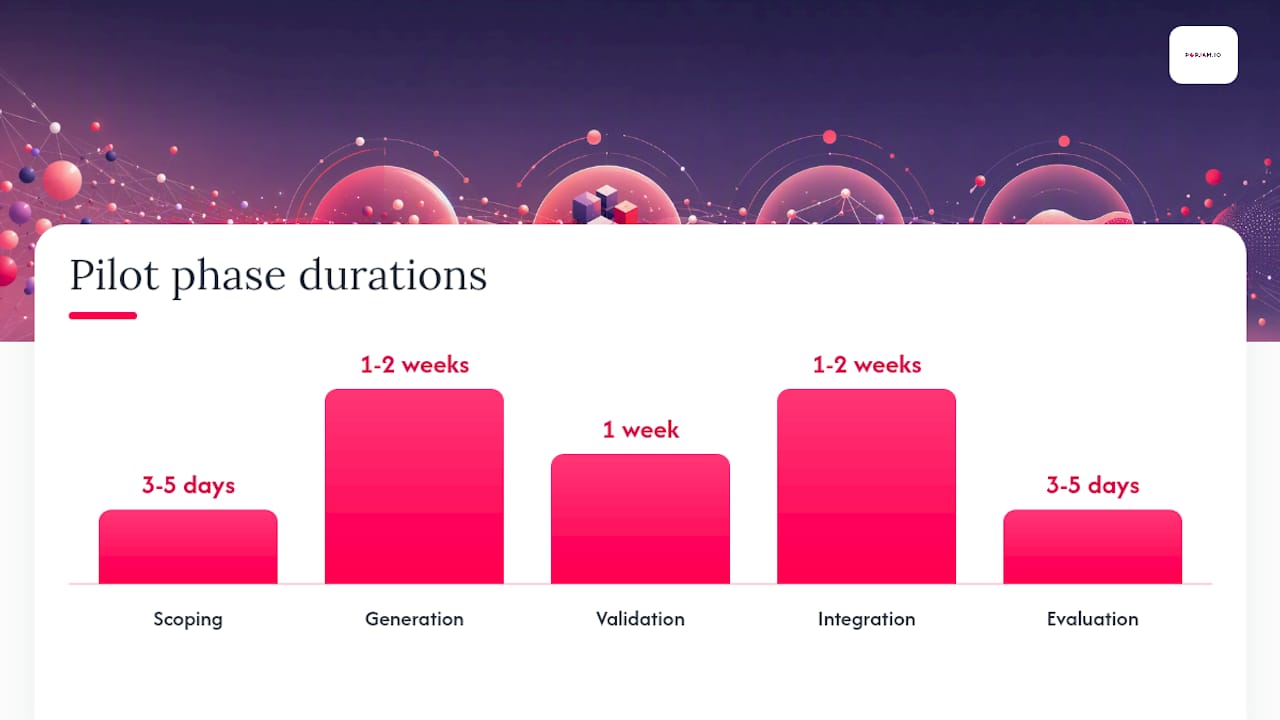
How Do You Run a Synthetic Data Pilot?
A pilot needs a fixed scope, a named owner from each function, and a hard stop date. Loop in data engineering for the pipeline, analytics for validation, legal for the privacy review, and whoever owns the creative or media decision the pilot is meant to inform.
- Define one narrow business question the pilot must answer
- Identify the minimal real dataset needed as a training seed and a holdout
- Choose a generation method that matches the use case, not the flashiest technology
- Set decision-alignment thresholds before generation begins
- Run the validation checklist and compare against the holdout
- Decide to scale, iterate, or kill based on the pre-set threshold, not gut feel
| Phase | Typical duration | Key output |
|---|---|---|
| Scoping | 3 to 5 days | Defined question, success threshold, named owners |
| Generation | 1 to 2 weeks | First synthetic dataset draft |
| Validation | 1 week | Decision-alignment score against holdout |
| Integration | 1 to 2 weeks | Pipeline connection to existing analytics tools |
| Evaluation | 3 to 5 days | Scale, iterate, or kill decision |
Treat success as a binary outcome tied to the threshold you set in scoping, not a vague sense that “the data looked good.”
What Should You Ask Synthetic Data Vendors?
Vendor pitch decks are full of confident claims. Your job is to ask for proof that survives scrutiny.
- How do you test for membership-inference resistance, and can you show results?
- What’s your novel-record rate, and how do you measure it?
- How often is the dataset refreshed, and what triggers a regeneration?
- Can you provide a reproducible validation report, not just a summary claim?
- How does your output integrate with our existing analytics and creative testing tools?
Score any vendor across a few concrete dimensions rather than trusting the pitch alone.
| Dimension | What to look for | Weak signal |
|---|---|---|
| Validation | Reproducible decision-alignment reports | Only “looks realistic” claims |
| Transparency | Clear documentation of generation method | Vague “proprietary AI” language |
| Integration | Works with existing analytics stack | Requires a full platform switch |
| Cost | Usage-based or tiered pricing that maps to pilot scope | Opaque enterprise-only pricing |
For a structured way to build these evaluation criteria into a broader testing program, the growth marketing experimentation framework from Kontrol Media is a useful reference for setting rigor before you start scoring vendors.
How Does POPJAM Fit Into a Synthetic Data Marketing Strategy?
POPJAM maps directly onto the highest-value use cases above. It generates on-brand ad creatives and tests them against synthetic buyer personas before anything reaches a live campaign, which is exactly the creative pre-testing and audience simulation loop marketers need to de-risk spend.
A scoped pilot looks like this:
- Upload brand guidelines and a draft creative set
- Generate synthetic persona reactions across the segments you care about
- Review psychographic feedback and creative fatigue signals before launch
- Compare the top-scoring variant’s real performance against the synthetic prediction
Metric callout: teams using data-backed creative testing report meaningful ROI gains when creative decisions are grounded in synthetic feedback rather than guesswork, a pattern consistent with the decision-alignment principle running through this entire guide.
What Are the Limitations of Synthetic Data in Marketing?
Synthetic data fails in predictable ways, and each failure has a straightforward fix.
- Overfitting to seed data: the synthetic set just echoes your training data instead of generalizing. Fix it by widening seed diversity and running novel-record checks.
- Trusting distributional similarity alone: a dataset can look statistically right and still be decision-wrong. Fix it with the decision-alignment tests from earlier.
- Mode collapse: repetitive, low-diversity outputs, common in GAN-based methods. Fix it with embedding-space diversity checks before you trust any output.
Set a refresh cadence and a review gate for every synthetic dataset in production. Consumer behavior shifts with seasonality, and a synthetic model trained on last year’s patterns quietly goes stale.
Should You Use Synthetic Data for Your Next Campaign?
Synthetic data earns a place in your marketing stack when it’s scoped narrowly, validated against a real holdout, and treated as a living tool rather than a one-time export. It doesn’t replace real consumer research. It de-risks the decisions you’d otherwise make on instinct or an underpowered sample.
Three next steps to prioritize:
- Run one narrow pilot this quarter with a pre-set decision-alignment threshold
- Build your validation gate before you evaluate any vendor’s output
- Shortlist two or three providers using the rubric above, not the flashiest demo
Start with a POPJAM pilot on a single creative decision you’re already planning to make.
A Marketing-First Take on Synthetic Data
The conventional pitch for synthetic data leans too hard on realism, as if a dataset that “looks like” real consumers is automatically useful. It isn’t. The research on decision-alignment makes a sharper point: a synthetic population can nail every marginal distribution and still lead you to the wrong creative or the wrong budget split, because the structure that drives real decisions is subtler than aggregate statistics.
What gets underrated is the pilotability of this technology. Marketers don’t need a data science team to test one creative concept against synthetic personas this month. They need a narrow question, a real holdout, and the discipline to set a threshold before looking at results. Most teams skip that last part and end up rationalizing whatever number comes out.
Where I’d push back on standard advice: don’t chase the most technically sophisticated generation method first. Chase the validation discipline first. A schema-driven dataset validated properly beats a fancy LLM-generated one nobody checked against reality.
Sources
- Trustworthy synthetic data for campaign decision support: strategy simulation fidelity and the PolicySynth framework
- Build an enterprise synthetic data strategy using Amazon Bedrock
- Filling the gaps: How synthetic data is reshaping the marketing landscape
- Preserving Privacy in Marketing: a Comparative Study of Synthetic Data for Personalized Campaign Generation
- Designing synthetic datasets for the real world: mechanism design and reasoning from first principles
- Why synthetic data could be advertising’s next big bet
FAQ
What does “synthetic data” mean?
Synthetic data is artificially generated information designed to mirror the statistical patterns of real data, such as consumer behavior or campaign responses, without containing any real individual’s records.
What are examples of synthetic data used in marketing?
Examples include synthetic buyer personas for audience simulation, synthetic ad-feedback logs for creative testing, synthetic transaction logs for pipeline testing, and synthetic queries for retrieval and search testing.
How do I generate synthetic data?
Common methods include generative adversarial networks and variational autoencoders for image and tabular data, large language models for text and persona generation, and schema-driven mechanism-design approaches for full production datasets, each with different tradeoffs in fidelity, control, and cost.
Is ChatGPT trained on synthetic data?
Large language models, including ChatGPT, have used synthetic data as part of broader training pipelines, particularly for tasks like generating synthetic queries and structured text, though the exact training composition of any specific model version isn’t publicly detailed in full.
How do I know if synthetic data is trustworthy for a marketing decision?
Check decision-alignment first: run a holdout test to see whether decisions made from the synthetic data match decisions made from real data, and confirm the results with mode-collapse and diversity checks before trusting the output for budget decisions.