

Dynamic Creative Optimization for Performance Marketers
TL;DR:
- Dynamic creative optimization involves AI-driven pre-launch creative generation, synthetic persona filtering, and adaptive experiments. It helps performance marketers and agencies identify top creatives faster and reduces wasted impressions. Field tests show significant upper-tail engagement lifts, validating the workflow’s effectiveness when properly implemented.
Dynamic creative optimization, as this article uses the term, means AI-powered pre-launch creative generation, simulation, and validation using synthetic buyer personas and adaptive experiments. It is a two-stage offline-to-online workflow: first, a generative model produces candidate creatives guided by a predictive ranker trained on your historical A/B data; second, a batched adaptive experiment selects winners in live traffic. If you run paid campaigns on Meta, Google, TikTok, or LinkedIn and you want to stop wasting budget on untested creatives, this is the workflow for you.
Table of Contents
- What does dynamic creative optimization actually mean here?
- Why an offline-to-online workflow changes your performance numbers
- What metrics and experiment parameters should you set?
- What data and infrastructure do you need?
- How do synthetic personas fit into the DCO loop?
- Best practices and common mistakes in DCO execution
- What do field experiments actually show?
- How to evaluate DCO vendors and what to ask
- Key Takeaways
- The honest case for doing this carefully
- POPJAM makes this workflow accessible from day one
- Useful sources
- FAQ
What does dynamic creative optimization actually mean here?
Most of the web defines DCO as real-time template assembly at ad-serving time. That is a different product for a different team. This article covers something more useful for performance marketers and growth teams: AI generation plus synthetic-persona pretests plus adaptive online experiments.
What this DCO covers:
- AI generation of on-brand creative variants from seed assets
- Synthetic persona simulation to pre-filter losers before spend
- Batched adaptive experiments that reallocate traffic toward winners
What it does not cover:
- Real-time template personalization at the ad server
- Dynamic product feeds or audience-segment pixel assembly
The two stages are complementary. Offline slate generation is fast and cheap. Online adaptive selection is slower but converts predictions into verified winners. Teams running more than a handful of campaigns monthly, or agencies managing multiple clients, benefit most from this approach versus a simple two-variant A/B test.
Why an offline-to-online workflow changes your performance numbers
The core value is straightforward: you surface upper-tail winners faster and waste fewer impressions on obvious losers. Field experiments using this workflow recorded engagement uplifts of 45.1%, 46.7%, and 36.2% across three separate deployments. Those are not average lifts across all creatives. They are the gains from finding the best creative in a slate rather than running a single untested ad.
A predictive ranker alone is not enough. Offline scores are noisy proxies for live performance. The ranker’s real job is to raise candidate-set recall, meaning it gets more genuinely strong creatives into your test slate. The adaptive experiment then does the actual selection under real traffic conditions. Skipping the online stage and deploying the top-ranked offline creative directly is one of the most common and costly mistakes teams make.
Top-performing brands test 3–5 new creative variations every week, turning creative testing into a continuous engine rather than a quarterly event. That cadence is only feasible when generation and pre-filtering are automated.
What metrics and experiment parameters should you set?
Metrics that matter
| Metric | What it measures | Priority |
|---|---|---|
| Candidate-set recall | Share of true top creatives captured in your slate | Offline |
| Selected-arm quality | Live performance of the experiment winner | Online |
| Regret | Impressions spent on sub-optimal arms during testing | Online |
| CTR / Thumb-stop rate | Engagement signal; noisy in short windows | Secondary |
| CPA / ROAS | Conversion efficiency; primary decision metric | Primary |
Optimize for CPA or ROAS as your stopping criterion. CTR is a useful early signal but brief quality and CLV alignment drive conversion impact more reliably than click-through alone.
Experiment sizing guidance
| Slate size (K) | Recommended initial batch | Minimum impressions per arm |
|---|---|---|
| 8 | 5,— total | — |
| 12 | 9,— total | — |
These are starting points. Noisy short-horizon engagement metrics can mislead early reallocation, so hold uniform allocation for at least one full batch before updating posteriors.
What data and infrastructure do you need?
Running this workflow at scale requires four concrete inputs before you start.
| Data type | What you need | Why it matters |
|---|---|---|
| Historical experiments | Randomized A/B test outcomes with creative IDs | Trains the predictive ranker |
| Event-level signals | Impression, click, conversion rows with timestamps | Feeds posterior updates in adaptive tests |
| Creative metadata | Copy, visual descriptors, format, placement | Enables deduplication and brand filtering |
| Cohort identifiers | Experiment ID, exposure window, attribution window | Ensures clean ranker training and result logging |
On the model side, you need a predictive ranking model (a gradient-boosted ranker or a fine-tuned embedding model both work), a frozen generative model with a prompt API, an experiment runner that supports batched reallocation, and logging infrastructure for observability.
Privacy note: train your ranker on aggregated, consented signals only. Never pass personal identifiers into creative metadata or experiment logs. Rely on cohort-level outcomes and anonymized event data. GDPR-compliant aggregation is not optional if any of your traffic touches EU users, and it is good practice regardless.
How do synthetic personas fit into the DCO loop?
Synthetic personas act as a fast pre-filter. Before you spend a dollar on live traffic, you run your candidate slate through calibrated AI personas that simulate how specific buyer segments would react to each creative. The goal is to eliminate obvious losers, not to replace live testing.
Documented case studies report significant uplifts in ROAS, CVR, and CTR when synthetic pre-tests are paired with live validation. The key word is “paired.” Synthetic panels predict relative ranking well. They are less reliable for absolute performance numbers.
When to run synthetic pre-tests:
- Concept screening across five or more messaging angles
- Cultural sensitivity checks before entering a new market
- Segment-specific hook validation (e.g., price-sensitive vs. feature-motivated buyers)
- Headline ranking when copy variants outnumber your live test budget
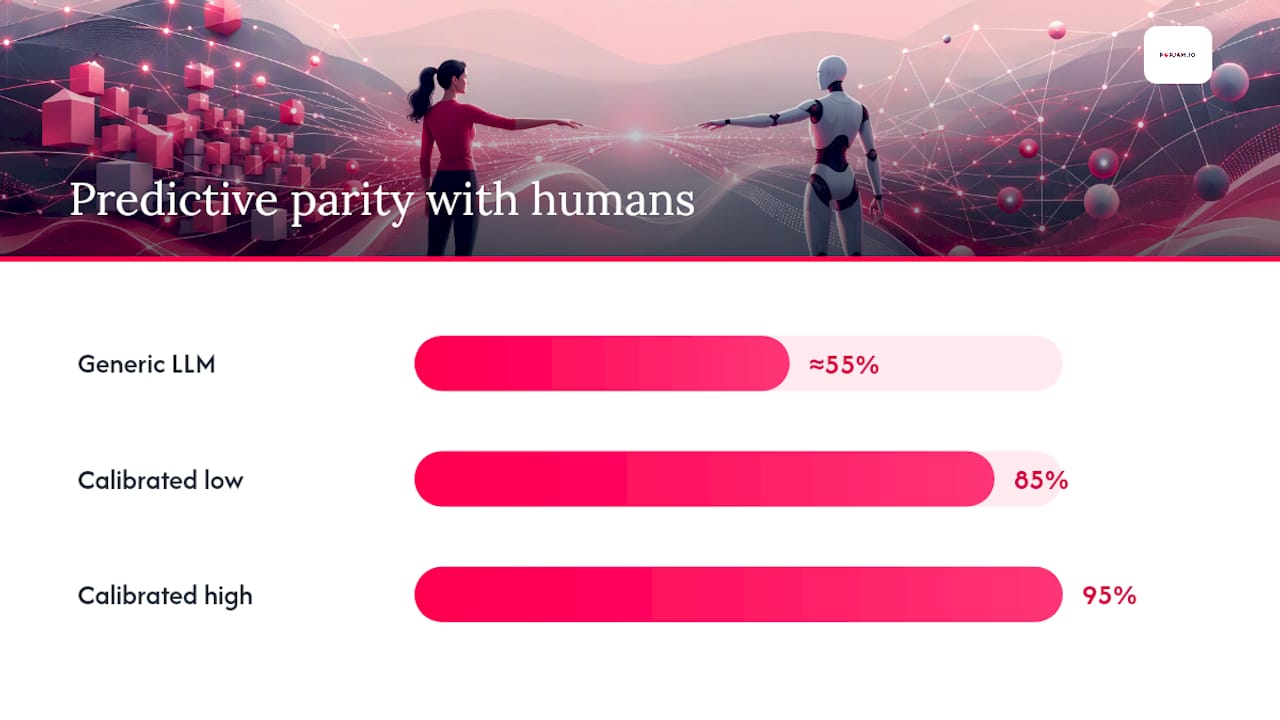
Calibration is everything. Generic LLM prompts produce roughly 55% predictive parity with real human panels. Calibrated synthetic personas grounded in real consumer psychographic data reach 85–95% parity. The difference is whether your personas reflect actual buyer behavior or a statistical average of internet text.
Keep a human validation round for high-stakes creatives, brand launches, or sensitive categories. Synthetic panels are a speed tool, not a replacement for judgment.
For a practical breakdown of how to build and use these personas, the POPJAM guide on what synthetic personas are is a solid starting point.
Best practices and common mistakes in DCO execution
Do these:
- Isolate one variable per generation batch so your ranker learns clean signals
- Lock brand tokens (logo placement, color palette, font) before generation runs
- Predefine stopping rules before launching any adaptive experiment
- Version every creative with a unique ID tied to its generation prompt and ranker score
- Run a human brand-safety review before any creative enters the live slate
Avoid these:
- Optimizing for clicks alone; CTR winners frequently underperform on CPA
- Deploying the top offline-ranked creative without live validation
- Running slates larger than your traffic can resolve in a reasonable window
- Skipping deduplication; near-duplicate arms dilute signal and inflate regret
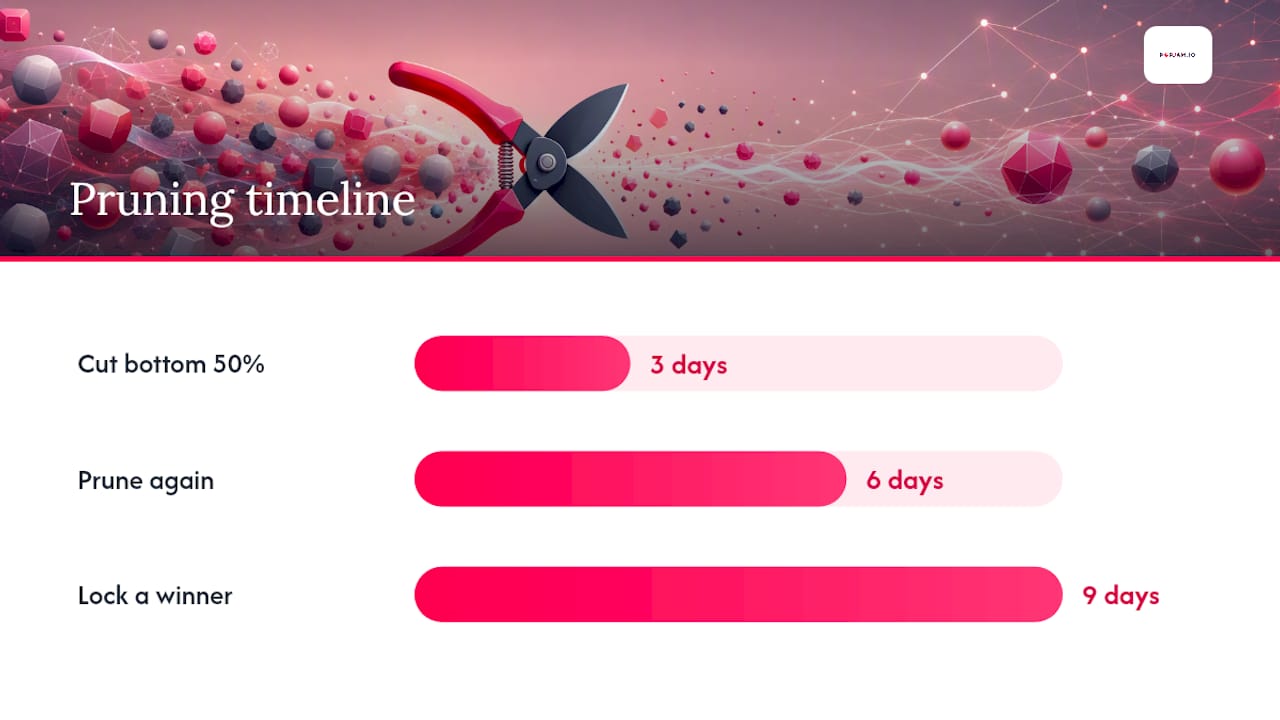
Pro Tip: Pair creative testing with landing page variants. A winning ad creative driving traffic to a mismatched landing page loses most of its lift. The 3-3-3 pruning rule (cut the bottom 50% after three days, prune again at day six, lock a winner by day nine) works well when you apply it to the full funnel, not just the ad unit.
Governance matters as much as methodology. Build a review queue into your workflow so no AI-generated creative goes live without a human sign-off. This is especially true for regulated categories and brand-sensitive campaigns.
What do field experiments actually show?
The most credible evidence comes from the offline-to-online workflow research, which documented three separate field deployments.
| Experiment | Reported lift | Workflow element validated |
|---|---|---|
| Deployment 1 | +45.1% engagement | Ranker-guided generation + adaptive selection |
| Deployment 2 | +46.7% engagement | Inference-time critic loop |
| Deployment 3 | +36.2% engagement | Batched adaptive reallocation |
These are upper-tail lifts, meaning the gain from finding the best creative in the slate versus a baseline. Interpret them as the ceiling of what the workflow can deliver when data quality is high and the ranker is well-calibrated. Your actual lift depends on historical data volume, ranker accuracy, and slate quality.
Reproducibility requires three things: randomized historical experiments (not observational data), event-level logging with clean attribution, and a slate formation process that does not leak test outcomes into training. Teams that skip any of these three steps will see weaker ranker performance and noisier experiment results.
How to evaluate DCO vendors and what to ask
When you assess any platform for this workflow, ask these questions directly.
- Can I import historical A/B experiment outcomes to train the ranker?
- How often does the ranker retrain, and can I trigger retraining manually?
- Does the generator support lock-and-edit controls for brand tokens?
- What adaptive experiment designs does the platform support (Thompson sampling, UCB, Bayesian)?
- Are experiment logs exportable for external analysis?
- How does the platform handle privacy compliance for training data?
- What is the minimum historical experiment volume needed for a reliable ranker?
What POPJAM delivers against these criteria:
POPJAM’s creative automation platform covers AI generation, synthetic persona simulation, and pre-launch testing in a single integrated workflow. It supports images, video, animation, social posts, and email across Meta, Google, TikTok, LinkedIn, and Reddit. Experiment data feeds directly into brief construction, which addresses the brief-quality gap that standalone generators leave open. POPJAM is GDPR-compliant by design, using aggregated and consented signals for persona calibration.
For agencies specifically, the agency-focused workflow includes team features and multi-client onboarding.
Pilot checklist:
- Minimum data: 50+ historical experiment outcomes with creative-level results
- Timeline: two to three weeks from data import to first live adaptive experiment
- Success criteria: candidate-set recall above 70%, at least one arm showing statistically meaningful lift by week three
Operationalizing AI across your team is also covered well in this practical AI marketing guide from Errant Agency.
Key Takeaways
The most reliable path to better ad performance is a two-stage offline-to-online DCO workflow: AI generation guided by a predictive ranker, followed by batched adaptive experiments that verify winners in live traffic.
| Point | Details |
|---|---|
| Offline ranker raises recall | Use the predictive ranker to fill your slate with strong candidates, not as a deployment rule. |
| Adaptive experiments verify winners | Batched reallocation toward promising arms reduces regret versus uniform A/B testing. |
| Synthetic personas pre-filter losers; calibrated personas reach high predictive parity with real human panels, and should always be followed with live validation. | |
| Field lifts are upper-tail gains | Documented lifts of 36.2%, 45.1%, and 46.7% reflect best-creative gains, not average campaign improvement. |
| POPJAM integrates the full workflow | POPJAM’s platform covers generation, persona simulation, and pre-launch testing in one place. |
The honest case for doing this carefully
The numbers from field experiments are genuinely exciting. Upper-tail lifts in the 36–47% range are not marketing copy. They come from peer-reviewed workflow research. But there is a version of this workflow that teams rush into and get almost nothing from, and it usually comes down to one mistake: treating the offline ranker as a deployment oracle.
The ranker is a compass, not a GPS. It narrows the field. It does not tell you which creative wins in your specific market, with your specific audience, at this specific moment in your campaign calendar. That answer only comes from live data. Teams that skip the adaptive experiment stage because the ranker “already told them the answer” are essentially posting and praying with extra steps.
The other thing I’d push back on is the instinct to build the largest possible slate. More candidates feel like more optionality. In practice, a slate of twelve on a 3,000-impression weekly budget means each arm gets 250 impressions, which is nowhere near enough signal to make a reliable decision. A tight slate of four, run cleanly, will outperform a sprawling slate of twelve every time when traffic is constrained.
The workflow works. Use it with discipline.
POPJAM makes this workflow accessible from day one
Most teams know they should be testing more creatives. The bottleneck is never ambition. It is the gap between having a great idea and having a tested, on-brand creative ready to launch with confidence.
POPJAM closes that gap. You bring your seed assets and historical experiment data. POPJAM generates on-brand variants, runs them through calibrated synthetic personas for a fast pre-filter, and gives you a ranked slate ready for live testing. The whole offline stage, which used to take a creative team days, runs in hours.
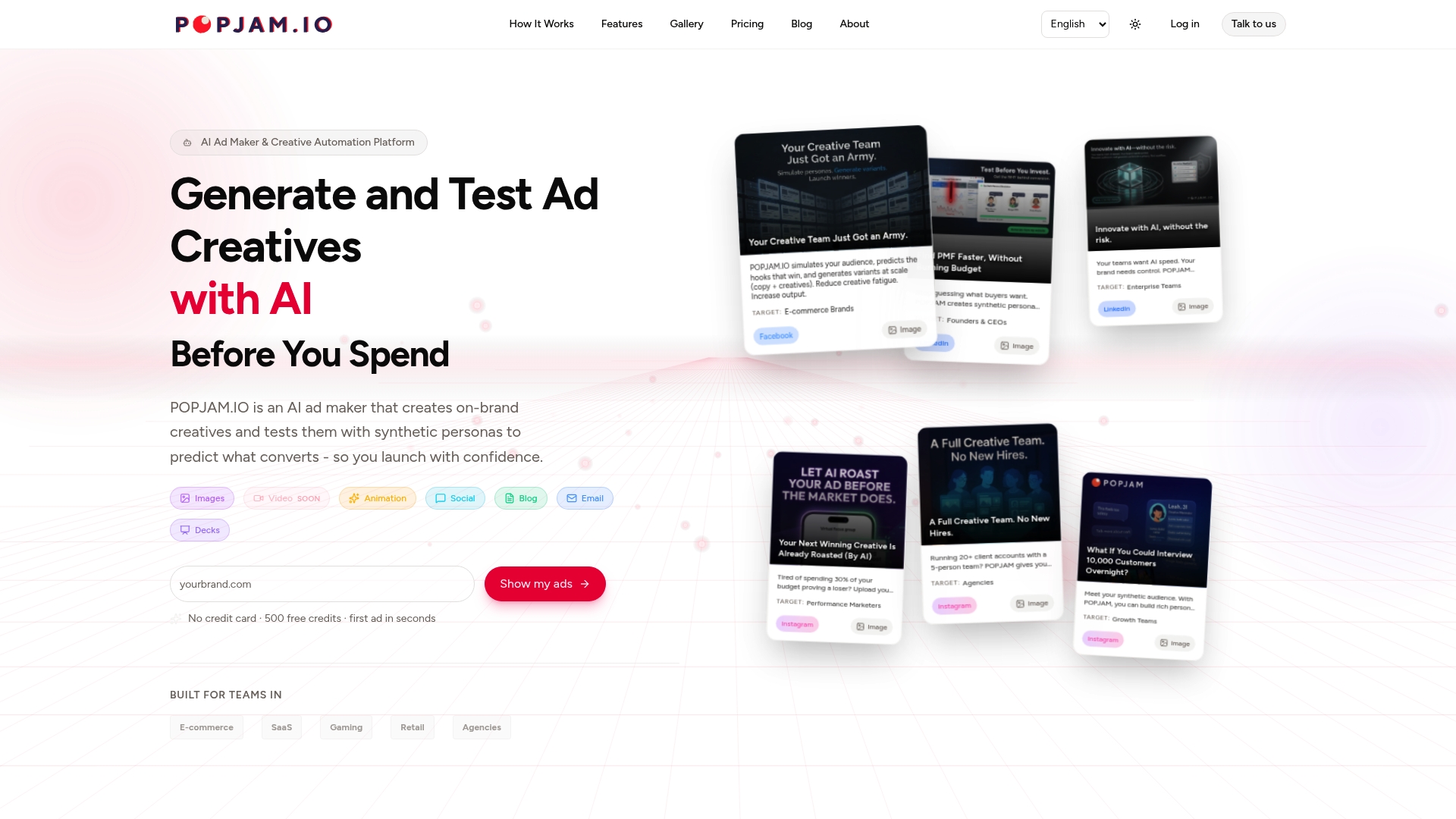
The platform supports every major ad format and placement across Meta, Google, TikTok, LinkedIn, and Reddit. It is built for performance marketers who need volume and for agencies managing multiple clients who need governance. GDPR-compliant by design, so your training data stays clean.
Ready to run your first pilot? Start with POPJAM’s AI ad maker and bring your historical experiment data. You can have a ranked slate and a live adaptive experiment running within two to three weeks.
Useful sources
| Source | Why it’s useful |
|---|---|
| ArXiv: AI-guided generation with predictive ranker and adaptive experiments | Primary research on the offline-to-online workflow; documents the three field experiment lifts. |
| Neuroflash: Synthetic Audience Case Studies | Documents ROAS, CVR, and CTR uplifts from synthetic pre-testing paired with live validation. |
| InsightIQ: AI Ad Creative Testing for E-Commerce | Practical cadence guidance including the 3-3-3 pruning rule and weekly variation targets. |
| Omniconvert: AI Ad Creative Generator | Three-layer framework (production speed, angle relevance, CLV alignment) for evaluating platforms. |
| POPJAM: Creative Automation Platform | Product documentation for POPJAM’s integrated generation, persona simulation, and testing workflow. |
| POPJAM: Generative AI for Marketing Playbook | Practical implementation guide for connecting generative models to experiment data and briefs. |
FAQ
What is dynamic creative optimization in this context?
Here, dynamic creative optimization means AI-powered pre-launch creative generation, synthetic persona simulation, and adaptive online experiments, not real-time ad-server template assembly.
How much historical data do you need to train a predictive ranker?
A minimum of 50 randomized experiment outcomes with creative-level results is a practical starting point; more data produces a more reliable ranker.
Can synthetic personas replace live A/B testing?
No. Calibrated synthetic personas are a pre-filter that raises slate quality, but adaptive online experiments are required to verify winners under real traffic conditions.
What lifts can you realistically expect from this workflow?
Field experiments documented upper-tail engagement lifts of 45.1%, 46.7%, and 36.2%; these reflect best-creative gains, not guaranteed average campaign improvement.
How does POPJAM support this workflow?
POPJAM covers AI generation, synthetic persona simulation, and pre-launch testing in one platform, with GDPR-compliant data handling and support for Meta, Google, TikTok, LinkedIn, and Reddit.
Recommended
- Creative Automation: The Complete Guide for Performance Marketers (2026) | POPJAM.IO Blog
- Creative Automation Platform | AI Ad Generation & Testing | POPJAM.IO
- Top performance marketing best practices for results | POPJAM.IO Blog
- Data-driven ad creatives: boost ROI with smarter testing | POPJAM.IO Blog