

Synthetic User Testing for Performance Teams: A Guide
TL;DR:
- Synthetic user testing uses AI personas to evaluate ad creatives before launch, reducing spend waste. It relies on high-quality data, accurate psychographic personas, and diverse testing methods to produce reliable predictions. POPJAM offers a full platform to embed these tests into marketing workflows, enabling quick, validated decision-making.
Before you commit a dollar to paid media, you can know which ad creative will win. Synthetic user testing, as implemented by platforms like POPJAM, uses AI-conditioned buyer personas to simulate audience reactions to your creatives before launch, giving you directional signal without burning live budget. The recommended first action: run a persona panel on your headline and thumbnail variants before committing any top-of-funnel spend.
Here’s what that unlocks in practice:
- Pre-test ad creatives across Meta, Google, TikTok, LinkedIn, and Reddit before a single impression is served
- Get psychographic feedback on images, video, copy, and social posts in one simulation run
- Stay GDPR and CCPA compliant because no real respondents are involved
- Use SimAB-style confidence scoring to know when to trust a synthetic winner
Table of Contents
- What does “synthetic user testing” mean for ad creatives?
- The three pillars that make synthetic tests actually predictive
- How to run a synthetic user test on ad creatives, step by step
- Which metrics should you capture from synthetic tests?
- Common pitfalls in synthetic testing and how to avoid them
- How POPJAM supports the full synthetic testing workflow
- Operational checklist and 30/60/90-day rollout plan
- Key Takeaways
- What synthetic testing actually gets you, and what it doesn’t
- POPJAM makes pre-launch creative testing practical
- FAQ
What does “synthetic user testing” mean for ad creatives?
Synthetic user testing, in this context, means simulating how AI-conditioned buyer personas respond to your ad creatives before those creatives go live. It is not UX research, not product usability testing, and not design validation. The personas are not real people; they are probabilistic models of your target segments, conditioned on consumer data, psychographic profiles, and purchase concerns.
Scope boundaries:
- Included: headline testing, thumbnail selection, video hook evaluation, offer framing, CTA copy, and multi-format creative panels
- Excluded: website usability, product feature testing, customer satisfaction surveys, and any post-launch research
- Where it fits: between creative production and media launch, as a pre-flight validation layer that replaces or supplements expensive fielded panels
Think of it as turning on the lights before you walk into a room. You’re not replacing the room; you’re just not walking in blind.
The three pillars that make synthetic tests actually predictive
Most synthetic tests fail not because the method is wrong, but because one of three foundations is weak. According to Forbes, enterprise brands that get synthetic personas right reduce creative risk and accelerate testing cycles. Here’s what “right” means.
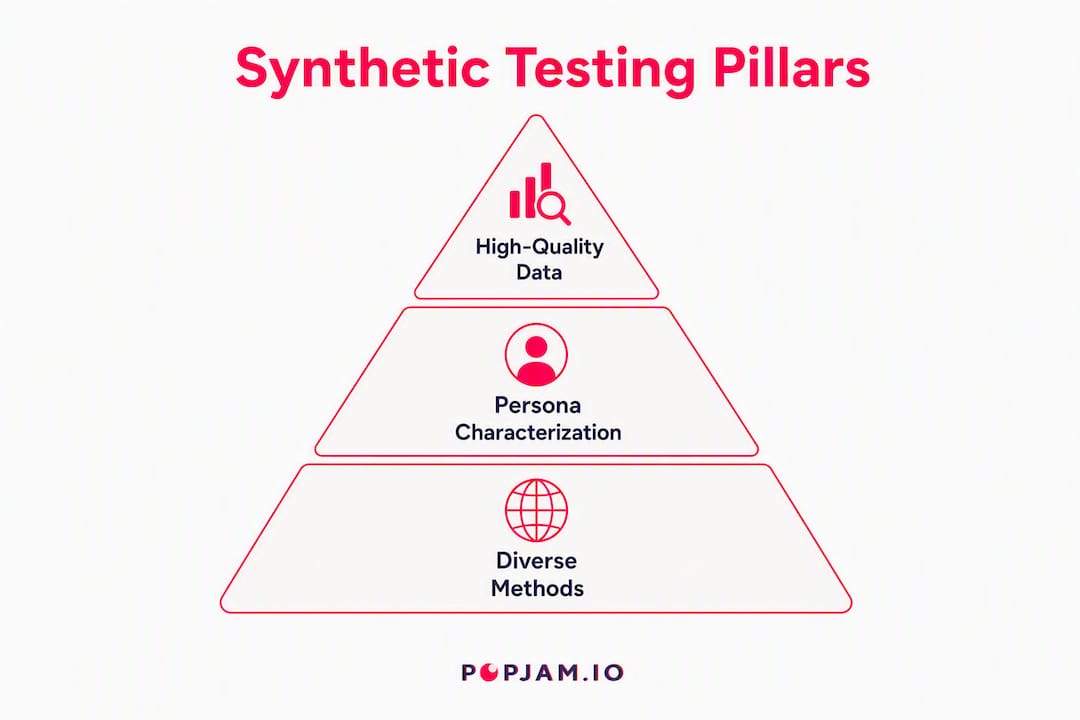
Pillar 1: High-quality consumer data
The data layer is the most important decision you’ll make. Survey responses, first-party signals, and retrievable evidence-backed corpora produce far more credible personas than models trained on unlabeled web text. GWI’s analysis identifies representativeness and data provenance as the primary determinant of persona quality. If your data is weak, your personas are fiction.

Pillar 2: Accurate persona characterization
A persona isn’t just an age and a job title. Effective synthetic personas are conditioned on psychographic dimensions: purchase concerns, channel mindset, brand familiarity, and objection patterns. Cold framing matters here too. Treat every persona as if they’ve never heard of your brand, because most cold-traffic users haven’t.
Pillar 3: Diverse testing methods
Text-only panels miss visual response. Image panels miss narrative. The most predictive tests combine text, image, and video simulations in a single panel. Format diversity catches the creative failures that single-format tests hide. Speed and cost advantages mean you can iterate overnight on hundreds of variants that would be prohibitively expensive to test live.
Pro Tip: Track the provenance of every data source feeding your personas. A provenance card, noting where each signal came from and when it was collected, is your audit trail for governance and client reporting.
Synthetic tests built on weak or unattributed data don’t just produce bad predictions. They produce confidently wrong predictions, which is worse than no test at all.
How to run a synthetic user test on ad creatives, step by step
This is the workflow you can embed into a sprint cycle starting this week.
- Define objectives and success criteria. Are you rank-ordering three headline variants? Validating a new offer frame? Decide the dimension you’re moving before you build a single persona.
- Design your persona panel. Include age range, primary purchase concern, channel mindset (scroll-native vs. search-intent), and brand familiarity. POPJAM’s persona builder guide walks through the exact dimensions. Default to cold framing for all top-of-funnel tests.
- Prepare your stimuli package. Each creative variant needs a control frame. Keep copy and visual variables isolated so you know what moved the needle.
- Set panel size. Smacient’s research recommends 35 personas for product page analysis and 20 for ad testing. Twenty personas is enough to reveal distribution shape and catch bimodal splits you’d miss with a smaller sample.
- Run the simulation. A persona-conditioned copy test that once took two weeks can now run in roughly 30 seconds, as demonstrated by Adobe’s Project Face Off prototype.
- Analyze distributions, not averages. Look at the probability mass function (PMF) across your panel, not just the mean score. Polarization in the distribution is a signal, not noise.
- Validate live. Run a small holdout test with minimal spend before scaling the synthetic winner. Synthetic testing is a decision-support layer, not a replacement for live data.
| Step | Key action | Output |
|---|---|---|
| Objectives | Define the dimension to move | Success criteria doc |
| Personas | Condition on psychographics + cold frame | Persona panel (20–35) |
| Stimuli | Isolate variables, set control | Creative variants package |
| Simulation | Run multi-format panel | PMF distributions |
| Analysis | Check for polarization, segment splits | Go/no-go recommendation |
| Live validation | Holdout test, minimal spend | Calibration data |
Pro Tip: For e-commerce teams, test retail creatives against purchase-concern personas first. Objection-based personas (price sensitivity, shipping anxiety) surface copy failures that enthusiasm-based personas miss entirely.
Which metrics should you capture from synthetic tests?
The output of a well-run simulation is richer than a single score. Here’s what to collect and how to read it.
- Predicted CTR lift: directional signal on which variant is more likely to earn the click, relative to your control
- Simulated purchase intent distribution: the spread of intent scores across your persona panel, not just the average
- Attention proxies: which visual or copy element the persona “focuses on” first, based on response weighting
- Engagement likelihood: probability that a persona would stop scrolling, comment, or share
- Confidence score: how certain the model is about its prediction for a given persona segment
Distribution-aware interpretation is the skill most teams skip. A creative that scores 7/10 on average across 20 personas looks fine until you see that 10 personas scored it 9/10 and 10 scored it 5/10. That bimodal split means the creative polarizes your audience, and you need to know which half is your actual buyer.
The SimAB study found 67% overall directional accuracy and 83% accuracy on high-confidence predictions when synthetic personas screened historical experiments. When your simulation returns a high-confidence result, trust it. When confidence is low, run a live validation test before scaling.
Interpretation quick-map:
- High confidence + clear winner: ship the variant, monitor live CTR
- Low confidence + flat distribution: the creative concept needs rework, not just copy tweaks
- Bimodal distribution: segment your audience before launch; one creative won’t serve both halves
Common pitfalls in synthetic testing and how to avoid them
Synthetic testing can mislead you just as easily as it can guide you, if you let these failure modes go unchecked.
- Hallucinated rationales: personas may generate plausible-sounding explanations that don’t reflect real consumer logic. Retrieval grounding and provenance metadata reduce this risk and make responses auditable.
- Weak data provenance: personas built on unattributed or outdated data drift from your actual audience. Use provenance cards and refresh signals regularly.
- Demographic bias: if your training data over-represents one segment, your panel will too. Audit segment coverage before running a panel.
- Overfitting to synthetic voice: teams that iterate exclusively on synthetic feedback start optimizing for the model, not the market. Live validation tests are the circuit breaker.
The goal is calibration, not replacement. A synthetic panel that has never been checked against live results is an uncalibrated instrument. Run at least one live A/B per quarter to keep your model honest.
Pre-launch mitigation checklist: For a practical example of how to efficiently review and optimize your campaign materials, see Growth Reach Marketing’s case example.
- Provenance card completed for all data sources
- Panel includes at least three distinct purchase-concern segments
- Cold framing applied to all top-of-funnel personas
- Confidence scores reviewed before acting on results
- Live holdout test scheduled before full budget commitment
Pro Tip: GDPR and CCPA compliance is built into the synthetic model by design: no real respondents, no PII, no consent workflows. Document this for client governance decks, especially in regulated categories.
How POPJAM supports the full synthetic testing workflow
POPJAM is built around the three-pillar framework above. Here’s how the platform maps to each stage.
- Persona builder: condition personas on psychographic dimensions, purchase concerns, and channel mindset; cold framing is the default
- Multi-format simulation: test images, video, animation, social posts, email, and presentations in a single panel run
- Provenance tagging: every data signal feeding a persona is tracked and exportable for governance
- PMF exports: download probability distributions for downstream analytics or client reporting
- Platform coverage: Meta, Google, TikTok, LinkedIn, and Reddit in one workflow
A growth team running a SaaS product launch, for example, can generate five headline variants, run them against a 20-persona cold-traffic panel, get PMF distributions in minutes, and ship only the high-confidence winner to a small live holdout. That’s a cycle that used to take two weeks compressed into a single afternoon.
| POPJAM feature | Pillar supported | Team benefit |
|---|---|---|
| Persona builder | Data + characterization | Psychographic conditioning, cold framing |
| Multi-format simulation | Test diversity | Images, video, copy in one panel |
| Provenance tagging | Data quality | Audit trail for governance |
| PMF export | Metrics | Distribution-aware analysis |
| Platform integrations | Workflow | Meta, Google, TikTok, LinkedIn, Reddit |
Pro Tip: For agencies, POPJAM’s agency workflow lets you run persona panels for multiple clients in parallel, with separate provenance cards and exportable reports per account.
To start, connect your first-party signals, build a pilot persona panel of 20, and run one creative test against a live campaign you’re already planning. That pilot gives you your first calibration data point.
Operational checklist and 30/60/90-day rollout plan
When to use synthetic testing:
- Before committing top-of-funnel spend on any new creative concept
- When testing more than two headline or thumbnail variants simultaneously
- When entering a new audience segment with no historical creative data
- Before seasonal campaign launches where live testing time is short
30/60/90-day rollout:
| Phase | Milestone | Team action |
|---|---|---|
| Day 1–30 (Pilot) | Run first panel on one live campaign | Build 20-persona panel, test 3 headline variants, record PMFs |
| Day 30–60 (Calibration) | Compare synthetic results to live holdout | Measure directional accuracy, adjust persona conditioning |
| Day 60–90 (Scale) | Embed into sprint ceremonies | Test all new creatives pre-launch, establish governance cadence |
Minimal technical requirements: access to first-party audience data (even basic demographic and behavioral signals), a creative production workflow that can produce variants, and a live holdout testing capability for calibration. No engineering team required to get started.
Key Takeaways
Synthetic user testing is most reliable when it combines high-quality consumer data, psychographically conditioned personas, and multi-format simulation, validated against at least one live holdout test per quarter.
| Point | Details |
|---|---|
| Three pillars are non-negotiable | Data quality, persona characterization, and format diversity all three must be solid for predictions to hold. |
| Panel size of 20–35 | Use 20 personas for ad tests; this is enough to reveal bimodal distributions and catch polarization. |
| Trust high-confidence results | SimAB data shows 83% accuracy on high-confidence predictions; act on those, validate the rest live. |
| PMFs beat averages | Always examine the distribution of persona responses, not just the mean score, to catch audience polarization. |
| POPJAM covers the full pipeline | POPJAM supports persona building, multi-format simulation, provenance tagging, and PMF exports in one platform. |
What synthetic testing actually gets you, and what it doesn’t
Here’s my honest take: synthetic user testing is one of the most underused pre-launch tools in performance marketing, and it’s underused for the wrong reason. Most teams assume it’s a replacement for live data. It isn’t, and it was never designed to be.
What it actually gives you is a faster, cheaper way to kill bad ideas before they cost you real money. The teams I see get the most out of it are the ones who treat it as a triage layer, not an oracle. They run a panel, identify the two or three concepts worth taking live, and then run a small holdout to calibrate. That combination, synthetic first, live second, is where the real efficiency gain lives.
The limitation worth naming: synthetic personas are only as good as the data behind them. A panel built on thin or unrepresentative data will confidently point you in the wrong direction. Provenance tracking isn’t a nice-to-have; it’s the thing that keeps your simulation honest. If you can’t answer “where did this persona’s beliefs come from?”, you’re not ready to act on its output.
POPJAM makes pre-launch creative testing practical
Wasted creative spend is a solved problem when you test before you spend. POPJAM gives performance teams and agencies a complete pre-launch testing workflow: AI-generated ad creatives, psychographic persona panels, multi-format simulation across Meta, Google, TikTok, LinkedIn, and Reddit, and exportable PMF reports, all in one platform. The simulation is GDPR-compliant by design, with no real respondents and full provenance tracking built in.
You get persona panel credits, creative generation credits, and basic analytics from day one. No long onboarding, no agency retainer, no waiting two weeks for panel results. Try POPJAM’s ad testing tool free, or go straight to the AI ad generator to run your first panel today.
FAQ
What is synthetic user testing for ad creatives?
Synthetic user testing for ad creatives uses AI-conditioned buyer personas to simulate audience reactions to your ads before launch, giving you directional signal on which variants will perform without spending live media budget.
How many personas do you need for a reliable ad test?
A panel of 20 personas is sufficient for ad testing and will reveal distribution shape, including bimodal splits that indicate audience polarization.
How accurate are synthetic persona predictions?
The SimAB study found 67% overall accuracy and 83% accuracy on high-confidence predictions when synthetic personas screened historical experiments.
Does synthetic testing replace live A/B testing?
No. Synthetic testing is a pre-launch triage layer. A small live holdout test should follow every synthetic panel to calibrate results and confirm the winner before scaling spend.
Can POPJAM run synthetic tests across multiple ad platforms?
Yes. POPJAM supports multi-format simulation and creative testing across Meta, Google, TikTok, LinkedIn, and Reddit in a single workflow.
Recommended
- Why Synthetic Personas Beat Real Focus Groups for Ad Testing | POPJAM.IO Blog
- What Are Synthetic Personas? AI Personas for Marketing | POPJAM | POPJAM.IO Blog
- Pre-Launch Creative Testing: 2026 Playbook for Small Teams | POPJAM | POPJAM.IO Blog
- How to Write a Buyer Persona Worth Testing Against | POPJAM | POPJAM.IO Blog