

AI Advertising Campaigns: Your 2026 Practical Guide
What makes an AI advertising campaign actually work?
An AI advertising campaign is a marketing initiative where machine learning, natural language processing, and predictive analytics handle the heavy lifting: targeting, bidding, creative generation, and real-time optimization. The result? You spend less time on manual adjustments and more time on strategy that actually moves the needle.
What separates AI-driven campaigns from traditional ones isn’t just speed. It’s the ability to process millions of signals simultaneously and act on them before a human team could even open a dashboard. Platforms like Google Gemini, StackAdapt, and Salesforce have made this kind of intelligence accessible to marketing teams of all sizes, not just enterprise giants with eight-figure budgets.
Here’s what the best AI advertising campaigns have in common:
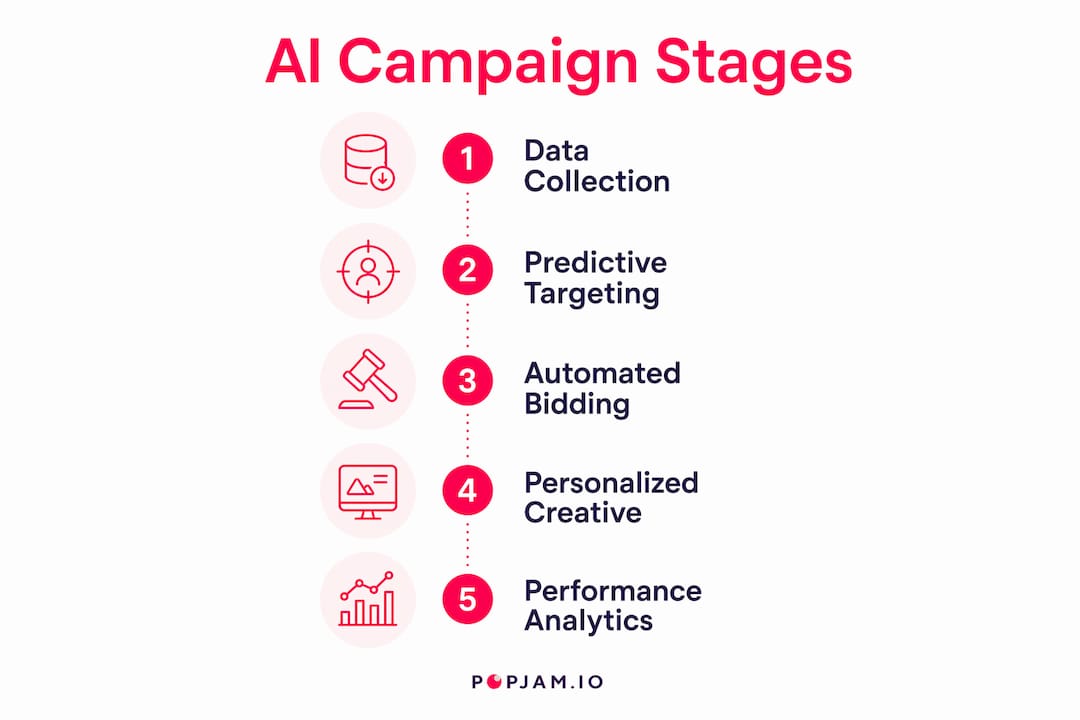
- Predictive targeting: Machine learning models identify high-value audience segments before a campaign launches, not after.
- Automated bid management: AI adjusts bids in real time based on conversion likelihood, inventory, and timing signals.
- Dynamic creative optimization (DCO): Headlines, images, and calls to action adapt automatically to match the audience and context.
- Real-time analytics: Performance data feeds back into the system continuously, enabling mid-flight adjustments that manual campaigns simply can’t match.
- Human oversight: The most effective setups keep strategists in control of brand voice, creative direction, and approval gates.
The AI advertising ecosystem has matured fast. Campaigns using DCO deliver a notably higher CTR rates, and advertisers who pair AI with first-party data see up to a substantially higher ROAS compared to third-party targeting. Those aren’t marginal gains. They’re the difference between a campaign that breaks even and one that funds your next quarter.

How do the core capabilities of AI campaigns actually function?
Understanding what’s happening under the hood helps you make smarter decisions about where to apply AI and where to keep humans in the loop.
Predictive marketing and audience targeting
Predictive models evaluate historical performance data, behavioral signals, and real-time inventory to forecast which audiences are most likely to convert. Instead of reacting to what happened yesterday, your campaign is already positioned for what’s about to happen. Google Analytics 4’s predictive audiences, for example, can identify users likely to purchase within seven days and feed that segment directly into your ad campaigns.
Automation of bidding and budget allocation
AI handles bid adjustments, pacing, and budget reallocation continuously, without anyone needing to log in at 2 AM. The system shifts spend toward placements, formats, and audience segments that show the strongest conversion signals. This is where scalable AI campaign management requires more than simple bidding automation. It demands unified data infrastructure where AI decisioning and deterministic automation work together end to end.
Personalization powered by machine learning and NLP
Natural language processing enables AI to generate and adapt ad copy that speaks to specific audience segments, in their language, at the right moment. Machine learning layers on behavioral and psychographic data to serve the right message to the right person. The output isn’t one ad for everyone. It’s hundreds of variations, each tuned to a different context.

Creative generation and dynamic creative optimization
Generative AI tools can produce ad copy, images, and video concepts at a scale no human team can match manually. StackAdapt’s Creative Builder, enhanced by Ivy™, lets teams generate and resize creatives from text prompts, swap backgrounds, and adapt assets across formats in a fraction of the traditional production time. The key caveat: AI output is raw material, not finished work. Human review remains non-negotiable for brand safety and quality.
Analytics, forecasting, and privacy
Real-time performance monitoring surfaces patterns that would take weeks to find manually. Predictive forecasting shifts campaign management from reactive to anticipatory. On the privacy side, the ethical use of AI in advertising requires clear data governance, consent frameworks, and compliance with regulations like GDPR and CCPA. First-party data strategies are now the foundation of any AI campaign worth running.
What do real AI advertising campaigns actually achieve?
Case studies cut through the theory. Here’s what structured AI campaigns have delivered for real brands.
The Salvation Army and Google Gemini
BarkleyOKRP ran a localized retail campaign for The Salvation Army using Google Gemini and Nano Banana. The results were striking: $11 cost per store visit, outperforming benchmarks by 138%, and a 2.6X higher CTR than the Google Display Network. Critically, 58% of clicks led to in-store searches, turning a digital campaign into measurable foot traffic. The campaign succeeded because it combined AI’s targeting precision with a clear human-led creative brief and a specific business objective: drive people into stores when online inventory was unavailable.
Structured workflows driving consistent results
Across higher-performing campaigns, a consistent pattern emerges. Teams that treat AI as part of a governed workflow, rather than a standalone generation tool, see more sustainable improvements. The elements that show up repeatedly:
- Structured creative briefs that give AI better source material to work with
- Explicit brand voice documentation instead of hoping the model gets it right
- Defined review standards so feedback is specific and efficient
- Human approval gates before any asset reaches a client or goes live
The brands winning with AI advertising in 2026 aren’t necessarily using the newest models. They’re the ones who built better systems around the tools they already have.
Meta Advantage+ and the scale of AI adoption
a majority of advertisers are already running campaigns through Meta’s Advantage+ suite. Advertisers who’ve run multiple campaigns through Advantage+ have seen a significant decrease in Cost Per Acquisition. That’s a meaningful signal about where the industry is heading, and how quickly.
Best practices for planning, executing, and optimizing AI campaigns
AI accelerates execution. It doesn’t replace the thinking that makes a campaign worth running. Here’s how to get the balance right.
Lead with human strategy, not automation
AI cannot define your positioning or tell you why a customer should choose you over anyone else. Those decisions require human judgment. Set your strategy first: audience, message, objective, and success metrics. Then let AI handle the execution layer.
Build structured workflows before you scale
Treating creative as a data problem means building structured briefs, brand voice guardrails, modular assets, and human review gates before you generate anything at scale. Teams that skip this step create more volume without improving consistency or performance. The revision cycles pile up, and trust in the AI output erodes fast.
Pro Tip: Before briefing any AI tool, document your brand voice in writing: tone, vocabulary, what you never say, and three examples of on-brand copy. Feed that document into every creative prompt. It’s the single fastest way to improve AI output quality.
Use creative intelligence to avoid fatigue
AI-driven creative pattern detection across large creative libraries helps marketers identify which elements are driving performance before briefing new work. Instead of rebuilding from scratch when a creative fatigues, you reverse-engineer what worked and iterate from that insight. Monitor leading indicators like hook rate, hold rate, and engagement score. Don’t wait for CPA to spike before you act.
Optimization tactics that actually move performance
- Audience segmentation: Use predictive audiences and first-party data to build segments based on likely behavior, not just demographics.
- Bid management: Give platform algorithms enough runway to exit the learning phase. Over-segmenting or constantly overriding automated bidding undermines the system.
- Budget allocation: Let AI shift spend toward what’s working. Spreading budget too thin across too many creative variants means none accumulate enough data to learn.
- Data hygiene: Clean, structured conversion events are the fuel. The more accurately you measure what matters, the better the algorithm optimizes toward it.
Integrate with existing channels thoughtfully
AI campaigns don’t operate in a silo. Connect your AI ad platform to your CRM, email platform, and analytics stack so audience signals flow in both directions. Organizations including Salesforce and the IAB recommend setting clear guardrails on what AI can generate, auditing outputs regularly, and training teams to flag issues before they reach clients.
Watch out for these common pitfalls
- Letting AI output go straight to senior reviewers without an intermediate quality gate
- Using weak or nonexistent brand voice guidance and hoping the model figures it out
- Over-automating to the point where no human understands why the campaign is making the decisions it’s making
- Ignoring creative strategy entirely and treating AI as a pure production shortcut
The most effective AI ad strategy uses selective automation: AI optimizes bidding and spend while humans maintain creative and strategic control. That balance is where the real gains live. For a deeper look at how AI shapes marketing strategy, the interplay between human insight and AI tools is worth understanding before you scale.
How POPJAM helps you test AI creatives before you spend
Most AI advertising tools help you generate creatives faster. POPJAM does something different: it helps you know which creatives will actually work before a single dollar goes to media spend.
POPJAM’s platform simulates audience reactions using Synthetic Personas built from psychographic profiles. You upload your ad creative, and POPJAM runs it against the personas that match your target segments. The feedback is qualitative and quantitative: what resonates, what falls flat, and why. That’s the kind of insight that used to require a focus group or a live A/B test burning through budget.
Here’s what makes POPJAM particularly useful for agencies, e-commerce brands, and SaaS teams:
- Pre-launch creative testing: Identify which ad concepts resonate with specific audience segments before you commit media spend.
- Synthetic Persona simulation: GDPR-compliant audience modeling that reflects real psychographic profiles, not just demographic buckets.
- Creative fatigue detection: Spot when a concept is likely to wear out with a given audience before it tanks your ROAS.
- Multi-format support: Test across Meta, Google, TikTok, LinkedIn, and Reddit formats including images, video, animation, and social posts.
- Psychographic feedback loops: Refine ad compositions based on how different personas respond emotionally and cognitively, not just whether they clicked.
The platform addresses one of the most persistent problems in AI-driven ad creative: you can generate hundreds of variations quickly, but without a way to predict performance, you’re still guessing. POPJAM closes that gap. Teams using creative automation with pre-launch testing report fewer revision cycles, faster approval processes, and creatives that arrive at launch already validated against real audience psychology.
For retail brands specifically, the ability to test localized creative concepts against synthetic buyer personas before committing to a campaign is a meaningful operational advantage. The same logic applies to SaaS companies running LinkedIn campaigns or agencies managing multiple client accounts simultaneously.
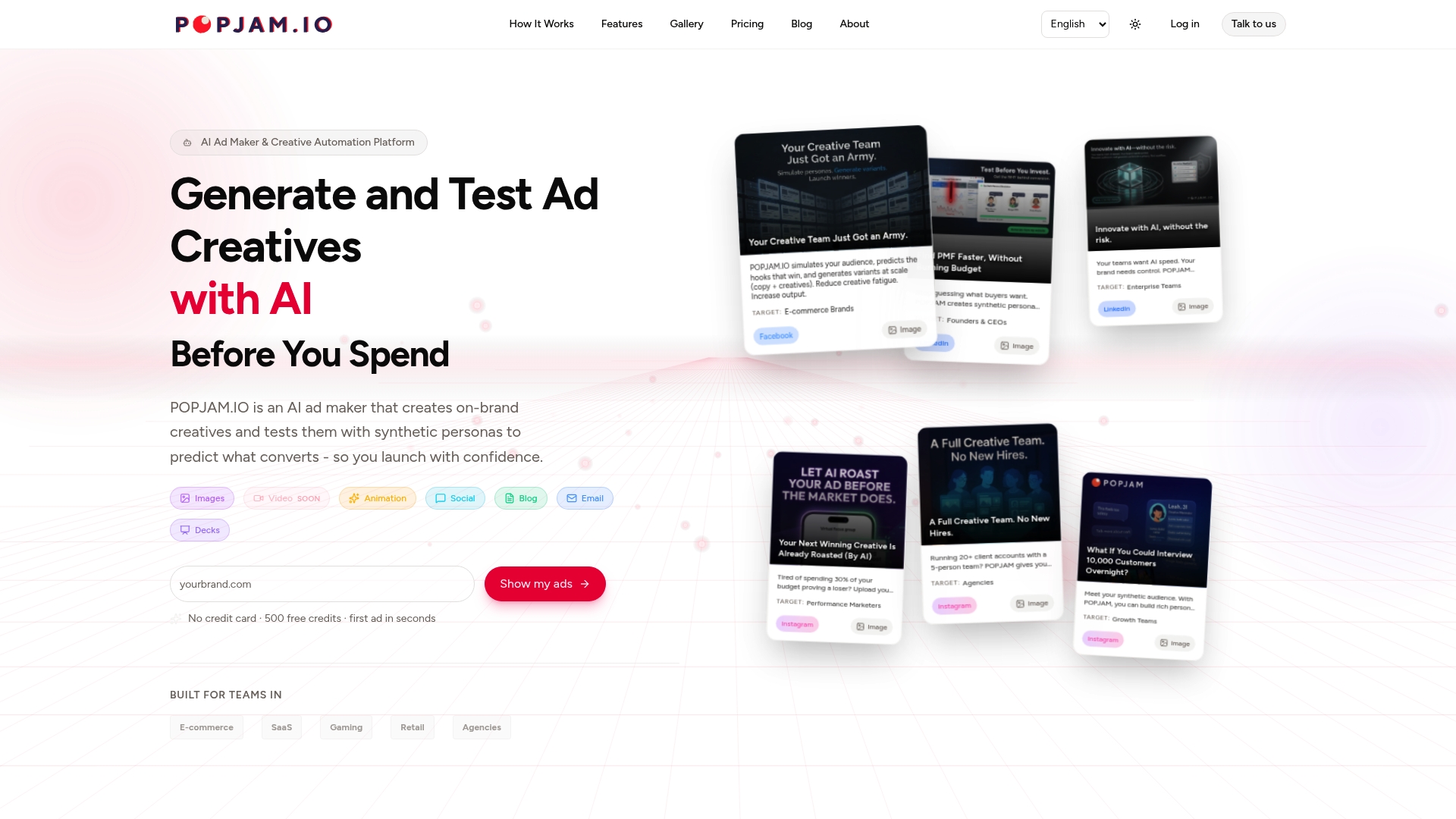
Ready to stop posting and praying? POPJAM lets you test your ad creatives against Synthetic Personas before you spend a dollar on media. See what resonates, fix what doesn’t, and launch with confidence.
What challenges and limitations should you expect from AI advertising?
AI advertising isn’t a magic switch. The teams that get burned are usually the ones who expected it to be.
Data dependency is the biggest constraint. AI systems learn from the data you feed them. If your conversion tracking is broken, your audience signals are stale, or your creative library is thin, the algorithm has nothing useful to optimize toward. Garbage in, garbage out applies here more than anywhere else in marketing.
Creative quality still requires human judgment. AI can generate at scale, but it can’t reliably produce work that’s emotionally resonant, culturally nuanced, or genuinely on-brand without human input. The expert-in-the-loop approach in AI-driven video campaigns, where human coaches guide the AI’s output toward authentic brand expression, exists precisely because fully autonomous generation tends to produce work that feels generic or falls into the “uncanny valley.”
Platform opacity creates accountability gaps. When Meta’s Advantage+ or Google’s Performance Max makes a targeting or bidding decision, you often can’t see exactly why. That’s fine when performance is strong. It becomes a problem when something goes wrong and you need to diagnose it fast.
Privacy regulations add real complexity. GDPR, CCPA, and evolving state-level privacy laws constrain how you collect, store, and use audience data. First-party data strategies are the answer, but building them takes time and organizational buy-in that many teams underestimate.
Creative fatigue accelerates. AI-generated creative at scale means audiences see more ads, more often. Fatigue arrives faster than it did in traditional campaigns. Without a proactive system for monitoring leading indicators and rotating creative, performance can erode quickly.
How to integrate AI advertising with your existing channels and workflows
Integration is where most AI advertising initiatives either compound their gains or stall out entirely. Here’s a practical sequence that works.
Start with an audit of your current data infrastructure. Map every conversion event, audience signal, and creative asset you already have. AI tools are only as good as the inputs you give them. Clean, structured data connected to a unified system is the foundation that scalable AI campaign management requires.
Connect your AI ad platform to your CRM and analytics stack. Audience signals from your CRM should flow into your ad platform’s targeting. Conversion data from your ad platform should flow back into your CRM and email tool. This bidirectional connection is what turns isolated AI campaigns into an intelligent marketing system.
Define clear ownership for AI outputs. Decide who reviews AI-generated creative, who approves it, and who has authority to override the algorithm’s recommendations. Without defined ownership, AI campaigns drift toward autopilot, and accountability disappears.
Run AI campaigns alongside existing manual campaigns initially. Don’t replace everything at once. Run parallel campaigns with equal budgets for 30 days and compare cost-per-acquisition. This gives you real performance data to justify further investment and helps your team build confidence in the AI’s recommendations before handing over full control.
Build feedback loops between creative performance and future briefs. When an AI-generated creative performs well, document why: which elements, which audience, which format. Feed that intelligence back into your next brief. This is how AI-driven marketing strategy compounds over time rather than plateauing after the first campaign.
Establish governance before you scale. Set guardrails on what AI can generate autonomously, what requires human review, and what requires senior approval. Document these standards. Revisit them quarterly as the technology and your team’s capabilities evolve.
Key Takeaways
AI advertising campaigns deliver their strongest results when structured workflows, human oversight, and clean data work together, not when automation runs unchecked.
| Point | Details |
|---|---|
| Human strategy comes first | AI executes faster, but positioning, brand voice, and objectives require human judgment before automation begins. |
| Structured workflows drive consistency | Briefs, brand guardrails, and review gates separate teams that scale quality from teams that only scale volume. |
| Data quality determines AI performance | Clean conversion tracking and first-party audience signals are the foundation every AI optimization layer depends on. |
| Pre-launch testing prevents wasted spend | Testing creatives against synthetic personas before media spend identifies what resonates without burning budget. |
| Selective automation outperforms full autopilot | Letting AI manage bidding and delivery while humans control creative strategy produces the strongest campaign outcomes. |