

Marketers: Rank Product Images Before You Spend a Dollar With Personas
Product image testing means running your ad visuals through calibrated synthetic buyer personas before launch, so you get a ranked prediction of which image wins instead of a guess. It reduces wasted media spend by turning creative selection into a data step, not a coin flip. The catch: the output is a ranked hypothesis, not a guarantee, so you still validate the winner with real spend. Tools like POPJAM build this exact workflow into one platform.
TL;DR:
- Product image testing provides ranked predictions of ad visual performance, but still requires live validation before full media spend.
- Variants should change only one variable at a time, with 3 to 5 options tested to ensure clear, actionable results.
- Synthetic panels built from actual audience data predict engagement with roughly 73 to 95 percent accuracy, yet should be treated as hypotheses.
- Proper setup includes defining objective, audience, and format beforehand, and continually recalibrating predictions with live results.
- Combining synthetic pretesting with real customer feedback enhances accuracy and reduces the risk of deploying ineffective creative.
Table of Contents
- What Is Product Image Testing and When Should You Use It?
- How Do You Run a Product Image Pretest Step by Step?
- What Image Signals Actually Move Predictive Scores?
- How Do You Read Pretest Rankings Without Overtrusting Them?
- How Do You Design Unbiased, Statistically Sound Test Variants?
- What Tools and Platforms Handle Product Image Testing?
- What Are the Most Common Mistakes in Product Image Testing?
- How Should You Combine Customer Feedback With Synthetic Testing?
- What Ethical and Privacy Issues Come With Synthetic Persona Testing?
- Why Rank-Order Thinking Beats Perfect-Prediction Thinking
- Test Your Product Images Before You Spend a Dollar on Media
- Sources
- FAQ
What Is Product Image Testing and When Should You Use It?
Here’s a checklist you can run through in the next hour, before your creative team touches a single ad account. Product image testing works best when you have real variants ready and a clear decision to make, not when you’re fishing for inspiration.
Start with these:
- Lock the objective and channel first. A thumb-stop test on TikTok and a click-through test on Google Search need different scoring criteria, so decide which one you’re optimizing before you generate anything.
- Prepare a few image variants, and write down exactly which single variable changes between each one (background, model presence, text overlay, color treatment).
- Define your audience seed signals. Age range, purchase intent, category familiarity, and platform habits all shape how a synthetic panel should be built to mirror your real buyers.
- Collect your metadata. Platform, campaign objective, and any targeting constraints (age gating, regional restrictions) all affect how a predictive model weighs the image.
- Set your decision rule in advance. Decide now that you’ll launch the top-ranked variant with a capped test budget and keep the runner-up in reserve, so no one argues about it after the scores come in.
Skip pretesting when you’re still in early concept exploration with rough mockups. It shines once you have near-final creative and a real media budget on the line.
How Do You Run a Product Image Pretest Step by Step?
The workflow behind synthetic persona testing follows a consistent five-step arc: generate variants, build the panel, score, ship the winner, and validate live, as neuroflash’s testing framework lays out. Here’s how each step actually plays out for a product-image ad.
-
Produce 3 to 5 near-final image variants, changing one variable at a time. If you swap the background AND the model AND the text overlay in the same variant, you’ll never know which change moved the score. Isolate variables the way you would in any controlled experiment.
-
Build a calibrated synthetic persona panel that mirrors your actual ad-target segment. This isn’t a generic “shopper” persona. It’s built from the psychographic and demographic traits of the audience you’re actually targeting in Meta Ads Manager or Google Ads. Digital twin panels like this can return ranked predictions in minutes, which is what makes pretesting fast enough to fit into a real production calendar, according to GWI’s research on synthetic personas.
-
Run the variants through the panel and collect predicted engagement, click-through rate, and conversion-intent scores. You want a ranked list, not a pass/fail grade.
-
Pick the top-ranked variant to launch, with a small controlled budget, and keep the runner-up on standby. Don’t commit your full monthly spend to the top prediction on day one.
-
Compare the prediction against actual live performance and log the gap. This is the step most teams skip, and it’s the one that makes every future pretest more accurate.
Pro Tip: Ask your synthetic panel narrow questions, like whether a hero product shot outperforms a lifestyle image for this specific audience, rather than a vague “will this ad win” prompt. Specific questions produce specific, actionable rankings.
What Image Signals Actually Move Predictive Scores?
Not every pixel matters equally. Predictive models weigh a fairly consistent set of visual and metadata signals, and understanding them helps you prioritize which changes to test first instead of tweaking everything at once.
- Composition and focal point. Where the eye lands first, and whether the product itself is that landing spot, drives a large share of the prediction.
- Contrast and background treatment. A product that visually separates from its background almost always scores better than one that blends into it.
- Face presence and placement. Faces can boost attention, but a face positioned too close to your product or headline text tends to pull focus away from the thing you’re actually selling.
- Text overlay density. Heavy text kills legibility on mobile feeds, where most of this creative will actually run.
- Platform-format fit. A square product shot built for a feed doesn’t perform the same way as a 9:16 crop built for Stories or Reels, and providing the intended platform and format when scoring creatives measurably improves prediction accuracy.
- Submitted metadata. Objective, channel, and audience details you attach to the image all sharpen what the model can predict.
Predictive systems that combine computer vision with natural language processing can hit roughly 73% accuracy identifying top-quartile creatives when these signals are weighted correctly. That’s a meaningful edge over guessing, but it’s not certainty, which is exactly why the next step matters so much.
How Do You Read Pretest Rankings Without Overtrusting Them?
Treat every pretest output as a rank-order hypothesis, not an absolute forecast. Experts studying relative versus absolute rating systems consistently find that relative rankings hold up better under real-world variance than a single predicted number ever does. A pretest telling you “Variant B beats Variant A” is more trustworthy than one telling you “Variant B will get a 4.2% CTR.”
Well-calibrated synthetic panels can reach 85 to 95 percent aggregate parity with real human panels in some studies. That’s strong, but it still leaves a real gap, which is why closing the loop matters:
- Set a validation window (typically 3 to 7 days of live spend) and a minimum sample size before you trust actual results over the prediction.
- Log predicted score versus actual performance every time, and watch for a consistent directional gap rather than one-off noise.
- Recalibrate around seasonality shifts, category changes, or genuinely novel creative styles your panel hasn’t seen before.
- Run a small live A/B even on your top-ranked creative when the stakes are high enough that a wrong call would be expensive.
Pro Tip: A gap between prediction and reality isn’t a failure of the model. It’s the signal that tells you when to recalibrate, which is the entire point of logging results in the first place.
How Do You Design Unbiased, Statistically Sound Test Variants?
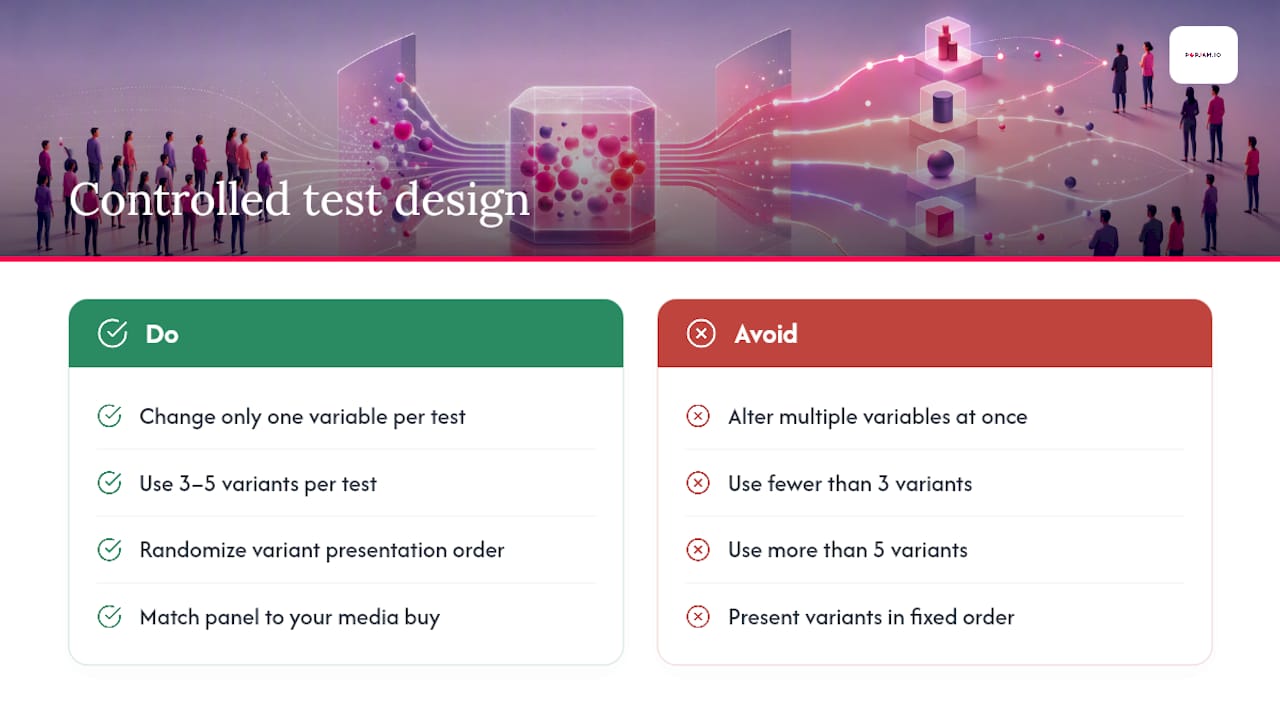
Bad variant design is the fastest way to get a confident answer to the wrong question. Change one variable per test, always. If you alter the background, the headline, and the product angle simultaneously, a higher score tells you nothing actionable about which change actually caused it.
Keep your variant count in the 3 to 5 range. Fewer than three gives you weak signal separation; more than five spreads your synthetic panel’s attention thin and makes it harder to draw a clean winner. Randomize the order in which variants get shown to the panel, since presentation order can quietly bias early results toward whichever image appears first.
Match your synthetic panel’s composition to your actual media buy. If your real campaign targets women aged 25 to 34 in the United States shopping on mobile, a generic or mismatched panel will hand you a ranking that has nothing to do with your actual buyers. Sample size matters here too. A pretest run against a thin panel can look statistically clean while carrying wide, unreported error margins.
Finally, hold your test conditions constant. If Variant A gets scored against an objective of “engagement” and Variant B gets scored against “conversion intent,” you’re not comparing images, you’re comparing different questions. Lock the objective, the channel, and the audience definition before you run a single variant through the panel.
What Tools and Platforms Handle Product Image Testing?
The category splits into a few practical lanes. Full-service creative platforms generate ad variants and run them through synthetic persona panels in one pass, which is the fastest route when you need both the creative and the score. POPJAM sits in this lane, pairing AI-generated ad creative with psychographic feedback from synthetic buyer personas before anything goes live.
Standalone synthetic-audience platforms focus purely on the scoring layer. You bring your own creative, and they return ranked predictions against a calibrated panel. These suit teams with strong in-house design resources who just need the validation step.
General visual-composition resources round out the toolkit. Understanding visual storytelling principles helps your team build better variants in the first place, before they ever hit a scoring panel. And if your pretested winner drives traffic to a product page, pairing image testing with conversion rate optimization on that landing experience closes the loop between the ad click and the sale.
For teams comparing options broadly, a side-by-side look at AI ad creative tools covers generation and testing capability tradeoffs worth understanding before you commit budget to any single platform.
What Are the Most Common Mistakes in Product Image Testing?
The single biggest mistake is treating a pretest score as a launch guarantee instead of a ranking. Teams that skip live validation entirely because “the model said Variant C wins” end up surprised when real-world performance drifts from prediction, especially in categories with fast-moving trends or seasonal shifts.
Changing too many variables at once is a close second. If your team is testing five wildly different concepts instead of five variations on one concept, you learn almost nothing about why one wins.
Using a mismatched or generic synthetic panel is another frequent error. A panel that doesn’t reflect your real targeting parameters will produce confident, clean-looking rankings that simply don’t transfer to your actual campaign. Along the same lines, teams sometimes forget to submit platform and format metadata when scoring, which strips the model of context it needs, since platform fit is one of the stronger predictive signals available.
Last, skipping the recalibration step is a slow-burn mistake. A model that isn’t checked against live results regularly will quietly lose accuracy as your category, competitors, and audience habits shift. Static models degrade. There’s no way around comparing prediction to reality on a recurring basis.
How Should You Combine Customer Feedback With Synthetic Testing?
Synthetic persona pretesting is fast and cheap, but it’s not a replacement for hearing from actual customers. The two work best layered together, not chosen one over the other.
Use synthetic pretesting first, to narrow a wide field of concepts down to your top two or three contenders. That’s where speed matters most and stakes are lowest. Then bring real customer feedback in at the validation stage, through post-purchase surveys, support ticket themes, or comments on live social posts, to sanity-check whether the synthetic ranking matches what actual buyers say they respond to.
Qualitative signals catch things synthetic panels sometimes miss: cultural nuance, brand-specific inside jokes, or a product detail that only makes sense to someone who’s actually held the item. If your customer service team keeps hearing that people love a specific color option, that’s a real-world signal worth feeding into your next round of image variants, even if the synthetic panel didn’t flag it first.
The teams getting the most out of this combination run a tight loop: synthetic pretest to narrow the field, small live test to confirm, then customer feedback to explain the “why” behind the winner.
What Ethical and Privacy Issues Come With Synthetic Persona Testing?
Synthetic personas are built from aggregated behavioral and demographic patterns, not real individual consumer data tied to a name or account. That distinction matters for how your team should talk about the method internally and to clients, since it avoids the privacy exposure that comes with testing against real, identifiable customer records.
Still, a few practical guardrails apply. Be transparent with clients or stakeholders about what a synthetic panel represents: a calibrated statistical model of a segment, not a focus group of real people. Overstating the panel as “real customer opinions” misrepresents the method, even when the predictions are accurate.
Watch for bias baked into the underlying training data. A panel calibrated on a narrow or skewed data set can quietly reinforce stereotypes about how a demographic group responds to imagery, particularly around gender, age, or cultural representation in product photos. Review panel composition periodically, the same way you’d audit any model for drift.
Finally, keep synthetic testing positioned as a pre-screening layer, not a replacement for real audience consent and feedback where it’s legally or ethically expected, such as in regulated categories like health or finance advertising.
Why Rank-Order Thinking Beats Perfect-Prediction Thinking
Most teams new to synthetic testing want a single number: “This image will get a 3.8% CTR.” That instinct is understandable and almost entirely the wrong way to use this tool.
What actually works is asking the panel to rank your options against each other, then treating the top choice as your best bet, not your guaranteed outcome. Vetting concepts against a calibrated panel before human testing measurably reduces the risk of shipping off-brand or poorly-received creative, and that risk reduction, not perfect prediction, is the real value here.
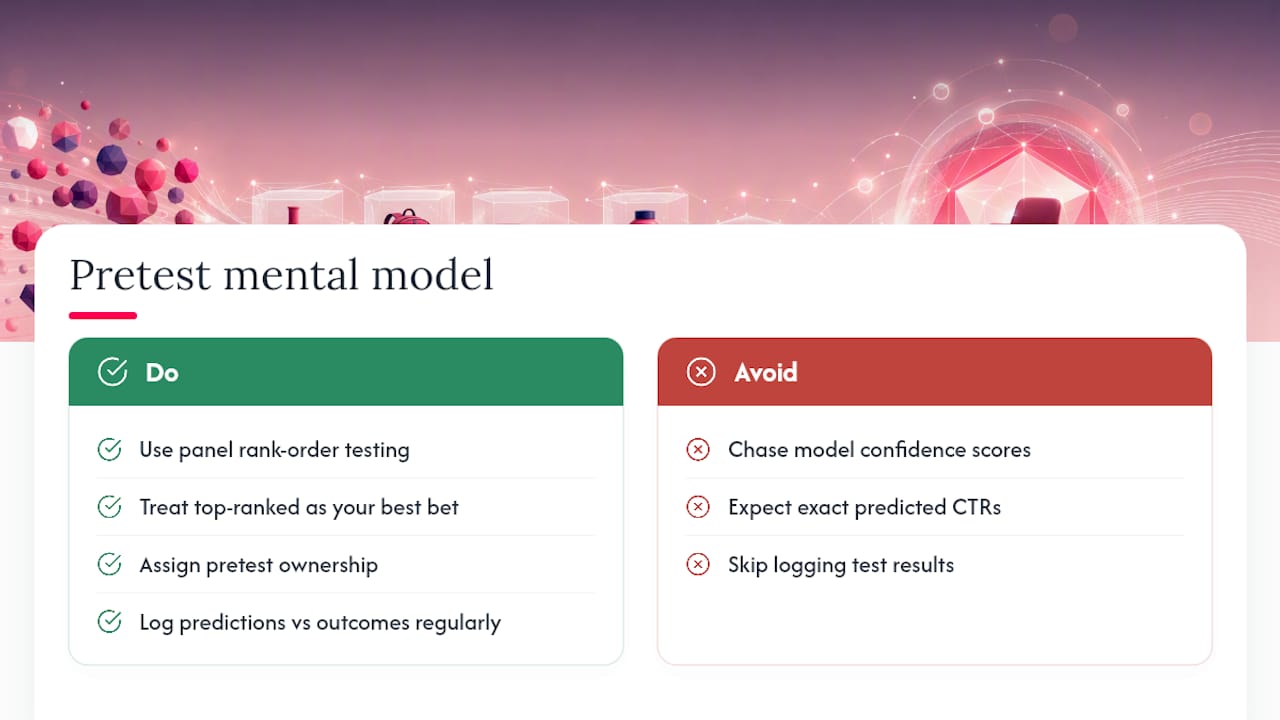
I’ve seen teams get this backwards constantly: they chase the model’s confidence score instead of its ranking, then get frustrated when live performance doesn’t match the predicted percentage exactly. The fix isn’t a better model. It’s a better mental model. Treat every pretest as a strong opinion from a well-informed panel, not a crystal ball.
Whoever owns your creative pipeline, whether that’s a solo growth marketer or a dedicated creative ops lead at an agency, should own the pretest step too, run it on a fixed cadence tied to your launch calendar, and log every prediction against actual results without exception. That habit compounds. Six months of logged gaps teaches your team more about your audience than any single test ever will.
— Doruk
Test Your Product Images Before You Spend a Dollar on Media
This workflow can be built into a single platform that generates image variants, runs them against calibrated synthetic buyer personas, and provides ranked predictions on engagement, click-through, and conversion intent before spending ad budget on Meta, Google, TikTok, or Reddit.
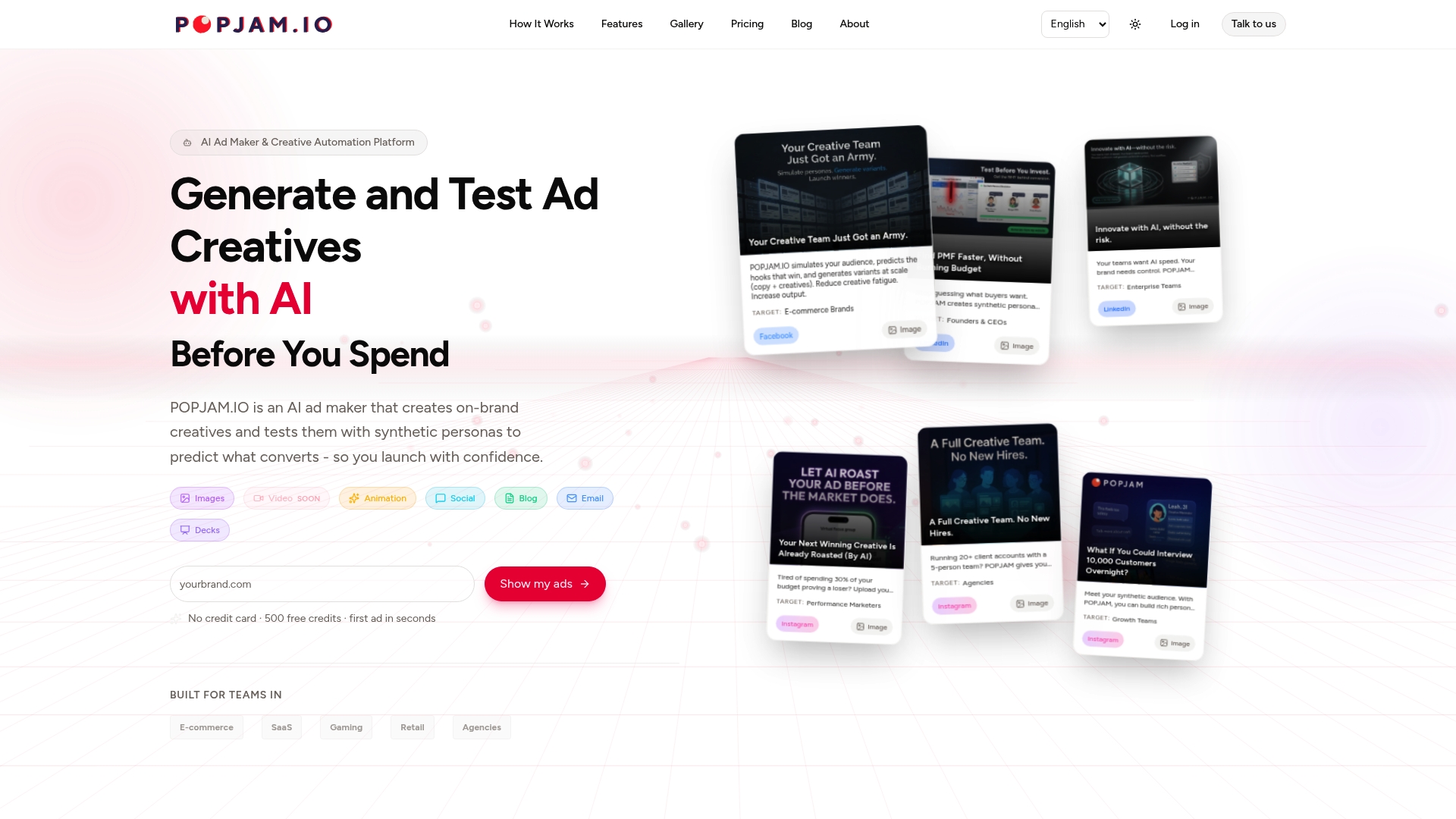
- Generate variants fast: produce multiple on-brand image options without waiting on a design queue.
- Score against synthetic personas: get psychographic feedback that ranks your options instead of leaving you to guess.
- Validate before you scale: launch your top-ranked variant with a small budget, then compare prediction to actual performance.
If you’re running product-image ads on any real budget, start with a contained pilot: one objective, one channel, one audience segment. Try the AI ad generator on your next campaign and see how the ranking holds up against your live results.
Sources
FAQ
What Is Product Image Testing?
It’s the process of running ad image variants through calibrated synthetic buyer personas to get a ranked prediction of which one will perform best before you spend real media budget.
How Many Image Variants Should I Test at Once?
Test several variants, changing only one variable between each one, such as the background, the presence of a face, or the text overlay.
Is Synthetic Persona Testing as Accurate as Real Human Testing?
Well-calibrated synthetic panels have reported 85 to 95 percent aggregate parity with real human panels in some studies, but outputs should still be treated as ranked hypotheses that need live validation, not guarantees.
Can Synthetic Testing Replace Live A/B Tests Entirely?
No. Synthetic testing works best as a pre-screening and ranking layer that narrows your options; you still confirm the winner with a small, controlled live test.
What Tool Handles Both Creative Generation and Pretesting?
POPJAM generates on-brand ad image variants and scores them against synthetic buyer personas in one workflow, so you don’t need separate tools for creative and validation.