

Get Creative Decisions in 48–72 Hours: GDPR User Testing for Marketers
Yes, you can run GDPR-compliant synthetic persona testing to pre-test ad creatives, and it’s becoming standard practice for performance teams that want signal before spend. Three controls make it defensible: an anonymization standard that clears the Article 29 Working Party’s identifiability bar, a documented Data Protection Impact Assessment wherever residual risk exists, and independent re-identification testing on a recurring cadence. Platforms like POPJAM.IO build these into the workflow rather than treating them as an afterthought; for a detailed GDPR-compliant AI practical guide for UK professionals, see this resource.
TL;DR:
- Fully anonymized synthetic data that cannot be linked back to individuals can fall outside GDPR, but partial or weak anonymization still triggers compliance obligations.
- Use anonymization standards, DPIAs, and independent re-identification testing regularly to keep synthetic persona testing GDPR-compliant.
- When real data is involved in training models, ensure lawful basis and explicit consent if sensitive information is used; synthetic output alone does not require consent.
- Limit each pilot to one campaign goal and one audience segment to prevent data leakage and simplify documentation for audits.
- Incorporate ongoing re-identification audits and detailed documentation to maintain defensibility and avoid common compliance pitfalls.
Table of Contents
- What Does GDPR User Testing Mean for Ad Creative?
- When Does GDPR Actually Apply to Synthetic Outputs?
- How Do You Run a GDPR-Safe Synthetic Persona Test?
- Differential Privacy, K-Anonymity, and Re-Identification Audits Explained
- What Documentation Does GDPR Require for This Testing?
- Do You Need Consent for Synthetic Persona Testing?
- What Mistakes Do Teams Make With Synthetic Persona Compliance?
- Why Synthetic Persona Testing Is Creative Ops, Not Just Compliance
- Test Creatives Before You Spend With POPJAM
- Sources
- FAQ
What Does GDPR User Testing Mean for Ad Creative?
When we talk about GDPR user testing here, we mean something specific: using AI-generated synthetic personas and simulated audience reactions to pre-test ad creatives before they ever touch a live campaign. This is not live usability research involving real participants, screen recordings, or personal data collected from actual users. That’s a different discipline with different rules.
Synthetic personas mirror the statistical patterns of real audiences, behavioral tendencies, purchase triggers, response patterns, without containing actual personal identifiers. Synthetic datasets can be built from CRM exports, engagement events, and historical campaign data to simulate how a segment might react to a headline, a visual, or a call to action.
Why teams lean into this approach:
- Faster iteration cycles: you get directional feedback in hours, not weeks of live testing
- No exposure of real user data to third-party creative vendors or agency partners
- Lower pre-launch ad spend since weak creative gets filtered before it burns budget
When Does GDPR Actually Apply to Synthetic Outputs?
This is where most teams get tripped up. GDPR Recital 26 and Article 4(5) draw a hard line: if data is truly and irreversibly anonymized, it falls outside GDPR’s scope. If it can be linked back, directly or indirectly, to an identifiable person, it’s still personal data and every GDPR obligation applies.
The tricky part is that “looks synthetic” and “is anonymous” are not the same thing. The Article 29 Working Party’s identifiability criteria assess whether a data subject could realistically be singled out, linked, or inferred, even from outputs that appear entirely fabricated. A synthetic persona built too closely on a small, distinctive customer segment can still be re-identifiable if enough correlated attributes leak through.
Fully anonymized synthetic data can sit outside GDPR entirely. Partially synthetic or weakly anonymized outputs typically remain personal data, which triggers the full compliance stack.
When outputs remain classified as personal data, you’re on the hook for:
- A documented lawful basis for the original processing that generated the synthetic model
- A DPIA before generation begins, not after
- Data subject rights (access, erasure, objection) tied back to the source data
- Explicit consent or another Article 9 condition if special category data was involved in training the model
How Do You Run a GDPR-Safe Synthetic Persona Test?
Here’s the workflow that holds up under scrutiny, from planning through validation.
- Plan the test. Define your campaign objective, your hypothesis (which creative direction you expect to win, and why), the scope of personas involved, your lawful basis if any real data feeds the model, and loop in your DPO early if there’s any ambiguity about identifiability.
- Handle the data correctly. Use fully synthetic personas whenever possible. If your model is partially built on real customer data, document the source’s lawful basis and apply data minimization, strip anything beyond what the test genuinely needs.
- Generate with privacy parameters set. Apply differential privacy or an equivalent noise calibration before generation. Hold out a validation set so you’re not overfitting your synthetic personas to a narrow slice of past behavior.
- Run the simulation. Rank creative directions against each other rather than chasing absolute scores. Treat every output as directional guidance, not gospel, and keep the test confidential until you’ve acted on the results.
- Validate independently. Commission re-identification testing on the dataset. Pilot the winning creative on a small live budget before full rollout, and log your assumptions, parameters, and results for the audit trail.
Pro Tip: Start every pilot with one campaign objective and one audience segment. Trying to validate three creative directions across five segments in your first run buries the signal you actually need and makes your documentation a mess to defend later.
Teams using this kind of structured approach have reported creative decisions turning around in 48 to 72 hours without exposing early concepts publicly, a meaningful edge when a competitor could screenshot a live test.

Differential Privacy, K-Anonymity, and Re-Identification Audits Explained
Privacy-enhancing techniques aren’t optional extras, they’re what makes a synthetic dataset defensible. Two do most of the heavy lifting.
Differential privacy injects calibrated statistical noise into a dataset so no single record can be reverse-engineered, while the aggregate patterns stay useful for analysis. The tradeoff is real: more noise means lower re-identification risk but weaker statistical fidelity, so teams need to iteratively tune noise levels until the data still supports the testing task without exposing individuals.
K-anonymity works differently: it groups records so that any individual is indistinguishable from at least k-1 others sharing the same attributes. The common pitfall is treating k-anonymity as a one-time checkbox. Attribute correlations shift as you add new data sources, and a dataset that was k-anonymous last quarter might not be today.
Re-identification is a moving target, not a one-and-done audit. Practitioners should treat the initial audit as a baseline and schedule periodic re-testing, recording the methodology each time so the audit trail holds up if a regulator asks questions later.
Before trusting any vendor’s synthetic persona engine, request:
- The specific privacy parameters used (noise levels, k-value thresholds)
- Independent audit reports, not just internal self-assessments
- Re-identification test artifacts with dates and methodology
- A record of how often those audits are refreshed
What Documentation Does GDPR Require for This Testing?
Governance is what separates a defensible testing program from one that collapses the moment legal asks a question. A recommended operational structure includes a DPIA, privacy-enhancing technologies, ongoing re-identification monitoring, and documented processing records.
Run a DPIA whenever synthetic generation draws on real personal data, especially at scale or involving sensitive attributes, and have it cover the data source, the anonymization method, and residual risk. Under Article 30, your processing records should note the lawful basis, the safeguards applied, retention windows, and deletion policies for both the source data and the synthetic outputs.
Assign clear roles before you start testing:
- DPO: reviews DPIA scope and identifiability risk
- Legal: confirms lawful basis and consent status
- Engineering: implements privacy parameters and maintains audit logs
- Marketing: signs off on test scope and confidentiality handling
Set review triggers, a new data source, a model retrain, or a scheduled quarterly check, and define an incident process for what happens if a re-id audit flags a problem.
Do You Need Consent for Synthetic Persona Testing?
Here’s the nuance that trips people up: synthetic personas themselves don’t need consent because they aren’t real people. But the moment real personal data feeds into building or training the model those personas are based on, consent (or another valid lawful basis) governs that input, not the synthetic output.
If you’re building personas from CRM exports, past campaign responders, or engagement events, that original data collection needed its own lawful basis at the point of collection. Retroactively deciding to use that data for synthetic model training without checking whether your original consent or legitimate interest basis covers it is a common gap.
Practical consent management for this workflow looks like:
- Auditing whether your original data collection consent covers “model training for testing purposes,” not just “campaign personalization”
- Keeping the synthetic generation process separate from any customer-facing consent changes, so a customer withdrawing consent triggers removal of their data from future model training runs
- Documenting the consent chain from source data through model to synthetic output, even though the final persona itself carries no personal data
If your synthetic personas are built entirely from licensed third-party panels or fully aggregated industry data with no direct customer input, your consent burden shrinks significantly, but you still need to verify the upstream provider’s own compliance posture.
What Mistakes Do Teams Make With Synthetic Persona Compliance?
The most common failure is confusing “looks anonymous” with “is anonymous.” A persona generator that produces plausible, fictional-sounding names and behaviors can still be built on a dataset small enough that individuals are re-identifiable, especially in niche B2B segments where a handful of firmographic attributes can point to one real company.
A second mistake: treating the DPIA as a one-time compliance exercise instead of a living document. Teams run a DPIA at launch, then keep adding new data sources to the training set over the following year without ever revisiting it.
Other recurring pitfalls:
- Skipping re-identification audits after the initial vendor onboarding, assuming the first test covers you indefinitely
- Failing to document why a dataset was judged sufficiently anonymized, leaving no defensible paper trail if challenged
- Sharing “anonymized” synthetic outputs with agency partners or contractors without checking whether those outputs still carry re-identification risk
- Using differential privacy noise levels so aggressive that the synthetic personas produce useless creative signal, defeating the purpose of testing at all
- Assuming a platform’s marketing claim of “GDPR-compliant” substitutes for your own DPIA and audit trail
The fix for most of these is procedural, not technical: build re-audits and documentation reviews into your calendar the same way you’d schedule a security review, rather than treating them as a one-time setup task.
Why Synthetic Persona Testing Is Creative Ops, Not Just Compliance
Most compliance content treats synthetic data as a legal workaround, something you tolerate to avoid risk. That framing undersells it. Marketing privacy specialists increasingly view synthetic personas as a competitive layer for creative ops: as first-party data access tightens across ad platforms, teams that can simulate behavioral response without depending on live audience data get a durable edge.
POPJAM.IO approaches this by generating on-brand ad creatives and running them against synthetic buyer personas built from psychographic profiles, giving marketing teams feedback before a single dollar hits Meta, Google, or TikTok. That’s the proof point worth internalizing: the workflow described above isn’t theoretical, it’s operational at the platform level right now. For teams that want to go deeper on methodology, POPJAM’s guide to synthetic user testing for performance teams walks through the mechanics in more detail.
If you’re designing your first pilot, keep it narrow: one campaign objective, three creative directions, a validation window of one to two weeks, and a clear metric (predicted engagement rank, sentiment split, or click intent) you’ll compare against live results afterward.
— Doruk
Test Creatives Before You Spend With POPJAM
POPJAM is the alternative to burning ad budget on guesswork, you generate on-brand creatives and run them against synthetic buyer personas before anything goes live, so weak concepts get filtered out in hours instead of after a failed campaign.
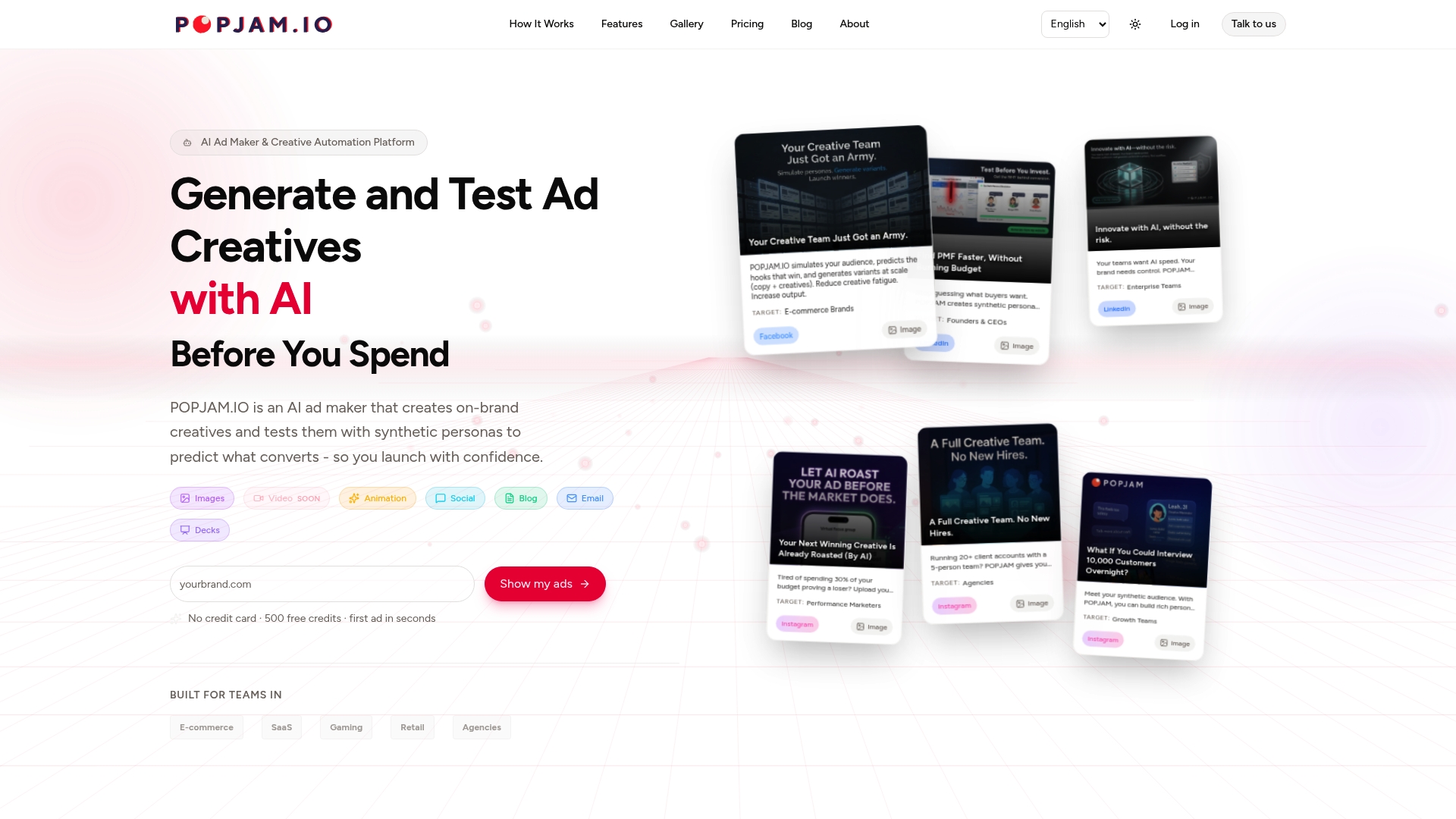
The platform builds privacy safeguards into the persona simulation layer itself, so your creative team gets psychographic feedback without the manual compliance scramble of building an anonymization process from scratch. Whether you’re screening Google Display concepts or a full multi-channel launch across Meta, TikTok, and LinkedIn, the workflow stays the same: generate, simulate, refine, then spend.
Agencies managing multiple client accounts can see how this scales on the AI ad generator for agencies page. If you’re ready to see how synthetic persona feedback changes your pre-launch process, start a trial and run your first creative comparison this week.
Sources
- Synthetic Data Under GDPR: Compliance Challenges - GDPR Local
- Using synthetic audiences to test ad creative without risking your budget - Sotavento Medios
FAQ
Is GDPR-compliant synthetic persona testing actually possible?
Yes. It requires an anonymization standard that meets Article 29 Working Party identifiability criteria, a DPIA where risk exists, and independent re-identification testing on a recurring basis.
Does GDPR apply to fully synthetic ad testing data?
Not always. Fully anonymized synthetic data can fall outside GDPR’s scope, but partially synthetic or weakly anonymized outputs typically remain personal data subject to full obligations.
Do I need consent to build synthetic personas?
The synthetic persona itself doesn’t need consent, but the real data used to train the underlying model does need a valid lawful basis, and special category data requires explicit consent or another Article 9 condition.
How often should re-identification audits happen?
Treat re-identification risk as ongoing rather than a one-time check. Schedule periodic audits, especially after adding new data sources or retraining a persona model, and document the methodology each time.
Can platforms like POPJAM help with GDPR-safe creative testing?
Yes. POPJAM generates ad creatives and tests them against synthetic buyer personas built from psychographic profiles, giving teams directional feedback before a campaign goes live without exposing real user data.
What’s the biggest compliance mistake teams make?
Assuming synthetic-looking data is automatically anonymous. A persona generator can produce fictional-seeming outputs that are still re-identifiable if built on a small or distinctive underlying dataset.