

A Creative Testing Framework for Performance Marketers
A creative testing framework is a repeatable system that finds winning ad creatives, confirms measurable lift, and scales proven concepts while cutting wasted spend. Enterprises report creative can account for up to 70% of paid social results when testing is done systemically, which means the difference between a disciplined framework and “post and pray” is not marginal. It’s the whole game.
Here’s what you can do in the next 24 hours to get started:
- Gap audit: Pull your last 90 days of ad data and identify which creatives were never properly tested against a control.
- Write one hypothesis: Use the format “If we change X to Y, then metric Z will improve by N because…” and commit to it before touching the platform.
- Choose your method: Decide whether you need an A/B test, a lift study, or a pre-launch simulation based on your traffic volume and objective.
- Set a sample size guardrail: Aim for at least 200 conversion events per variant before reading results, or use engagement metrics if traffic is low.
- Pre-register your end date: Lock in a stop date before you launch. Peeking early is the single fastest way to a false winner.
Key Takeaways
A rigorous creative testing framework compounds over time: each validated learning sharpens the next brief, reduces wasted production spend, and builds a reusable asset that outperforms any single winning ad.
| Point | Details |
|---|---|
| Start with a gap audit | Review the last 90 days of ad data to identify untested hypotheses and underperforming formats before briefing new work. |
| Write causal hypotheses | Use the “If X then Z by N because…” format to pre-specify what you’re testing and what a conclusive result looks like. |
| Match method to traffic | Use A/B for single-variable tests, holdout tests for causal proof, and engagement metrics to shortlist when conversion volume is low. |
| Aim for 200+ events per variant | Reaching 200 conversion events per variant before reading results prevents premature conclusions and false winners. |
| Use POPJAM for pre-launch filtering | POPJAM’s synthetic persona simulation ranks concepts by predicted performance before live spend, reducing production waste and speeding up winner discovery. |
Table of Contents
- What is a creative testing framework and when should you run one?
- What are the core components of a repeatable creative testing framework?
- How do you set objectives, map KPIs, and write testable hypotheses?
- Which creative elements should you test, and in what order?
- Which testing method should you use for your campaign?
- How do you set up and run a test that produces valid results?
- How do you analyze results and turn significance into a decision?
- How do you turn test learnings into sustained creative performance?
- How does privacy change the way you measure creative tests?
- How does AI-powered simulation fit into your testing workflow?
- Why a test-first creative culture is the real competitive advantage
- POPJAM makes your creative testing faster and sharper
- Sources
- FAQ
What is a creative testing framework and when should you run one?
Creative testing is a data-driven process used to predict ad performance and produce repeatable learnings. The goal is not just to find a winner once. It’s to build a system that keeps finding winners, documents why they work, and feeds those insights back into future briefs.
A formal framework makes sense when you have a real business objective tied to the test, a budget large enough to reach statistical power, and a KPI that can actually be measured within your attribution window. Not every campaign needs a full experimental design. But if you’re spending meaningfully on paid social or paid search and you’re not running structured tests, you’re leaving compounding learnings on the table.
When a full framework is worth the setup:
- Upper-funnel awareness campaigns where hook rate and view-through lift are the primary signals
- Mid-funnel engagement tests where click-through rate and landing page scroll depth tell you what’s resonating
- Conversion-focused campaigns where CPA, ROAS, or form completion rate is the north star
- Any campaign where creative fatigue is suspected and you need causal evidence before pulling spend
Decision checklist before launching a test:
- Do you have enough traffic to reach 200+ conversion events per variant within a reasonable timeframe?
- Is the business objective clearly mapped to a measurable test KPI?
- Is the budget ring-fenced so the platform algorithm can’t reallocate spend mid-test?
- Have you pre-specified your minimum detectable effect (MDE) and confidence level?
If you can check all four boxes, run the test. If you can’t, use cheaper engagement metrics to shortlist creatives first, then run the conversion test on the finalists.
What are the core components of a repeatable creative testing framework?
Think of the framework as a production line, not a one-off project. Each component has an owner, a deliverable, and a handoff point. Without that structure, tests produce noise instead of signal.
The eight building blocks:
- Gap analysis: Audit existing creatives and performance data to identify untested hypotheses and underperforming formats.
- Objective and KPI definition: Map each business goal to a specific, measurable test metric.
- Hypothesis library: A living document of causal hypotheses ranked by expected lift and production cost.
- Variant pipeline: The process for briefing, producing, and QA-checking creative variants before they enter a test.
- Testing methodology selection: The decision logic for choosing A/B, multivariate, lift/holdout, or adaptive bandit tests.
- Measurement and dashboards: Pre-built reporting views that surface significance, segment splits, and practical effect sizes.
- Learning repository: A structured archive of test results, winning patterns, and failed hypotheses that informs future briefs.
- Governance and cadence: Weekly or biweekly review cycles, naming conventions, versioning rules, and escalation paths.
Roles and responsibilities:
| Component | Owner | Key Deliverable |
|---|---|---|
| Hypothesis library | Creative strategist | Ranked backlog of testable ideas |
| Audience definition | Media planner | Audience spec with freshness controls |
| Statistical validation | Analytics lead | Pre-registered MDE, power, and significance threshold |
| Test documentation | Performance marketer | Structured result write-up in the learning repo |
Operational controls matter as much as the components themselves. Every test needs a unique naming convention (campaign, variant, date, hypothesis ID), a versioning rule so you never accidentally run an old creative against a new one, and a budget guardrail that prevents the platform from reallocating spend before you hit your sample size.
How do you set objectives, map KPIs, and write testable hypotheses?
The most common reason tests produce inconclusive results is not a statistics problem. It’s a hypothesis problem. Vague objectives produce vague results. The fix is to write hypotheses with causal language before you touch the platform.
Mapping business KPIs to test KPIs:
- Revenue goal → ROAS or CPA at the ad set level
- Lead generation goal → Form completion rate or cost per lead
- Awareness goal → Reach, frequency-adjusted hook rate, or brand lift survey score
- Engagement goal → Thumb-stop rate, video view rate, or click-through rate
Hypothesis template:
That specificity does three things. It tells the creative team exactly what to produce. It tells the analytics team exactly what to measure. And it tells everyone what a conclusive result looks like before a single dollar is spent.
Acceptance criteria to pre-register:
- Confidence level: 95% (or 90% for early-stage concept tests with lower stakes).
- Minimum detectable effect: Set based on what lift would actually change a budget decision.
- Sample size: Plan for 200+ conversion events per variant for conversion tests; use impressions thresholds for upper-funnel metrics.
- End date: Fixed in advance. No early stopping.
- Decision rule: Define “confirm and scale,” “iterate,” or “kill” outcomes before the test runs.
Which creative elements should you test, and in what order?
The sequencing matters more than most teams realize. Testing button colors before you’ve validated the core concept is like optimizing the font on a billboard nobody reads. Start with concept testing, then move to hook testing, then refine tactical variations. Each level answers a progressively smaller strategic question.
What to test at each level:
- Concept level: Core message, value proposition angle, emotional vs. rational framing, problem-first vs. product-first structure
- Hook level: Opening frame (first 3 seconds of video or headline for static), visual treatment, narrator vs. text-on-screen, UGC vs. produced
- Variation level: CTA copy, color palette, format adaptation (square vs. vertical vs. landscape), copy length
How many variants per round:
Run two to four concepts per concept-testing round. More than four dilutes your budget across too many cells and extends the time to significance. Once a concept wins, run two to three hook variants against it. Variation testing can handle more options because the production cost is lower and the signal is faster.
Prioritization heuristic:
Score each hypothesis on four dimensions before adding it to the queue:
- Expected lift (high/medium/low based on past learnings)
- Production complexity (hours to produce the variant)
- Learnability (will the result teach you something reusable?)
- Audience reach (is there enough traffic to reach significance?)
Prioritize high-lift, high-learnability hypotheses even when production complexity is moderate. Low-lift, low-learnability tests should sit at the bottom of the backlog regardless of how easy they are to produce.
Creative QA checklist before launch:
- Correct aspect ratios and file specs for each placement
- No policy-violating claims or restricted imagery
- Consistent UTM parameters and tracking pixels
- Landing page URL matches the test condition
- Creative is not already in active rotation (audience freshness risk)
Pro Tip: Run your creative QA checklist as a shared doc that both the creative team and the media buyer sign off on before any variant goes live. One missed UTM parameter can corrupt an entire test’s attribution data.
Which testing method should you use for your campaign?
The right method depends on your traffic volume, your objective, and how much causal certainty your stakeholders need. Here’s how the four main methods compare:
| Method | Best for | Traffic requirement | Causal clarity | Speed |
|---|---|---|---|---|
| A/B test | Isolating one variable | Moderate | High (single variable) | Medium |
| Multivariate | Testing many variables simultaneously | High | Medium (interaction effects) | Slow |
| Holdout / incrementality | Proving absolute lift vs. doing nothing | Any (5% holdback) | Very high | Slow |
| Adaptive bandit | Fast optimization, not causal inference | Any | Low | Fast |
A/B testing is the workhorse for most creative tests. Change one element, hold everything else constant, and let the data decide. It’s clean, interpretable, and works at moderate traffic volumes.
Multivariate testing answers “which combination of elements performs best?” but requires significantly more traffic to reach significance across all cells. Most paid social campaigns don’t have the volume to run true multivariate tests cleanly.
This method measures absolute lift versus doing nothing, which is the evidence finance teams and CMOs actually want. Use it when you need to prove that your creative program is driving real business outcomes, not just winning internal comparisons.
Adaptive bandits allocate more budget to better-performing variants in real time. They’re fast, but the algorithmic reallocation biases the inference. Use bandits for optimization, not for learning. If you need a clean causal answer, a bandit test won’t give you one.
A practical decision path:
- Low traffic, upper-funnel objective: A/B test on engagement metrics, then scale the winner to a conversion test.
- High traffic, multiple variables: Multivariate if you have the volume; otherwise run sequential A/B tests.
- Stakeholder needs causal proof: Holdout test with a 5% control group.
- Need fast optimization without causal inference: Bandit, but document the limitation.
How do you set up and run a test that produces valid results?
Setup is where most tests fail. Not in the analysis. The platform is already running before the team has agreed on what “winning” means, the budget is split unevenly, and someone peeks at results on day three. Here’s the runbook to avoid all of that.
Pre-launch checklist:
- Write and sign off on the hypothesis and acceptance criteria before touching the platform.
- Set equal spend per variant using ad set budget optimization (ABO), not campaign budget optimization (CBO). Platform algorithms will reallocate spend toward early performers, which biases the test before you reach significance.
- Confirm the same landing page, conversion event, and pixel configuration for all variants.
- Define a fixed end date or a sample size trigger, whichever comes first.
- Block cross-exposure: use separate ad sets or platform experiment tools to prevent the same user from seeing multiple variants.
- Confirm audience freshness. Don’t run a test against an audience that has already been saturated by the control creative.
Sample test plan structure:
- Hypothesis: If we lead with a social proof hook instead of a product feature hook, CPL will decrease by 20% because prospects trust peer validation more than brand claims.
- Variants: Control (product feature hook) vs. Test (social proof hook).
- Budget per variant: Equal daily spend, ring-fenced at the ad set level.
- Audience: Cold lookalike, 1% similarity, no overlap with retargeting pools.
- Duration: 14 days or 200 conversion events per variant, whichever comes first.
- Success criteria: 95% confidence, 20% MDE on CPL.
Common mistakes that invalidate results:
- Peeking at results before hitting the pre-specified sample size and stopping early when one variant looks ahead
- Changing bids, audiences, or creative copy mid-test
- Running the test during an anomalous period (major sale event, platform outage, seasonal spike)
- Letting CBO or algorithmic delivery reallocate budget across variants
For teams building toward scalable digital marketing systems, test governance is the foundation. Without it, every test is a one-off experiment rather than a compounding asset.
How do you analyze results and turn significance into a decision?
Statistical significance tells you the result is probably real. Practical significance tells you whether it’s worth acting on. You need both.

Statistical checklist before declaring a winner:
| Check | What to verify |
|---|---|
| Pre-registered MDE | Did the observed effect meet or exceed the MDE you set before launch? |
| Confidence level | Is the result at or above 95% (or your pre-specified threshold)? |
| Sample size | Did each variant reach the minimum event count? |
| Multiple comparisons | If you tested more than two variants, did you adjust for multiple comparisons? |
| No early stopping | Was the test allowed to run to its pre-specified end date? |
The winner’s curse is real. Observed lifts in early tests almost always overestimate the true effect. When you scale a winner, expect the lift to compress. Plan for roughly half the observed effect at full scale and you’ll make better budget decisions.
Segment checks before rollout:
- Split results by device (mobile vs. desktop) to catch placement-specific effects.
- Split by audience segment to see if the winner holds across demographics.
- Check placement-level data (Feed vs. Stories vs. Reels) before assuming the result generalizes.
The right call is to scale the mobile placement first, monitor CPA as spend increases, and run a separate desktop-specific test rather than assuming the result holds everywhere.
How do you turn test learnings into sustained creative performance?
Winning a test is step one. Keeping that win alive and building on it is the actual job. Creative fatigue is the silent budget killer, and most teams only notice it after frequency has already crushed their ROAS.
Scale rules for rolling out a winner:
- Phase the budget increase: double spend in week one post-test, then reassess CPA/ROAS before doubling again.
- Monitor frequency closely. When frequency climbs above 3–4 for a cold audience, fatigue is likely starting.
- Set a CPA or ROAS threshold that triggers a creative refresh review. Don’t wait for performance to fall off a cliff.
The 60/30/10 creative mix:
Enterprise teams use a 60/30/10 model to balance iteration and exploration without exhausting production resources:
- 60% of creative budget goes to iterating on proven winners (new copy, new voiceover, seasonal adaptation).
- 30% goes to remixing winners into new formats (turning a winning video into a static carousel, adapting for a new placement).
- 10% goes to testing entirely new concepts that could become the next generation of winners.
Roadmap cadence:
- Weekly: Review frequency and performance signals on active creatives. Flag anything approaching fatigue thresholds.
- Biweekly: Review the hypothesis backlog and brief the next round of variants.
- Monthly: Conduct a full learning review. Pull winning patterns, update the learning repository, and brief the creative team on what the data says works.
- Quarterly: Run an explore-confirm-scale cycle. Use the 10% budget to test new concepts, confirm the strongest with a proper A/B, and scale winners into the 60% bucket.
How does privacy change the way you measure creative tests?
The short answer: it makes clean attribution harder and causal evidence more valuable, not less. SKAdNetwork (SKAN) limits attribution windows, reduces conversion data granularity, and introduces reporting delays that make real-time optimization unreliable for iOS traffic. IDFA deprecation has similar downstream effects on audience-level measurement.
Under these constraints, the guidance is to rely more on lift testing, modeling, and aggregated metrics rather than last-click attribution for causal decisions. A few practical alternatives:
- Aggregated event measurement (AEM): Use platform-level aggregated signals for optimization, but don’t treat them as ground truth for causal inference.
- Probabilistic modeling: Blended attribution models that combine platform data, first-party signals, and modeled conversions give a more complete picture than any single source.
- Incremental lift studies: When you need to prove that a creative drove real business outcomes, a holdout test with a 5% control group is more defensible than any attribution model.
- Privacy-safe synthetic persona validation: Pre-launch simulation using synthetic psychographic personas lets you filter out weak concepts before spending a dollar on live traffic, which is especially valuable when iOS attribution is unreliable.
The practical implication for test design: run engagement-metric A/B tests (hook rate, CTR, video view rate) to shortlist creatives quickly, then use lift studies or modeling to confirm conversion impact. Don’t try to run conversion A/B tests on iOS traffic with small budgets and expect clean results.
How does AI-powered simulation fit into your testing workflow?
Pre-launch simulation doesn’t replace live testing. It compresses the number of live tests you need to run by filtering out weak concepts before they consume media budget.

Here’s how it works in practice. Imagine a performance team preparing to test four new video concepts for a SaaS product launch. Production cost per concept is roughly $3,000. Running all four in a live A/B test requires enough budget to reach significance across four cells, which could take three to four weeks and significant spend. With pre-launch simulation, the team runs all four concepts through synthetic psychographic personas that mirror their target audience. Two concepts score significantly lower on predicted hook rate and message clarity. The team produces only the top two, runs a clean A/B test, and reaches significance faster with half the production cost.
That’s the value of integrating simulation early in the pipeline. It’s not a replacement for statistical rigor. It’s a prioritization filter that makes your live tests more efficient.
Integration checklist for adding simulation to your framework:
- Concept validation stage: Run all candidate concepts through simulation before briefing production. Use simulation scores to rank concepts by predicted hook rate and audience resonance.
- Hook testing stage: Use simulation outputs to identify which opening frames score highest with each psychographic segment before committing to production.
- Variant prioritization: When your hypothesis backlog has more ideas than your budget can test, use simulation scores to decide which hypotheses get live budget first.
- Brief alignment: Feed simulation outputs back into creative briefs so the production team understands which specific elements drove the highest scores.
- Live test calibration: Track how simulation scores correlate with live test results over time. A well-calibrated simulation model becomes a faster, cheaper first filter.
POPJAM’s creative automation platform uses AI to simulate audience reactions with synthetic personas built on real psychographic profiles, giving teams qualitative and quantitative feedback before a single dollar goes to live media. For teams running pre-launch ad testing, this kind of simulation is especially useful when traffic is too low to run statistically valid conversion tests quickly.
Pro Tip: Use simulation scores as a tiebreaker when two hypotheses have similar expected lift scores in your backlog. The one that scores higher in simulation gets the live budget first. This keeps your test queue moving without requiring a committee decision every time.
Why a test-first creative culture is the real competitive advantage
Here’s my honest take: most teams talk about creative testing but run it as an afterthought. The brief goes to the creative team, the creative goes live, and then someone checks the numbers two weeks later. That’s not a framework. That’s a post-mortem.
The teams that consistently outperform aren’t the ones with the biggest production budgets. They’re the ones where testing is baked into the brief, not bolted on after launch. When a hypothesis is required before production starts, something shifts. Creative directors stop defending their instincts and start defending their reasoning. Media buyers stop optimizing blindly and start reading results with context. And the learning repository stops being a graveyard of old reports and starts being a genuine competitive asset.
Three practical tips for building that culture:
- Make the hypothesis mandatory in the brief. No hypothesis, no production approval. This one governance rule eliminates more wasted spend than any analytics tool.
- Separate optimization from learning. Bandit tests and algorithmic delivery are great for performance. They’re terrible for learning. Protect a portion of your budget for clean A/B tests where the goal is a reusable insight, not just a short-term ROAS bump.
- Celebrate failed hypotheses. A well-designed test that disproves a hypothesis is more valuable than a sloppy test that “confirms” one. Teams that punish failure run fewer tests. Teams that reward rigor run better ones.
The data-driven ad creative approach compounds over time. Each test adds to the learning repository. Each learning sharpens the next brief. Within two or three quarters of consistent testing, your team will be briefing creatives that start closer to the winner and need fewer rounds of live testing to confirm.
POPJAM makes your creative testing faster and sharper
If you’ve read this far, you know the framework. The bottleneck for most teams isn’t knowledge. It’s execution speed. Briefing, producing, and testing enough variants to keep the learning cycle moving is genuinely hard when you’re doing it manually.
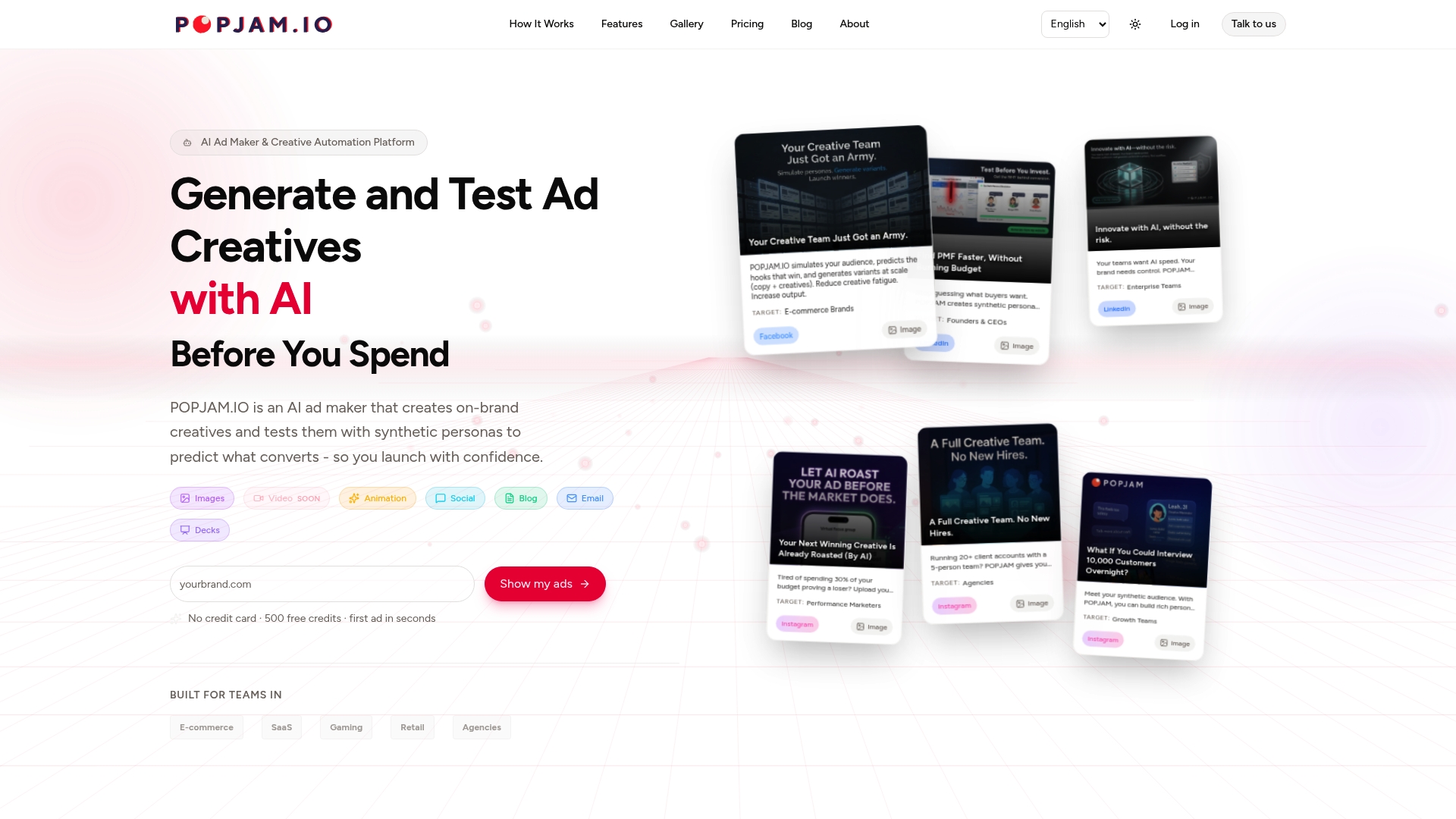
POPJAM is built for exactly this workflow. It generates on-brand ad creatives across Meta, Google, TikTok, LinkedIn, and Reddit, then tests them against synthetic buyer personas before a single dollar goes to live media. You get psychographic feedback on hook rate, message clarity, and audience resonance at the concept stage, so you only produce and test the variants most likely to win. Less production waste. Faster winner discovery. A learning repository that builds itself.
Performance marketers, growth teams, and agencies use POPJAM to pre-test ad creatives and cut the number of live tests needed to find a winner. The platform is GDPR-compliant and works across images, video, animation, social posts, and email. Try it yourself at POPJAM’s AI ad generator and see how simulation fits into your existing testing workflow.
Sources
Dig deeper into the methods and tools covered in this guide:
FAQ
What is a creative testing framework?
A creative testing framework is a repeatable system for designing, running, and interpreting ad creative experiments. It combines hypothesis writing, controlled test design, sample-size planning, and structured result interpretation to find winning creatives and build compounding learnings over time.
How do you run a creative test properly?
Write a causal hypothesis before production, set equal budgets per variant using ABO, pre-register your MDE and end date, and wait for at least 200 conversion events per variant before reading results. Avoid peeking early or changing bids mid-test.
What is the 3-2-2 method for Facebook ads?
The 3-2-2 method refers to testing three audiences, two ad formats, and two creatives within a single campaign structure to identify the highest-performing combination efficiently. It’s a practical shorthand for early-stage concept testing when budget is limited.
When should you use a lift test instead of an A/B test?
Use a lift or holdout test when you need to prove absolute business impact versus doing nothing, rather than just comparing two creatives against each other. A small holdback control group measures true incrementality and is the preferred method when stakeholders need causal evidence.
How does AI simulation fit into a creative testing framework?
AI simulation, like POPJAM’s synthetic persona testing, acts as a pre-launch filter. It ranks concepts by predicted hook rate and audience resonance before live spend, so you only produce and A/B test the variants most likely to win, reducing both production cost and time to a validated result.
Recommended
- Creative Automation: The Complete Guide for Performance Marketers (2026) | POPJAM.IO Blog
- Creative Automation Platform | AI Ad Generation & Testing | POPJAM.IO
- How to Test Ad Creatives Before Launch (2026 Guide) | POPJAM.IO Blog
- Pre-Launch Creative Testing: 2026 Playbook for Small Teams | POPJAM | POPJAM.IO Blog