

Validate Buyer Personas in Four Weeks With 6 Testable Examples
The best buyer persona examples are not mood boards. They’re research-backed profiles built from 8 to 12 real customer interviews per segment, packed with specific triggers and objections, and validated against actual campaign data before anyone writes a single ad. This article gives you six annotated examples across B2B and B2C, a template you can fill in this week, and a four-week sprint for proving your personas actually move the metrics that matter.
TL;DR:
- Effective buyer personas rely on 8 to 12 real customer interviews per segment to identify genuine triggers and objections, not just demographic guesswork.
- Validation through customer conversations, analytics, and ad testing is essential to ensure personas predict actual buying behavior.
- Keep personas current by reviewing them quarterly, especially after market shifts, and link them directly to messaging channels and sales assets.
- Limit active personas to two to four for operational focus and assign owners to update and validate them consistently.
- Industry-specific examples demonstrate that trigger events and objections vary widely, making tailored personas far more effective than generic templates.
Table of Contents
- Buyer Persona Examples for B2B and B2C Teams
- What Belongs in a Buyer Persona Template
- How to Research Buyer Personas With Real Customer Data
- How to Validate and Test a Buyer Persona
- Turning Personas Into Campaigns Sales Teams Will Actually Use
- Common Buyer Persona Mistakes and How to Fix Them
- Buyer Persona Examples Across Different Industries
- Keeping Buyer Personas Current as Your Market Shifts
- Tools for Building and Managing Buyer Personas
- One Habit That Makes Personas Stick
- Test These Personas Before You Spend a Dollar on Media
- Sources
- FAQ
Buyer Persona Examples for B2B and B2C Teams
Most persona templates you find online are demographic sketches with a stock photo attached. That’s not a persona, it’s a guess wearing a name tag. A useful persona ties a real trigger event to a real objection and gives you language you can put in an ad tomorrow. Below are six examples built the way Salesforce’s own persona library frames them, with role, goals, and preferred content baked in, then pushed a layer deeper with the psychographic detail that actually drives targeting and creative decisions.
B2B Example 1: The RevOps Leader Background: Manages a sales organization at a Series B SaaS company, reports to the CRO. Goal: cut the sales cycle significantly this fiscal year. Trigger: a board meeting where pipeline velocity got flagged as a risk. Objection: “We already have three tools that promised this.” Channel: LinkedIn, plus warm intros from peer Slack communities. Sample message: “See where your deals actually stall, not where your dashboard says they do.”
B2B Example 2: The Technical Evaluator Background: Senior engineer tasked with vetting vendors before procurement signs off. Goal: avoid being blamed for a bad integration six months from now. Trigger: assigned to a vendor shortlist by a director. Objection: “Your API docs looked thin.” Channel: developer forums, direct documentation links, not paid social. Sample message: “Full API reference and a sandbox environment, no sales call required.”
B2B Example 3: The Enterprise HR Economic Buyer Background: VP of People Operations at a 2,000-employee company, owns a large software budget. Goal: consolidate multiple HR point solutions. Trigger: a renewal deadline plus a new CFO asking hard questions. Objection: “Migration always takes longer than vendors promise.” Channel: industry conferences, analyst reports, referrals. Sample message: “A 90-day migration plan with a named project lead, not a PDF.”
These three map closely to the archetypes The Starr Conspiracy documents as producing measurable KPI shifts once teams stop guessing at the objection and start quoting it verbatim from interviews.
B2C Example 1: The Deal-Driven Parent Background: Household budget manager, price-checks everything on a phone before buying. Goal: outfit two kids for a new school year under a fixed budget. Trigger: a back-to-school reminder from the school district. Objection: “Is this actually cheaper than last year, or just repackaged?” Channel: Instagram Reels, retargeting after cart abandonment. Sample message: “Same backpack, $12 less than last month. Here’s the price history.”
B2C Example 2: The Status-Conscious Early Adopter Background: Follows three niche subreddits about the category before anyone else has heard of the brand. Goal: be the first among friends to own the new thing. Trigger: a limited drop announcement. Objection: “Is this actually limited, or is that just marketing?” Channel: Reddit, TikTok, email waitlists. Sample message: “500 units. We’ll show you the counter.”
B2C Example 3: The Skeptical Repeat Buyer Background: Bought once, had a mixed experience, needs reassurance before buying again. Goal: solve the same problem without repeating last time’s frustration. Trigger: the old product finally wore out. Objection: “Did you fix the thing that annoyed me?” Channel: email, direct retargeting with review snippets. Sample message: “We rebuilt the clasp. Here’s what 400 reviewers said this time.”
Pro Tip: Write the objection in the customer’s own words, not your marketing team’s paraphrase. “Too expensive” and “I got burned by a competitor’s version of this” call for completely different ad copy.
What Belongs in a Buyer Persona Template
A persona template only earns its place in your stack if every field changes what you write or where you spend. Vague fields like “interests: technology” don’t move a single decision. Specific fields do.
Here’s what a working template needs, and where to actually find each answer:
- Role and firmographics (title, company size, industry): pull from CRM segmentation and closed-won deal records.
- Goals and KPIs (what they’re measured on): surface in discovery calls and sales call recordings.
- Decision criteria (what makes them choose one vendor over another): ask directly in interviews, cross-check with win/loss reports.
- Trigger events (what makes them start looking today): mine support tickets, renewal dates, and CRM “reason for contact” fields.
- Top objections (in their own words): record interviews with permission and pull verbatim quotes rather than summarizing them.
- Preferred content and channels: check analytics for which content types get engagement from that segment.
- Sample quotes: direct lines from real interviews, never invented dialogue.
Two things determine whether this template becomes a working tool or a slide nobody opens again:
- Assign one owner per persona who updates it after every quarterly sales review.
- Cap your active persona count at 2 to 4. Factors makes the case plainly: more personas than that and teams lose the operational focus that made personas useful in the first place.
If you’re building your first template from scratch, POPJAM’s guide to writing personas worth testing walks through a format built specifically for creative testing rather than internal documentation.
How to Research Buyer Personas With Real Customer Data
Skip the whiteboard brainstorm. The teams whose personas actually predict buyer behavior start with three concrete steps, not a workshop.
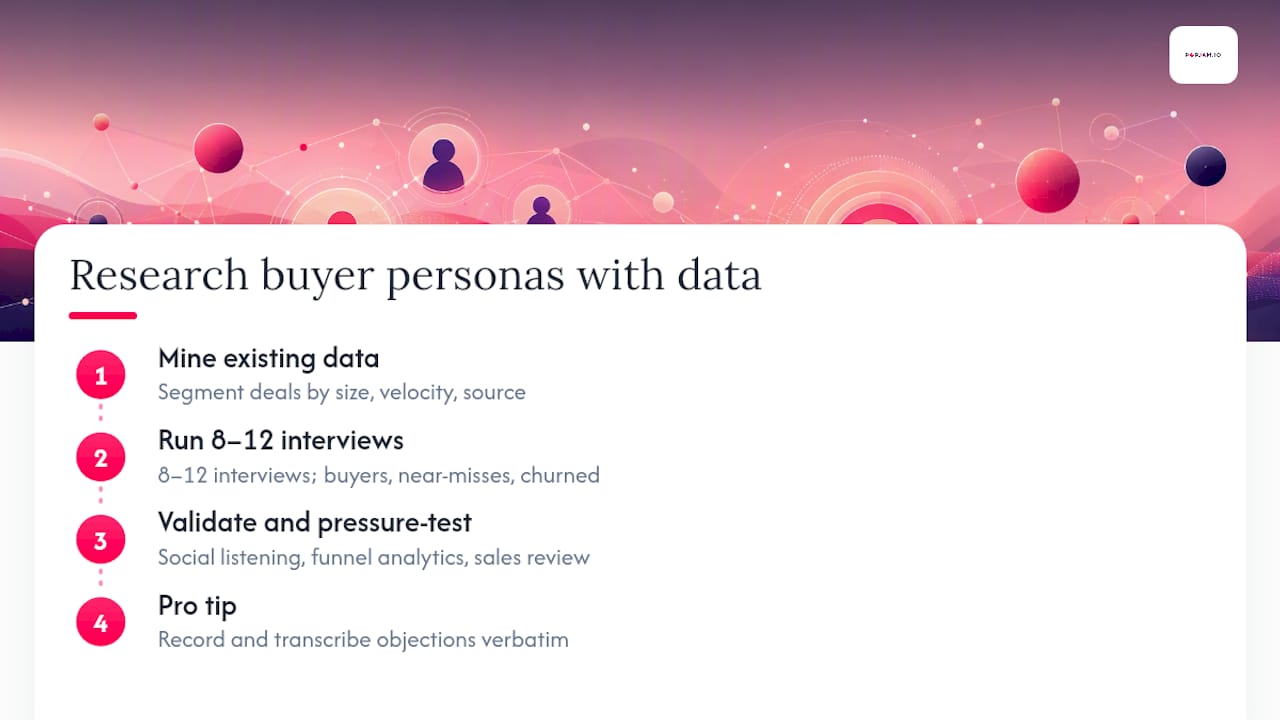
Step 1: Mine your CRM and analytics for existing signals. Before you talk to a single customer, look at what your data already tells you. Segment closed-won deals by company size, deal velocity, and source. Segment your web analytics by which pages high-intent visitors hit before converting. This gives you a hypothesis to test, not a blank page to fill with guesses.
Step 2: Run 8 to 12 interviews per segment. This range isn’t arbitrary. It’s the sample size most practitioner guidance points to for catching consistent patterns in triggers and objections without drowning in noise. Recruit a mix of recent buyers, near-misses who almost bought a competitor, and churned customers, not just your happiest accounts. Ask open questions about the moment they started looking, not just what feature closed the deal: “What was happening at your company the week you started evaluating vendors?” gets you a trigger event. “What almost stopped you from buying?” gets you the objection you’ll need to rebut in your ad copy.
Step 3: Validate with social listening and funnel analytics, then pressure-test with sales. Read the language customers use in reviews, support tickets, and relevant subreddits or LinkedIn threads. Then sit down with your sales team and read the draft persona out loud. If a sales rep says “that’s not how they actually talk,” you have more interviews to run.
Pro Tip: Record every interview with permission and transcribe the objections word for word. A prospect saying “we got burned by a vendor that overpromised integration timelines” is ten times more useful in an ad than your internal summary: “concerns about implementation.”
For a structured walkthrough of turning these interviews into a campaign-ready persona, POPJAM’s guide to building target personas for campaign success covers the handoff from research to creative brief.
How to Validate and Test a Buyer Persona
A persona draft is a hypothesis, not a fact. Validation is where you find out if your RevOps Leader profile actually predicts who clicks, converts, and closes, or if it’s a well-organized guess.
Three validation methods work together rather than standing in for each other:
- Confirmatory interviews: take the drafted persona back to two or three customers who fit the profile and ask if it sounds like them.
- Cohort checks in analytics: pull the segment your persona describes and see if their actual behavior (session length, pages visited, email open rates) matches what you predicted.
- Ad creative A/B tests against segmented audiences: running creative variations against distinct audience segments is the fastest way to see whether persona-driven messaging actually beats generic copy.
Track CTR lift, conversion rate lift, lead-to-opportunity rate, cost-per-acquisition change, and funnel velocity (how fast a lead moves from click to opportunity). A persona that doesn’t move at least one of these within a testing window needs revision, not a longer runway.
A 4-week sprint you can run starting Monday: Pairing creative variations with segmented audiences under a fixed decision window turns a persona draft into a validated (or retired) profile fast. Week one, finalize two persona drafts and build three ad variations per persona. Week two, launch against a minimum viable sample per segment and hold creative constant except for the persona-specific hook. Week three, monitor CTR and conversion daily but resist changing anything before day 10.
Turning Personas Into Campaigns Sales Teams Will Actually Use
A persona that lives only in a slide deck never earns its keep. The fields you researched need to map directly to a channel, a message, and a sales asset, or the whole exercise stalls at “interesting read.”
Start with channel mapping. A trigger event tied to a renewal date points you toward email and retargeting. A trigger tied to peer discovery points you toward LinkedIn or Reddit, depending on whether you’re selling to the RevOps Leader or the Status-Conscious Early Adopter. Preferred content format (documentation versus video versus case study) tells you what to build first, not what to build eventually.
For messaging, keep it to a repeatable structure your whole team can use:
- One-line value proposition written in the persona’s own vocabulary, not your internal jargon.
- Three supporting bullets, each tied to a goal or KPI from the template.
- One objection rebuttal, quoting the actual concern raised in your interviews.
Sales enablement needs its own set of assets built from the same research: a one-page persona summary reps can skim before a call, an objection cheat sheet pulled straight from interview transcripts, and an email cadence sequenced around the trigger events you identified. Marketing and sales working from the same source document, instead of two separate interpretations of “who we sell to,” is what actually closes the gap between campaign clicks and closed deals.
Common Buyer Persona Mistakes and How to Fix Them
Three mistakes account for most persona projects that quietly die in a shared drive.
- Building personas from internal guesswork instead of primary research. Fix: mandate a minimum of 8 interviews per segment before a persona gets approved for use in a campaign brief. A persona built in a conference room without a single customer conversation is fiction with a nice layout.
- Creating too many personas. Fix: prioritize 2 to 4 personas that map directly to revenue outcomes. A stack of 12 personas covering every possible buyer means nobody remembers which one matters for this quarter’s campaign.
- No validation and no owner. Fix: assign a named owner per persona and set a validation KPI, like a minimum CTR lift, before launch. Personas without an owner rot the same way outdated pricing pages do, quietly, until someone notices during a campaign postmortem.
Buyer Persona Examples Across Different Industries
A SaaS company’s economic buyer and a direct-to-consumer skincare brand’s ideal customer share almost nothing structurally, which is exactly why industry-specific examples matter more than generic templates.
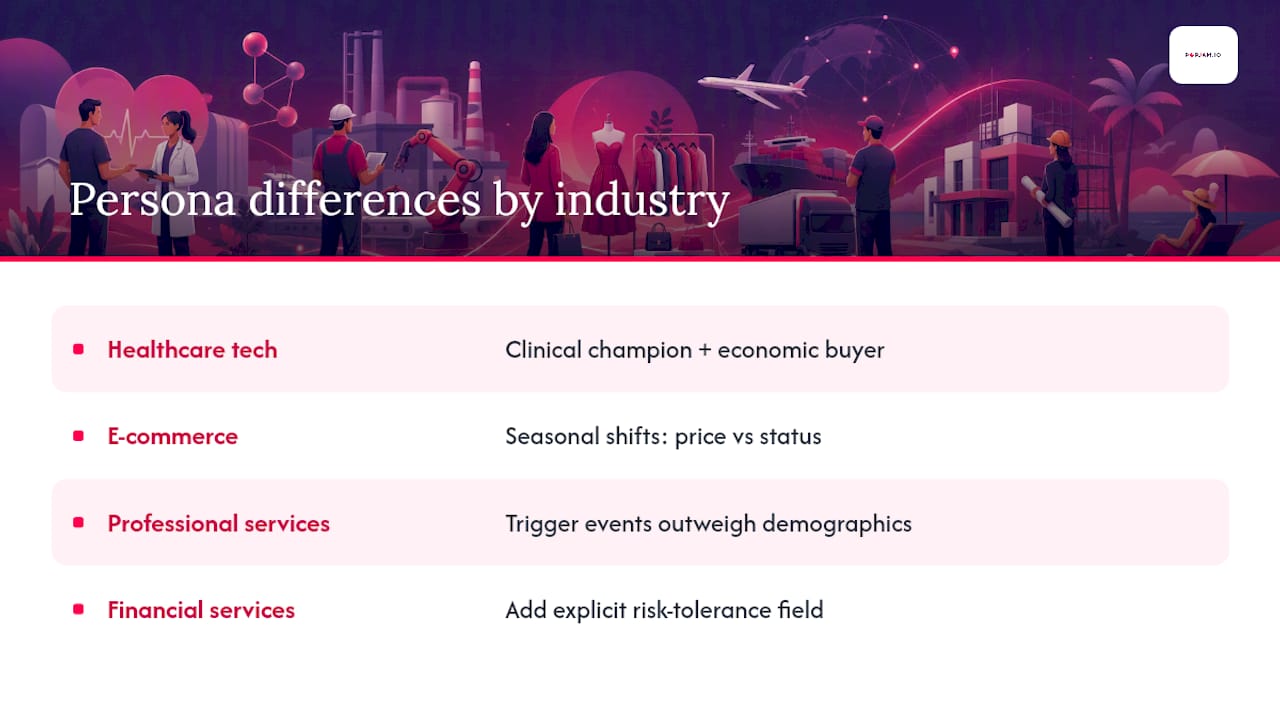
In healthcare technology, the persona often splits into a clinical champion (a nurse or physician who feels the daily pain point) and a separate economic buyer (a hospital administrator who signs the check but never touches the product). Treating those as one persona is a common and costly shortcut.
In e-commerce, seasonality reshapes the persona itself. The same shopper looks price-driven during a holiday sale and status-driven during a limited product drop, so a single static persona misses half the buying behavior.
In professional services, the trigger event usually outweighs demographics entirely. A mid-sized law firm looking for practice management software after a partner retires behaves nothing like the same firm shopping calmly during a normal renewal cycle, even though the firmographic profile is identical.
Financial services personas need an added layer most other industries skip: risk tolerance as an explicit field, not an assumption, since it changes both messaging tone and the compliance language your ads legally need to include.
The pattern across every industry is the same. Generic templates fail exactly where trigger events and objections differ most, and that’s precisely where a tailored example earns its value.
Keeping Buyer Personas Current as Your Market Shifts
A persona built in 2024 describing 2026 buying behavior is a liability dressed up as documentation. Markets move, and personas that don’t move with them start actively misdirecting campaigns instead of guiding them.
Set a quarterly review cadence tied to actual events, not a calendar reminder that gets ignored. A pricing change, a new competitor entering the market, or a shift in your average deal size are all triggers to revisit persona assumptions immediately, not at the next scheduled review.
Watch three signals that a persona has drifted out of date: win rate against that segment dropping without an obvious cause, sales reps reporting objections that don’t appear anywhere in the current persona doc, and ad creative built for that persona underperforming creative built for no persona at all. Any one of those is a signal to run fresh interviews, not to tweak the existing copy.
Treat every closed-lost deal as a small research opportunity. A five-minute debrief with the rep on why that specific deal died adds real signal to a persona at almost no cost, and compounds over a quarter into a genuinely current picture of your buyer.
Tools for Building and Managing Buyer Personas
The right tool for persona work depends on which stage you’re stuck on: research, documentation, or testing.
For research, your CRM and analytics platform are your first tools, not an afterthought. The signals sitting in your existing pipeline data (deal velocity by segment, churn reasons, support ticket themes) should shape your interview questions before you schedule a single call.
For documentation, a shared template beats a static slide every time, because personas that live in a document nobody can edit collaboratively stop getting updated within a quarter.
For testing, the gap most teams hit is speed: writing a persona is one afternoon, but validating it against real ad performance traditionally takes a full campaign cycle and real budget at risk. Tools built specifically for pairing persona drafts with creative variations before spend, like the free AI persona generator, compress that validation window considerably. For readers who want a broader look at how these platforms compare, POPJAM’s roundup of AI ad creative tools breaks down generation and testing capabilities across the category.
One Habit That Makes Personas Stick
The single habit that separates personas people actually use from personas that get built once and forgotten is a quarterly review tied to real campaign results, not a calendar reminder to “revisit branding.” Pull the CTR and conversion data for every campaign that used a given persona, and ask sales which quotes still sound right in a live deal conversation.
Verbatim customer language deserves more weight than most teams give it. A persona document full of paraphrased objections reads like marketing wrote it, because marketing did. A persona document full of actual customer sentences reads like the customer wrote it, and that’s the version sales reps actually pick up before a call.
— Doruk
Test These Personas Before You Spend a Dollar on Media
Writing a sharp persona is half the job. Proving it moves a real metric before you commit budget is the other half, and that’s usually where teams either run a slow live test or skip validation entirely. Some platforms close that gap by letting you generate on-brand ad creative for each persona and run it against synthetic audiences built from relevant psychographic signals, so you can see which message actually lands before spending on Meta, Google, TikTok, LinkedIn, or Reddit.
Instead of the four-week live sprint described earlier, you can compress creative testing into days: build a persona, generate creative variations, and watch simulated audience reactions flag which objection your copy failed to address. That’s the same validation logic, just without waiting on live spend to tell you what a synthetic test could have caught first. Try the AI ad generator with your next persona draft and see which version of your message actually holds up before it goes live.
Sources
For methodology on interview sample sizes and persona triggers, see the Rework buyer persona guidance and Ahrefs’ persona creation walkthrough. For B2B use cases tied to measurable KPI impact, The Starr Conspiracy’s persona examples are worth a close read, alongside Babylovegrowth’s guide to persona construction.
- How to Build Buyer Personas That Actually Help You Sell (Search Engine Journal)
- Buyer persona interview guidance (Rework resources)
- B2B buyer persona use cases with KPI impact (The Starr Conspiracy)
- How to create a buyer persona (Ahrefs)
FAQ
Can you give me some examples of personas?
Common examples include a RevOps leader evaluating sales tools, a technical evaluator vetting vendor documentation, and a deal-driven parent price-checking purchases on a phone. Each becomes useful only once it includes a specific trigger event and objection, not just a job title and hobbies.
What are the four types of buyer personas?
Definitions vary across sources, but a widely used version splits buyers into the economic buyer (controls budget), the user buyer (uses the product daily), the technical buyer (evaluates specs and integration), and the champion (advocates internally for the purchase).
What is a buyer persona?
A buyer persona is a research-backed profile of a real customer segment, built from interviews and data rather than assumptions, that captures their goals, triggers, objections, and preferred channels to guide targeting and messaging.
What are the five types of buyers?
Buyer classifications differ by source and industry, so there’s no single universal list of five. Most B2B frameworks instead group buyers by role in the decision (economic, technical, user, champion, and blocker) rather than by a fixed personality typology.