

The Best UGC Ad Examples to Copy for Your Next Campaign
The strongest UGC ads fall into four formats: unboxing, testimonial or talking-head, before/after, and day-in-life lifestyle content. Coca-Cola’s Share a Coke campaign turned personalized bottles into millions of organic posts. Apple’s #ShotoniPhone made customers the brand’s photography department. Doritos built its Legion of the Bold program by handing creative control to fans. Each format fits a different funnel stage.
- Unboxing: best for cold audiences discovering your product for the first time.
- Testimonial: best for warm audiences weighing a purchase decision.
- Before/after: best for skincare, fitness, or home categories where transformation sells.
- Day-in-life: best for building trust through ambient, lifestyle context.
UGC-based creative commonly beats branded ads on click-through rate and cost-per-click, which is exactly why brand teams keep chasing that “shot on a phone, not a soundstage” look.
Key Takeaways
UGC ads outperform standard branded creative when the format matches the funnel stage and the brief specifies a clear hook, proof point, and call to action.
| Point | Details |
|---|---|
| Match format to funnel stage | Use unboxing for cold audiences and testimonials for warm, purchase-ready audiences. |
| Brief for structure, not luck | Ask every creator for a hook, proof point, and CTA regardless of format. |
| Get permission in writing | Paid use requires an explicit license covering duration, platforms, and edit rights. |
| Test before you scale | Run three hooks across two audiences for three to five days before picking a winner. |
| Adapt, don’t reuse blindly | Recut the same asset per platform: native sound on TikTok, tighter pacing on Reels. |
Table of Contents
- UGC Ad Formats That Convert (With a Recipe for Each)
- Adapting One UGC Asset Across TikTok, Reels, YouTube, and Meta
- Finding Creators and Writing a Brief They Can Actually Use
- Permissions, FTC Rules, and Scaling Without Losing the Vibe
- Turning UGC Examples Into Measurable Ad Wins
- How POPJAM Helps You Test UGC-Style Concepts Before You Spend
- Why Example-First Beats Trend-Chasing in UGC Advertising
- Sources
- FAQ
UGC Ad Formats That Convert (With a Recipe for Each)
You don’t need to guess what makes these ads work. Each format has a repeatable structure, and once you know it, briefing creators gets a lot easier.
- Testimonial / talking-head. Hook in the first two seconds with a specific complaint (“I tried five serums before this one worked”), then walk through the experience, the result, and a direct call to action. Starbucks leaned into this dynamic with its White Cup Contest, turning customer creativity into a talking-point campaign built entirely on user submissions. Ask creators for three beats: problem, proof, push.
- Unboxing. Curiosity carries this format. The camera should open on the package itself, cut to the reveal, then linger on a genuine reaction shot. This format performs especially well with cold audiences who have never heard of your brand. GoPro built an entire content engine around this instinct, letting customers unbox and film their own adventures instead of producing polished commercials.
- Before/after. Nothing sells transformation like a legible side-by-side. Keep lighting and angle consistent across both shots so the change reads clearly. One caution here: the FTC requires that transformation claims reflect typical results, not best-case outcomes, so document what the creator actually experienced.
- Day-in-life / lifestyle. The product should feel woven into a normal routine, not staged as a prop. ASOS built #AsSeenOnMe around exactly this idea, inviting shoppers to style outfits in their own lives rather than a studio. Brief creators for authenticity, not polish: ask for their actual morning, their actual kitchen, their actual dog barking in the background.
- Founder POV and hashtag-driven community campaigns. These work when you want to build a movement, not just sell a unit. Aerie’s #AerieREAL campaign turned unretouched customer photos into a brand identity built on body positivity, and it still shapes how the brand briefs creators today.
Pro Tip: Ask every creator for the same three beats, problem, proof, call to action, regardless of format. Consistency in structure is what lets you A/B test hooks later without reshooting everything.
Adapting One UGC Asset Across TikTok, Reels, YouTube, and Meta
The same raw clip rarely performs the same way twice across platforms. Small edits matter more than most teams expect, and mastering digital targeting tips for marketers is key to pairing UGC ad testing with effective audience and funnel targeting.
- TikTok rewards native sound, a hook inside the first three seconds, a vertical crop, and burned-in captions. Audiences here actively prefer content that doesn’t feel overly polished, so resist the urge to over-edit.
- Instagram Reels wants a slightly tighter cut, a branded thumbnail frame, and pacing that assumes a more design-conscious scroller.
- YouTube Shorts allows a slightly longer runway before the hook lands, since its discovery algorithm rewards watch time more than instant retention.
- Meta (Feed and Stories) is less about the edit and more about continuity. Match the ad’s visual tone to the landing page, and choose Feed for consideration-stage targeting or Stories for retargeting warm traffic.
For teams running TikTok specifically, POPJAM’s AI TikTok ad generator can help test hook variations before committing media spend to a single cut.
Finding Creators and Writing a Brief They Can Actually Use
You have three real paths to sourcing creators: searching relevant hashtags directly, using platform-native creator search tools, or working through a marketplace built for this exact purpose. Marketplaces such as Insense, JoinBrands, and Backstage handle deliverable-based pricing and rights management, which saves you from negotiating usage terms creator by creator.
Whatever the source, request the same package every time:
- Vertical and horizontal cuts of the final asset.
- Raw, unedited files, in case you need to re-cut later.
- Written captions matched to the video’s message.
- Explicit written permission for paid use, not just organic posting.
A brief can be short and still be complete. State the target audience in one line, the hook you want tested, the single proof point the product needs to demonstrate, and the exact shot list. Briefing creators with audience, hook, proof point, and deliverables consistently produces better footage than an open-ended “just film yourself using it” request.
Pro Tip: Budget for revisions. A first cut rarely nails the hook on the first try, and a small reshoot fee is cheaper than a whole new creator search.
Permissions, FTC Rules, and Scaling Without Losing the Vibe
Paid use of creator content requires a signed, explicit license. Verbal agreement to “post it” on their own feed does not extend to your ad account, and platforms and legal guidance are consistent on this point.
A usable license should cover:
- Duration and platforms where the ad can run.
- Whether the brand can edit, subtitle, or re-cut the footage.
- Documentation supporting any before/after or results claim, per FTC guidance.
- Simple metadata tagging in your asset library so legal status travels with the file, not just in someone’s inbox.
As volume grows, a lightweight contract checklist and a tagging system in your digital asset manager prevent the single biggest scaling failure: losing track of which clips you’re actually allowed to run.
Turning UGC Examples Into Measurable Ad Wins
Great creative means nothing if you can’t tell which version is actually working. Four numbers matter most: first-three-second hook rate, watch or hold rate, click-through rate paired with cost-per-click, and downstream conversion rate.
- Build a simple matrix: three hooks tested across two audience segments.
- Let each combination run for three to five days before judging it.
- Pick the winner by hold rate and CTR together, not either alone. A high CTR with a weak hold rate usually means the ad promises something the content doesn’t deliver.
- Scale only once you see consistent outperformance on CPC or CPA alongside stable conversion on the landing page.
Most underperformance traces back to one of three problems: the creative promises something the landing page doesn’t match, the edit is too polished for the platform it’s running on, or the call to action is vague. Practitioners who run high creative volume often test five to ten new concepts per week specifically to find hooks worth scaling before the account plateaus.
Pro Tip: If hold rate drops sharply in the first three seconds, the fix is almost never the whole video, it’s the first line of the hook.
How POPJAM Helps You Test UGC-Style Concepts Before You Spend
Producing and testing UGC at the pace performance requires is expensive when every variant needs a new creator, a new shoot, and a new ad account test. POPJAM shortens that loop.
- Generate on-brand ad variants that mirror the UGC formats above, testimonial, unboxing, before/after, without waiting on a creator’s shoot schedule.
- Run those concepts against synthetic personas built from real psychographic profiles, so you get directional feedback before spend hits the account.
- Review creative analytics that flag which hook, proof point, or CTA is likely to underperform, before you scale it.
The workflow mirrors what this article just walked through: brief, generate variants, test hooks, scale the winner. It just compresses the timeline. Explore the AI ad generator to see how the testing loop works, or check the e-commerce ad generator if your catalog is the main driver of creative volume.
Why Example-First Beats Trend-Chasing in UGC Advertising
Most UGC advice tells you to “be authentic” and leaves it there. That’s not wrong, but it’s incomplete, and it’s why so many brands end up with a folder of raw creator footage and no idea which clip to run first.

The examples that actually built categories, Share a Coke, #ShotoniPhone, GoPro’s entire content model, weren’t lucky accidents. They worked because someone identified the exact beat structure that made the content shareable, then repeated it deliberately. That’s the part conventional advice skips.
If you take one thing from this piece, prioritize the brief over the aesthetic. A creator who nails your hook, proof point, and CTA in an imperfect video will outperform a beautifully shot clip with no structure, almost every time. Chase the format logic first. The vibe follows naturally once the structure is right, not the other way around.
Sources
For readers who want to verify the format taxonomy and platform stats cited above, these three sources go deeper.
- UGC Ads: The Complete 2026 Guide for DTC Brands and Agencies
- What are UGC Ads? | Feefo
- User Generated Content Ads: A DTC Playbook for Paid Social | Landra
FAQ
What Are UGC Ad Examples?
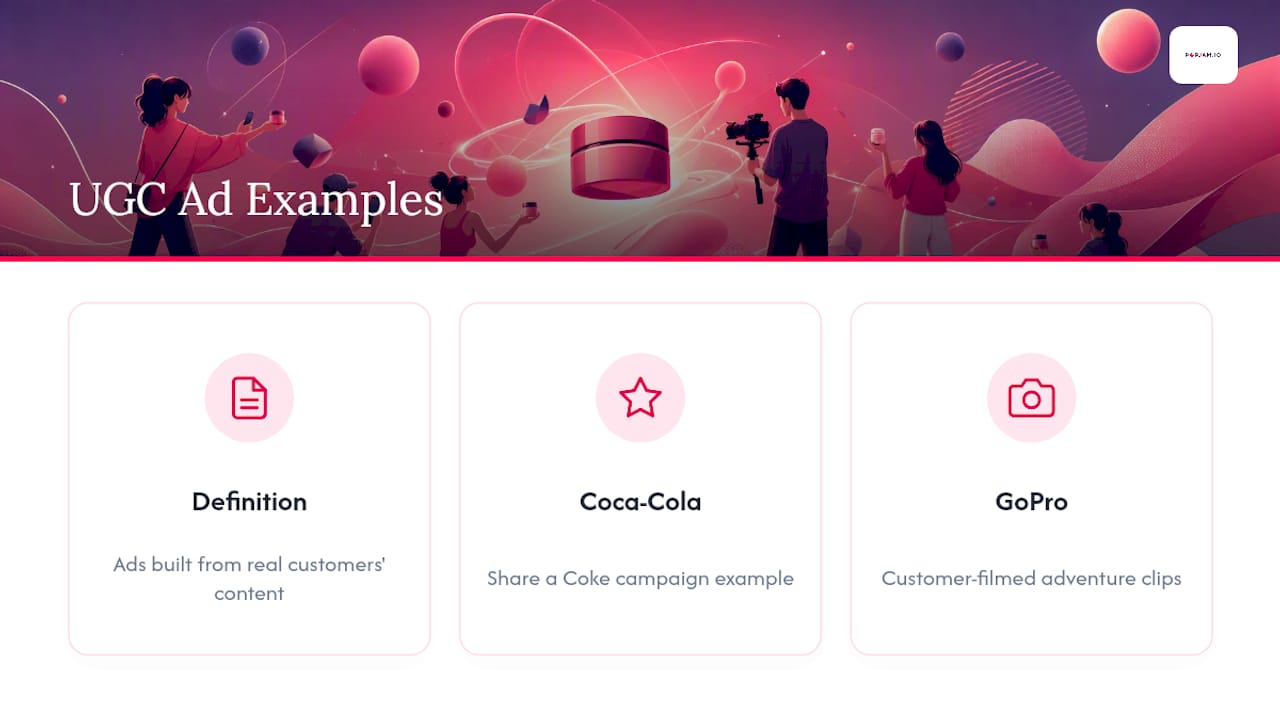
UGC ad examples are paid advertisements built from content originally created by real customers or creators rather than a brand’s in-house production team. Coca-Cola’s Share a Coke and GoPro’s customer-filmed adventure clips are widely cited examples.
What Is UGC, With an Example?
UGC stands for user-generated content, meaning any photo, video, or review created by a customer rather than the brand itself. Apple’s #ShotoniPhone campaign, built entirely from customer photography, is a clear example.
What Is an Example of UGC at Starbucks?
Starbucks ran its White Cup Contest, inviting customers to decorate a plain Starbucks cup and submit photos of their design. The best entries were used in Starbucks marketing, turning customer creativity into branded content.
How Do I Make a Good UGC Ad?
Brief the creator with a specific hook, a clear proof point, and one desired call to action, rather than asking for open-ended footage. Request both vertical and raw file formats, and secure written permission for paid use before the ad runs.