

Audit First: Marketers Recover 15–40% of Wasted Ad Spend in 30 Days
Run three checks this week: pull your Search Terms report and kill zero-conversion queries, verify your conversion tracking isn’t double-counting, and pretest any creative before it touches a live budget. Together, these moves recover 15% to 40% of monthly spend inside 30 days for most accounts. The rest of this guide walks through exactly how to find that waste and where to redirect it once you do.
TL;DR:
- Running a Search Terms report to eliminate zero-conversion queries above your target CPA can recover up to 40% of monthly ad spend.
- Verifying conversion tracking ensures no duplicate tags or miscounted conversions, preventing blind spots in performance data.
- Pausing or restricting high-spend, zero-conversion keywords and customizing ad schedules and device bids can quickly reduce waste within hours.
- Creative testing with synthetic personas helps identify resonant concepts before live spend, cutting wasted budgets on ineffective ads.
- Reallocating recovered funds to efficient campaigns requires gradual scaling and ongoing performance monitoring to maintain ROI.
Table of Contents
- How Do You Reduce Wasted Ad Spend Fast?
- High-Leverage Fixes You Can Apply This Week
- Why Does Tracking Hide Wasted Spend?
- Does Creative Fatigue Cause Wasted Ad Spend?
- When Should You Trust Automated Bidding?
- How Do You Reallocate Recovered Budget?
- What Most Audits Get Backwards
- Test Creatives Before They Touch Your Budget
- Sources
- FAQ
How Do You Reduce Wasted Ad Spend Fast?
Most accounts bleed budget in the same handful of places, and finding them doesn’t require a forensic accountant. A typical unaudited Google Ads account wastes 20% to 30% of its budget on clicks that never had a shot at converting. Run this sequence in order. Each step builds on the last, so don’t skip ahead to the fun fixes before you’ve confirmed the diagnosis.
- Pull the Search Terms report for the last 30 to 90 days, sort by cost descending, and flag any query with zero conversions above your cost threshold (start at 2x your target CPA).
- Verify your conversion tracking. Check for duplicate tags, confirm whether you’re counting “every” conversion or “one” per session, and test that tags still fire after your last site deployment.
- Triage at the campaign level. Identify zero-conversion campaigns, look for impression share losses due to budget or rank, and check whether search campaigns are quietly showing on the Display Network.
- Segment by geography, device, and time of day. Systematic leaks hide in these dimensions. If you’re bleeding clicks from regions you can’t service, switch your location setting from “people in” to “presence,” which stops ads from firing to searchers merely interested in that area.
A short diagnostic sequence like this, moving from search terms to campaign structure to Performance Max spillover, tends to surface the majority of leaks before lunch.
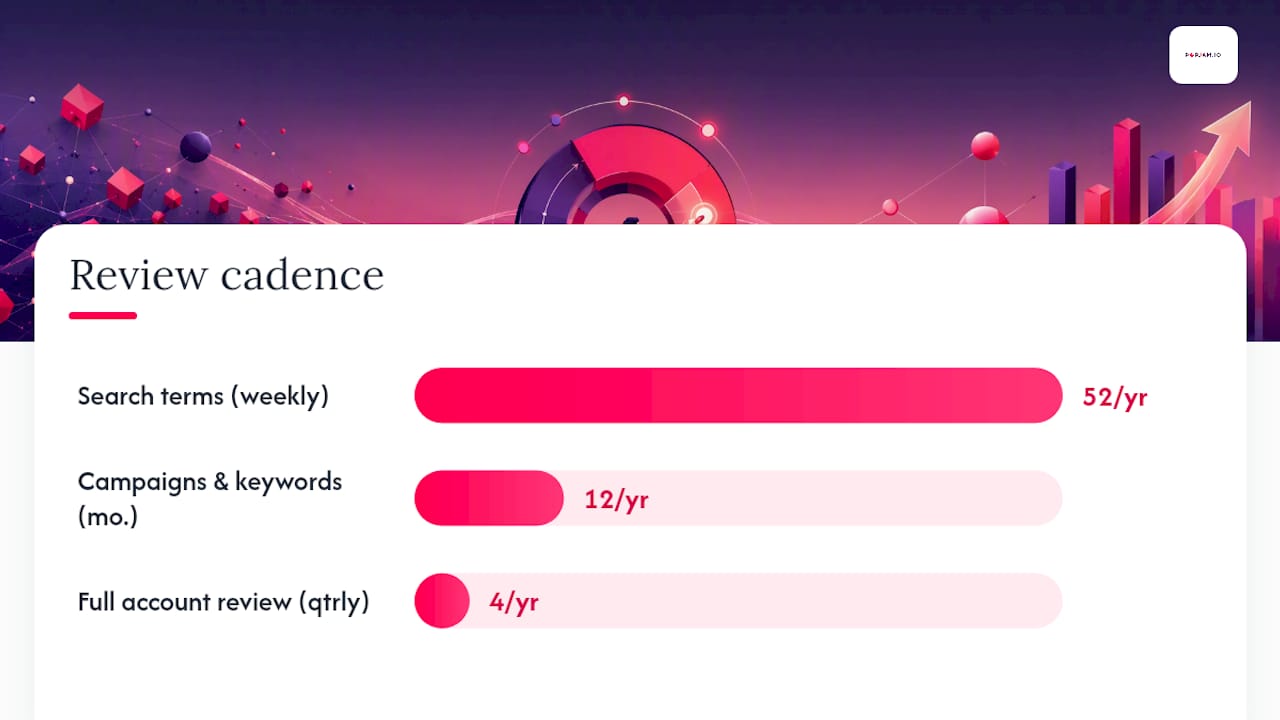
Once the one-time audit is done, keep a cadence: review search terms weekly, audit campaigns and keywords monthly, and run a full account review quarterly.
Pro Tip: Set your Search Terms report to auto-export every Monday morning. A five-minute Friday review habit dies within a month; a report sitting in your inbox does not.
High-Leverage Fixes You Can Apply This Week
You don’t need a platform migration to stop the bleeding. These are the fixes that move the needle inside a single afternoon.
- Pause or heavily restrict any keyword that has spent 3x your target CPA with zero conversions, and promote your best-converting search queries to exact match so you control exactly when they trigger.
- Build themed shared negative keyword lists (“jobs,” “free,” “how to,” “competitor names”) and apply them account-wide in one pass. Practitioner audits show a single themed list can block dozens of irrelevant queries at once.
- Adjust ad scheduling and device bid adjustments to reduce spend during hours or on devices that historically convert at a fraction of your average.
- Tighten geographic targeting and explicitly exclude regions you can’t ship to or service, rather than relying on default broad settings.
- Isolate broad match experimentation into its own low-budget campaign with aggressive negatives, so discovery doesn’t quietly drain your core budget.
None of these require new tools or a bigger team. They require someone willing to open the account and actually look.
Why Does Tracking Hide Wasted Spend?
You can’t fix what your dashboard doesn’t show you, and broken tracking is the single most common reason marketers misjudge where their budget is going. Fix the measurement layer before you touch a single bid.
Run this checklist before trusting any ROAS number:
- Confirm your conversion definitions match across Google Ads, GA4, and your CRM. A “lead” in one system should mean the same thing in all three.
- Check for duplicate conversion tags firing on the same thank-you page.
- Verify tag firing after every site deployment. Developers break tracking constantly and rarely tell marketing.
- Reconcile counting methods (“every” versus “one” conversion) between platforms before comparing their numbers side by side.
Fixing tags is only half the job. In-platform ROAS and CPA are siloed by design, and up to 30% of paid media spend can be underperforming in ways that platform-level metrics simply don’t reveal. That’s why blended metrics matter: Marketing Efficiency Ratio (MER), new customer CAC (nCAC), and the ratio of customer lifetime value to acquisition cost (CLV:CAC) give you a cross-channel reality check that no single dashboard provides on its own.
Set automated alerts for sudden ROAS drops or conversion volume swings, and don’t hand the keys to Smart Bidding until your tracking has run clean for at least two to three weeks. Automation trained on dirty data just learns to repeat your mistakes faster.
Does Creative Fatigue Cause Wasted Ad Spend?
Yes, and it’s one of the most underestimated sources of waste in the entire funnel. Creative that fails to resonate with your audience doesn’t just underperform quietly. It drives fast exits, drags down click-through and conversion rates, and burns through impression volume that a stronger asset would have converted. Irrelevant creative reliably causes exits that look identical to wasted spend on a report, even though the targeting was fine all along.
The fix isn’t guesswork after launch. It’s testing before launch.
- Run structured A/B tests on headlines, thumbnails, and hooks before scaling budget behind any single creative.
- Use synthetic-persona simulation to see how different audience segments react to a concept before it ever reaches a live auction.
- Iterate fast. A creative that flops in simulation costs you nothing; a creative that flops after two weeks of live spend costs you real budget.
- Maintain a refresh cadence of every 4 to 6 weeks for evergreen campaigns, and supply automated bidding systems with enough asset variety to actually learn.
Preflight testing does double duty: it keeps low-resonance ads out of your budget, and it gives Google’s and Meta’s learning algorithms cleaner signal from day one, which shortens the “expensive guessing” phase every new campaign goes through. If you’re building a testing workflow, our ad spend optimization guide covers the mechanics in more depth.
Pro Tip: Test your worst-performing headline from last quarter against a brand-new one before you write ten new concepts from scratch. You’ll learn more from that single comparison than from a week of fresh brainstorming.

When Should You Trust Automated Bidding?
Automated bidding earns its keep once your account has clean conversion data and enough volume to learn from. Turn it on too early and it optimizes toward noise.
- Use Target CPA once you have at least 15 to 30 conversions in the last 30 days; Target ROAS and Maximum Conversion Value need reliable conversion value data on top of that.
- Set budget caps and CPA or ROAS floors as guardrails, not suggestions. Automation can quietly over-prioritize low-margin conversions or underbid new products with no history.
- Watch for Performance Max cannibalizing branded search. If PMax is spilling over into brand terms you already rank for, add brand exclusions and isolate branded spend in its own campaign.
- Test changes through controlled experiments rather than flipping strategies across the whole account at once.
How Do You Reallocate Recovered Budget?
Once you’ve trimmed the waste, move fast but move carefully. Recovered budget only helps if it lands where it can actually convert.
- Protect campaigns already converting efficiently in lower-funnel positions before you touch anything else.
- Calculate headroom by checking impression share on your top performers; a campaign losing 20% of impression share to budget has real room to scale.
- Fund the winners first, phasing budget increases over two to four weeks rather than doubling spend overnight.
- Watch marginal CPA, conversion rate, impression share, and ad frequency weekly as spend scales, since efficiency often erodes before volume plateaus.
- Keep automated alerts running so a scaled campaign that starts drifting gets caught in days, not at month’s end.
What Most Audits Get Backwards
Most teams treat wasted spend as a targeting problem, and it partly is. But the bigger blind spot is sequencing. Marketers fix bids before fixing tracking, or they scale a campaign before confirming the “winner” wasn’t just an artifact of duplicate conversion tags. Order matters more than most audit checklists admit.
The other gap is creative. Search marketers obsess over match types and negatives, which is correct, but many treat the ad itself as fixed once it’s live. It shouldn’t be. A campaign with flawless targeting and a flat, irrelevant headline still wastes money, just more slowly. Combining the measurement fixes here with creative preflight testing is what actually locks in the gains instead of losing them back to the next fatigued asset.
— Doruk
Test Creatives Before They Touch Your Budget
Fixing tracking and pruning search terms recovers the waste that’s already happened. Stopping the next wave means knowing which creative will resonate before it ever enters an auction. This gap is closed by generating on-brand ad creatives and running them against synthetic buyer personas that simulate real audience reactions, so you see what falls flat before you pay to find out.
Start with the cheap questions that cost the most when you guess wrong: which audience segment reacts best to this angle, which thumbnail actually stops the scroll, and which headline gets ignored. Test those three first, and you’ll cut the guesswork out of your next launch instead of your last one. Try the AI ad generator free and see how your next creative performs before a single dollar of media spend touches it.
Sources
- How to Find and Eliminate Wasted Spend in Google Ads (2026 Guide)
- Paid media efficiency: How to cut waste and improve ROAS
- PPC marketing spend optimization
- Minimizing wasted ad spend: making every dollar count
FAQ
What Is the 3-3-3 Rule in Marketing?
It’s a shorthand some marketers use for testing structure: three audiences, three creative concepts, and three messaging angles tested simultaneously before scaling budget behind a winner. Definitions vary across agencies, so treat it as a testing framework rather than a fixed formula.
What Does the 70:20:10 Rule Mean in Advertising?
It’s a budget allocation model where 70% of spend goes to proven, reliable channels and formats, 20% goes to promising but less-proven tactics, and 10% funds experimental ideas. It’s a planning heuristic, not a rule enforced by any platform.
What Is the 60/40 Rule in Advertising?
It traces back to brand-building research suggesting a roughly 60% brand-building to 40% direct-response split protects long-term growth while still driving short-term conversions. Most performance marketers adapt the ratio to their own funnel data rather than following it literally.
Is $20 a Day Good for Google Ads?
It depends entirely on your cost per click and conversion rate. In a market with an average CPC, a low daily budget buys a limited number of clicks, which can result in thin data for Smart Bidding to learn from. Expect a longer, noisier learning phase at lower budget levels.
Does Pretesting Creative Actually Reduce Wasted Ad Spend?
Yes. Simulating audience reactions before launch, the approach POPJAM uses with synthetic personas, catches low-resonance concepts before they burn live budget on clicks that were never going to convert.