

Top 5 Best Ad Making Apps Alternatives 2026

Building ads that perform well across multiple platforms without burning time or budget is harder than it should be. Most ad making apps split creative generation and testing into separate workflows, forcing manual copy-paste and live spend for validation. This comparison lays out export options, validation features, and workflow integration for five ad creative platforms so performance marketers can pick one without costly trial runs.
Table of Contents
POPJAM
At a Glance
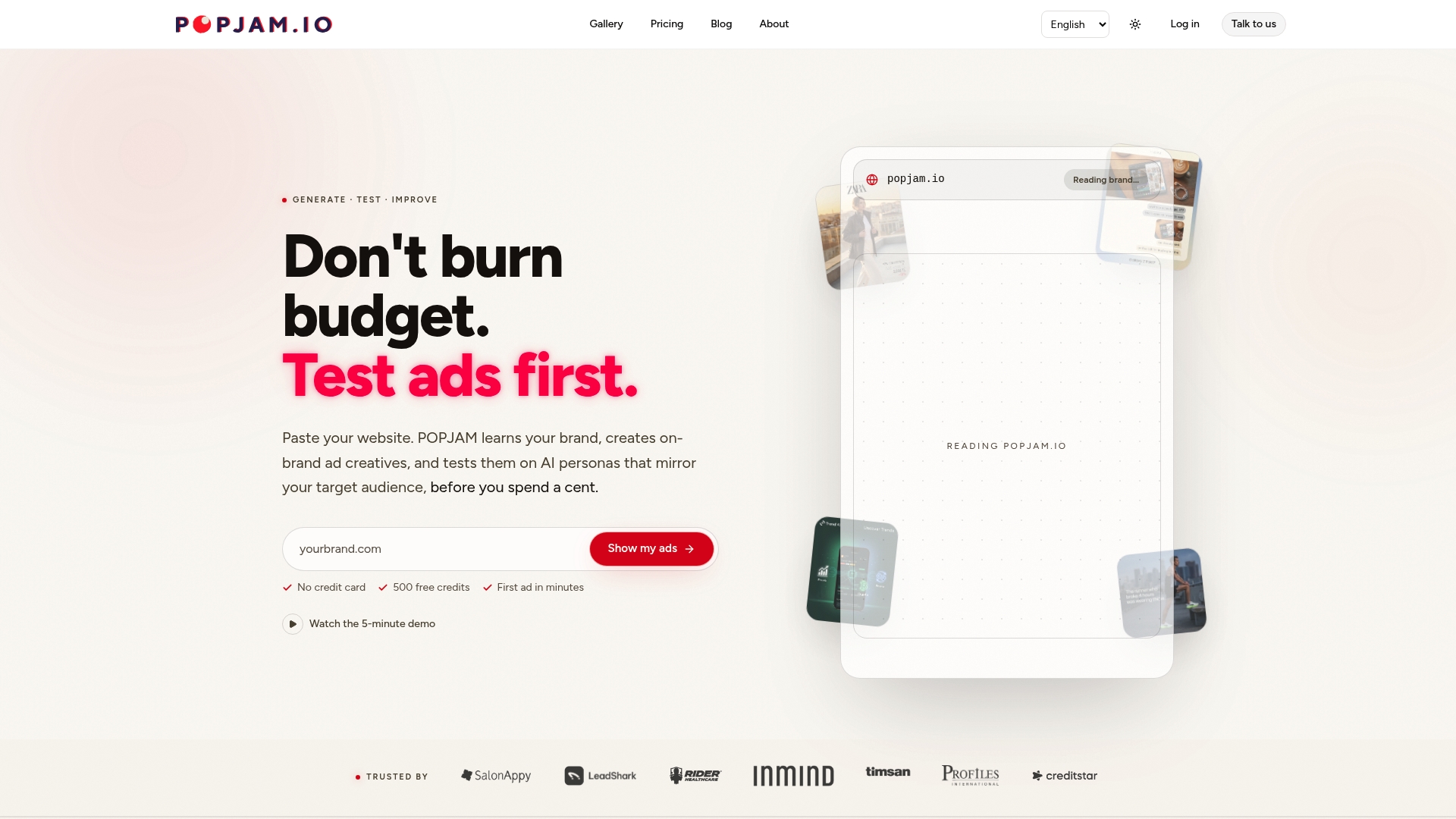
POPJAM reports a free tier that includes 500 credits for experimentation. The vendor states it is GDPR-compliant. The product generates platform native ad variants and validates them against simulated buyer personas before you run paid campaigns.
Core Features
POPJAM uses AI driven generation to produce ad variants for major platforms and for multiple formats, then runs tests inside the same workflow. It validates concepts against synthetic personas and captures open ended feedback and survey responses to estimate audience reaction. The tool also supports native ad format export for Meta, Google, TikTok, LinkedIn, and Reddit so creatives require little manual rework.
Key Differentiator
POPJAM centers creative generation and audience simulation in one GDPR compliant workflow rather than splitting ideation and testing across separate tools. That combined setup shortens the iterate test loop and keeps experiments off live ad spend. The compliance claim above reduces the need to supply real customer data to run validation.
Pros
Combines creative generation and validation in a single workflow so teams can move from concept to tested creative without switching tools. Because it uses synthetic personas, you do not need to upload customer lists to get audience level feedback. Multi platform exports and the credit based free tier let small teams test formats for Meta, Google, TikTok, LinkedIn, and Reddit before committing budget. Detailed simulated reactions and open ended feedback help you pick variants that match psychographic cues rather than guessing.
Cons
- Relies on AI generated personas, which may not capture complex real world audience nuances.
Who It’s For
This fits performance marketers, agencies, and e commerce brands that run paid social or search and want to validate creatives before buying test traffic. It also suits SaaS growth teams that need platform native assets without hiring extra motion or design resources. Use it when you want quick creative iterations and pre launch confidence.
Unique Value Proposition
Pre launch validation inside the creative workflow lets teams avoid paying for low performing test traffic. Running validation against synthetic buyer personas produces comparative feedback so you can prioritize variants to scale. That workflow change shifts time from manual split testing to selecting higher probability winners before launch.
Real World Use Case
A digital marketing team builds ten headline and image combinations for a new product. They run those variants through POPJAM and collect simulated responses and survey comments. The team exports the top two creatives in native formats and launches them with higher confidence while cutting the number of poor performing ads.
Pricing
POPJAM offers a free tier with the credit allotment noted above and paid plans for scale. Pricing tiers list €99 per month for Essential and €399 per month for Business, with custom pricing available for Enterprise customers. The free credits let you validate formats and proofs of concept before upgrading.
Website: https://popjam.io
Playad
At a Glance
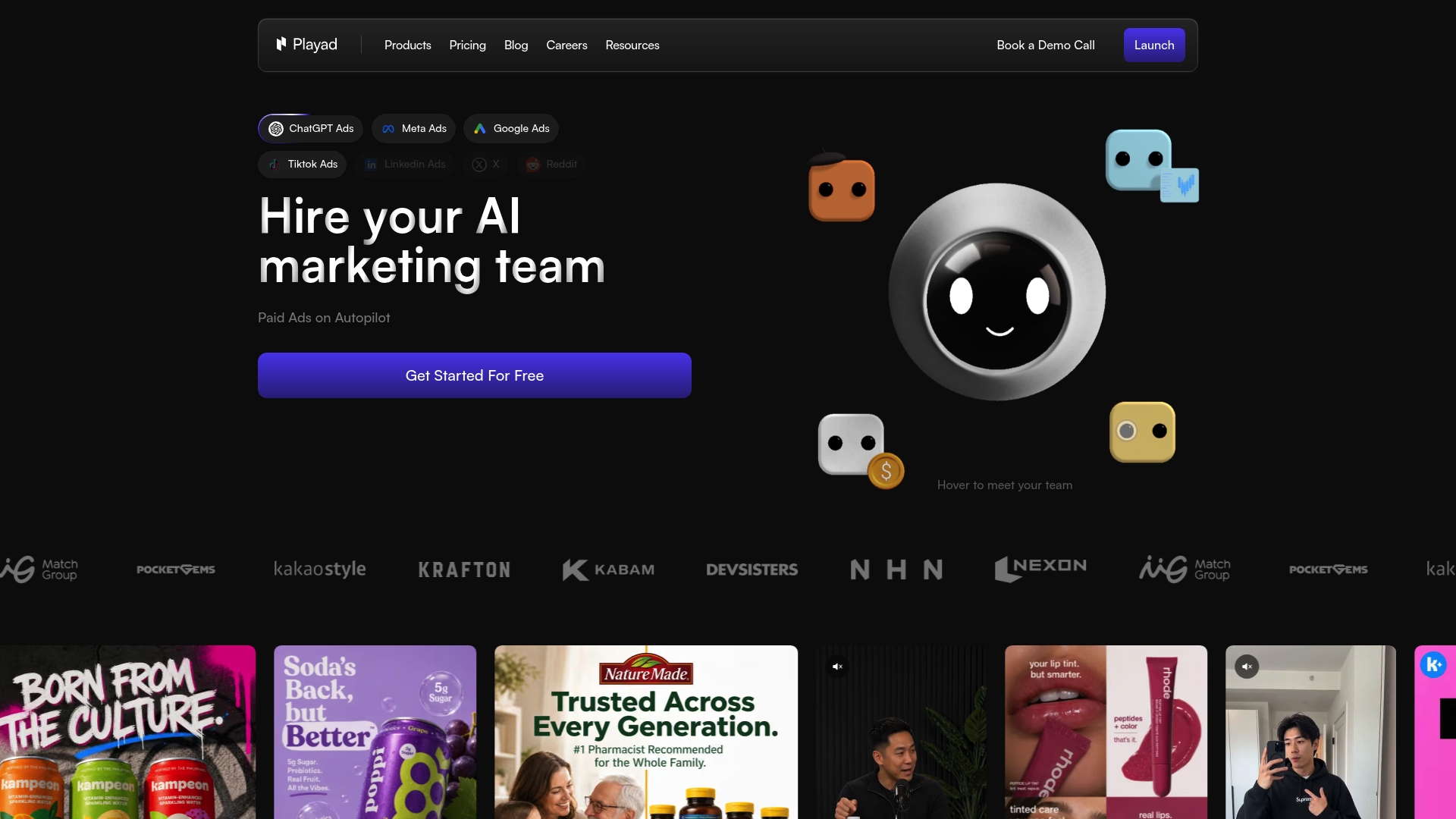
Free tier is available. Paid plans start at $39/month for the entry level and scale to enterprise pricing.
Playad markets itself as an autonomous ad manager that handles creative production, campaign setup, and optimization across Meta, Google, TikTok, and ChatGPT Ads. The platform targets marketing teams and solo founders who want high creative throughput with reduced human overhead.
Core Features
Playad combines AI powered campaign planning, creative generation from competitor links or websites, and performance tracking in one workflow. It includes competitor ad monitoring and hypothesis driven testing so teams can iterate creative quickly while the system adjusts bids and placements automatically. Chat and automation modes let you operate via messages or set end to end workflows.
Key Differentiator
Playad’s main difference is a multi agent AI architecture that separates research, creative generation, and performance analysis into distinct agents. That structure lets the platform run experiment cycles continuously and scale creative volume beyond what small teams usually produce. The vendor positions this model as a low overhead alternative to hiring full service agencies.
Pros
Built marketing knowledge into the product comes from training with top performance marketers, which helps the system propose tested strategies and copy variants. Playad generates high volumes of creatives and runs systematic A/B testing so you can expose multiple concepts quickly. It automates routine campaign management tasks and integrates with major ad networks so deployment requires less manual work than typical DIY setups.
Cons
- Mixed third party reviews show significant dissatisfaction among some users, which raises questions about consistency.
- Users report erratic performance and technical errors during peak periods, which can interrupt active campaigns.
- Customer support response times are often perceived as slow or unresponsive, creating risk for urgent fixes.
- Some users describe confusing subscription practices and unexpected billing after cancellation.
When It May Not Fit
Teams that need rock solid uptime and prompt human support will find Playad risky given the reports of instability and slow service. Agencies billing clients for guaranteed delivery may prefer a platform with formal SLA commitments. Organizations sensitive to billing surprises or with strict procurement controls should review contract terms closely before committing.
Notable Integrations
Playad connects directly to Meta Ads, Google Ads, TikTok Ads, and ChatGPT Ads for both creative push and campaign management. These integrations allow the platform to create, launch, and monitor ads on the same channels your team likely uses now.
Who It’s For
Mid market brands and marketing teams seeking automated, scalable ad management with high creative throughput will get the most from Playad. Solo founders and small growth teams who prioritize frequent creative tests over hands on control may also benefit. Larger enterprises that need strict SLAs and dedicated support may find the trade offs unsuitable.
Real World Use Case
A SaaS startup uses Playad to generate and A/B test hundreds of ad creatives weekly across Facebook, Google, and TikTok. The system runs hypothesis driven experiments and adjusts bids in real time so the marketing team spends less time on operational tasks and more on strategy.
Pricing
A Free tier exists for basic exploration. Paid plans start at $39/month for the intern level and scale up to enterprise plans with custom pricing. The vendor offers a range from entry subscriptions to bespoke contracts for larger accounts.
Website: https://playad.ai
Arcads
At a Glance
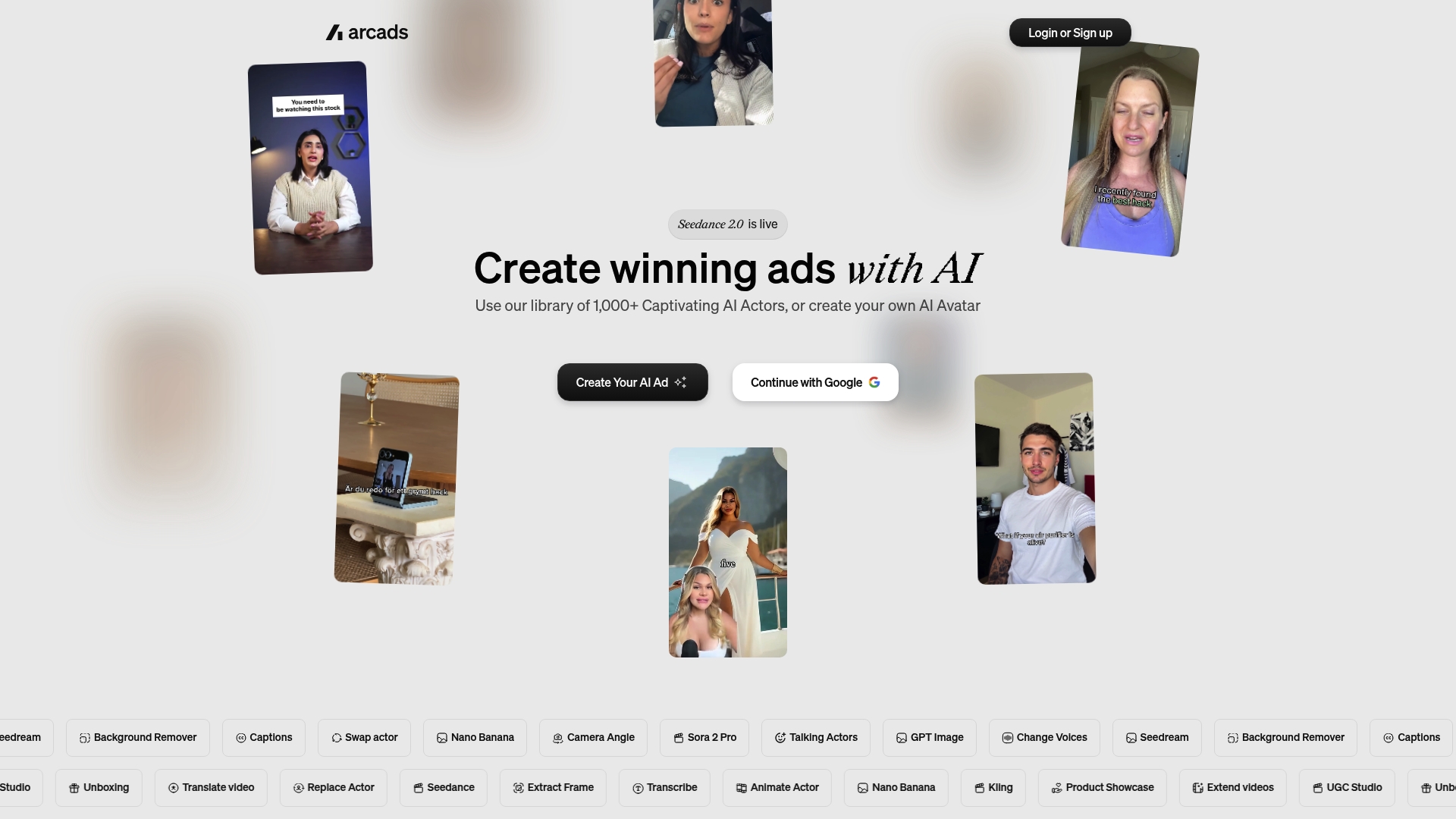
Arcads reports a library of over 1,000 AI actors, which the vendor highlights as its core content resource. The platform pairs those actors with automated ad workflows and AI video editing. That combination targets teams that must produce many social ads quickly.
Core Features
Arcads combines an AI UGC Generator with AI Avatars and text to speech to produce talker-driven short videos. The platform includes AI-driven ad templates for Facebook and TikTok, lip-sync technology, and an API surface for programmatic video generation. Real-time collaboration and workflow automation sit alongside AI editing tools to speed batch ad production.
Key Differentiator
The standout is the size and accessibility of the AI talent pool tied to workflow automation. The vendor positions the actor library as fully customizable and directly usable in ad templates. That setup reduces the manual casting and shooting steps for social campaigns. Teams can iterate ad variants by swapping actors and text rapidly.
Pros
Testing scenarios show the platform creates believable, lip-synced speaking videos that cut production steps compared with hiring actors and booking shoots. Automation features let teams assemble platform-specific ad cuts and captions without manual timeline work. The vendor materials and user reports emphasize responsive support and language options, which helps teams localize at scale. The system supports e-commerce, SaaS, mobile apps, and agency workflows, making it familiar to multi-industry creative teams.
Cons
- Pricing is commonly reported as high, and several users describe encountering aggressive or hidden paywalls during workflows.
- Output quality varies by script complexity, so some clips need manual refinement or re-rendering.
- Customer support is sometimes slow, according to user accounts, which can delay urgent campaign fixes.
- A few reviewers flagged marketing claims that felt optimistic compared with final deliverables.
When It May Not Fit
Small brands or independent creators on tight budgets will likely find costs prohibitive. Teams that require bespoke, cinematic video with precise lighting and camera moves will hit quality limits. Agencies needing guaranteed frame-perfect results for high-profile spots should plan for additional postproduction. Projects that cannot tolerate output variability will need an alternate production route.
Notable Integrations
Arcads lists integrations with various industry-specific tools and social media platforms. The vendor description does not name specific connector partners. Expect direct publishing links or export options for major social networks and ad platforms rather than deep third-party workflow ecosystems.
Who It’s For
Performance marketers, in-house brand teams, and creative squads that need fast, repeatable social ads will get the most value. It fits teams that prioritize volume and iteration over bespoke cinematography. Multimarket teams that need multi-language variants will find the language and avatar mix helpful.
Real World Use Case
A D2C brand used Arcads to produce dozens of localized social spots for a holiday push. The team swapped AI actors and copy to test creative hooks across regions. That approach reduced reliance on remote shoots and sped up the launch cadence for paid channels.
Pricing
Pricing is listed as informational only and no public tiered pricing is provided in the product data. Prospective buyers must contact Arcads for plan details, usage limits, and any render or export fees.
Website: https://arcads.ai
Kreator.ai

At a Glance
Turn a single product photo into multiple ad creatives. Kreator.ai converts one image into social, eCommerce, and ad-ready visuals plus pages that capture brand rules. The platform also includes simulated product photoshoot tools to speed visual consistency across channels.
Core Features
Kreator.ai transforms one image into many formats and sizes for social feeds, product pages, and paid ads. It includes brand guidelines export and a product photoshoot generator to keep visual assets consistent and on brief. Kreator.ai’s marketing materials state it relies on proven patterns aimed at higher engagement and conversions.
Key Differentiator
The platform bundles ad generation, photo synthesis, and brand guideline output into a single flow. That reduces handoffs between creative and marketing teams and gets test-ready assets faster. The focus on producing scale from minimal input is the product’s central angle compared with more fragmented toolsets.
Pros
The interface is intuitive and includes a helpful article wizard plus keyword tools that guide copy and asset selection, which speeds setup for noncreative teams. It supports images, short videos, and user generated content styles so teams can produce varied ad formats across feeds and stories. Built by founders with marketing backgrounds, the product prioritizes consistent visual output and repeatable templates for campaign testing at scale. For small eCommerce teams the time savings and lower production costs make frequent creative tests practical without a studio.
Cons
- Customer support responsiveness is reportedly poor, which delays fixes and onboarding for some teams.
- Some users report issues with promised lifetime access and unclear business practices.
- Advanced designers may find customization limited when they need highly tailored creative direction.
- Integrations are limited, which complicates automation for complex marketing stacks.
When It May Not Fit
If your team requires pixel perfect bespoke creative direction the platform may miss the mark. If guaranteed lifetime access or dedicated support matters, user reports suggest exercising caution. Enterprise buyers that need deep API integrations and custom workflows will likely prefer a platform with broader partner support.
Who It’s For
DTC founders and small marketing teams that need fast, repeatable ad output will get value. Brands running frequent creative tests across social channels benefit from rapid variation generation. Agencies managing multiple small eCommerce accounts can use it to lower per-client production costs and speed campaign launches.
Real World Use Case
A three person eCommerce team uploads a single SKU photo and generates twenty ad variants across stories, feed, and product pages. They export brand guideline sheets so freelance editors follow the same visual rules. Campaign pacing improves because new assets reach test faster and cost far less than a studio day.
Pricing
Plans start at $99/month for the Starter tier, with higher tiers at $299 and $599/month. Higher tiers add more credits, storage, and team collaboration features.
Website: https://kreator.ai
Airpost
At a Glance
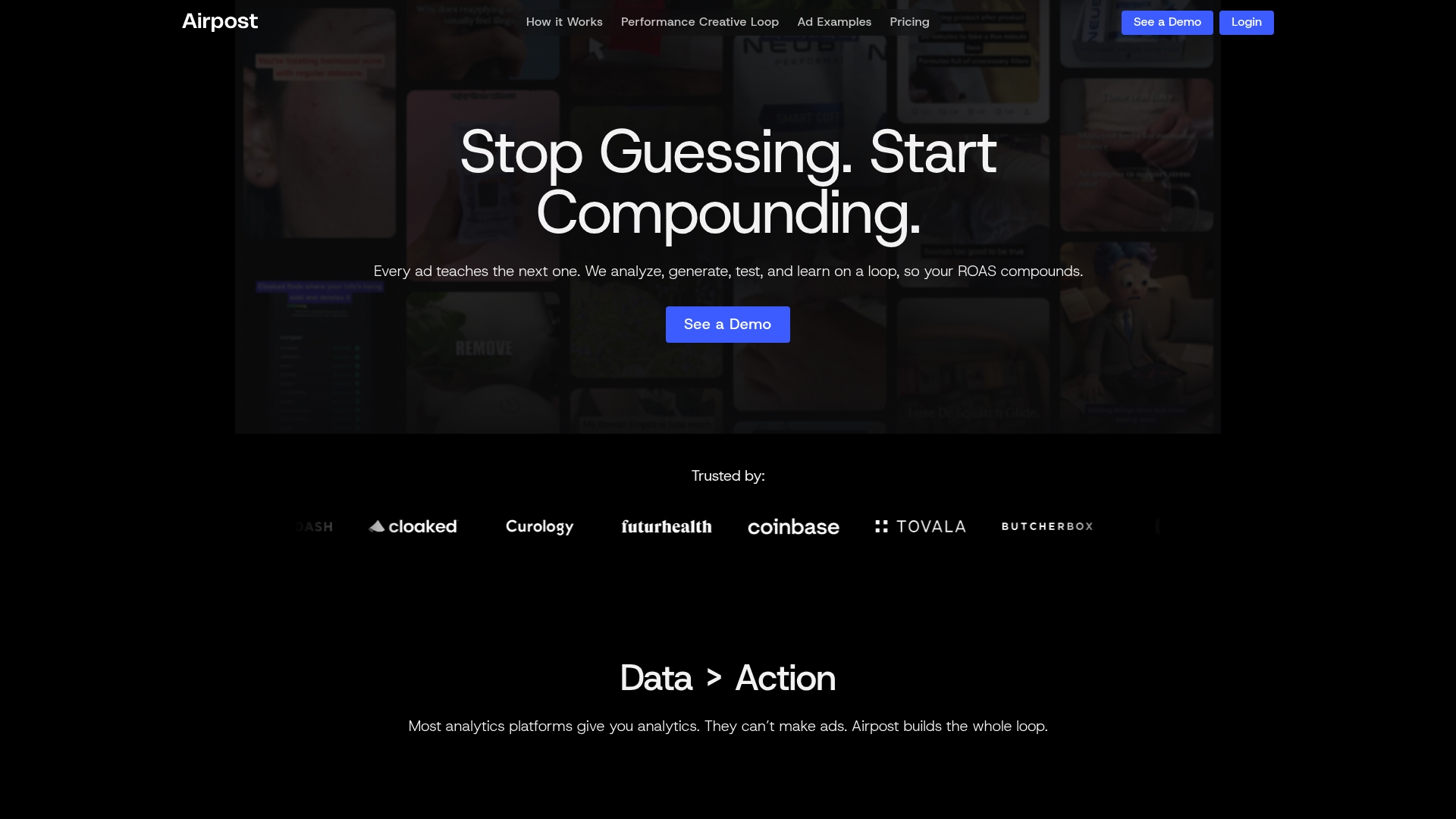
Hybrid AI and human-managed workflows continuously learn from live ad performance to refine creative assets. That learning loop lets teams scale variations quickly while keeping strategic oversight. The platform targets video-first campaigns and emphasizes repeatable testing to improve creatives over time.
Core Features
Airpost generates AI-generated video ads from brand assets and briefs, then runs performance analysis to guide edits and new variants. The platform supports mass production of concepts while expert strategists review outputs and refine messaging. Integrations with cloud storage and asset management systems speed asset transfer and version control.
Key Differentiator
The defining feature is the platform’s hybrid approach. Human strategists work with AI models so creative choices evolve from real performance data. That continuous feedback loop focuses development on assets that show measurable engagement.
Pros
Combining automation with strategist oversight reduces time spent heads-down in the cave and improves the odds a variant performs. Integration with Google Drive, Dropbox, and DAM systems keeps existing asset workflows intact. The model supports rapid testing and iteration, which lowers per-creative cost compared with traditional full-service agencies.
Cons
-
No substantive third-party reviews or user feedback are publicly available, which makes vendor claims harder to verify.
-
Creative diversity and fine-grained customization depend on the quality of input assets and briefs. Outputs may reflect those limits.
-
Buyers needing highly bespoke or sensitive brand content may find the AI output too prescriptive for strict creative control.
When It May Not Fit
If your campaigns demand full manual control over every frame and line of copy, this hybrid service may slow approval workflows. Organizations that require extensive face or legal clearance for every asset might prefer a purely manual creative partner. Teams that prioritize vendor reputation proofs should view the limited external reviews as a procurement risk.
Notable Integrations
-
Google Drive
-
Dropbox
-
DAM systems
Who It’s For
Marketing teams and brands that need to produce many video variants fast will benefit most. E-commerce teams that test creative repeatedly to find winners will see the value. Agencies seeking to expand video output without hiring a larger creative staff will also find this model useful.
Real World Use Case
A consumer brand uploads product clips and a creative brief. Airpost generates multiple ad variations, the strategist refines the best performers, and the team tests them across segments. The workflow improves campaign agility and shortens the test cycle between creative iterations.
Pricing
Pricing is not applicable in the product data and is listed as informational only. The offering is presented as a managed hybrid service, so expect custom pricing tied to creative volume and strategic support. Contact the vendor for a quote and details.
Website: https://airpost.ai
Comparison of alternatives
POPJAM, Playad, Arcads, Kreator.ai, and Airpost present a spectrum of capabilities for ad creative generation. Each platform targets a specific aspect of advertising workflows, and their strengths and weaknesses inform their suitability for different teams and scenarios.
Integrated workflows and validation
POPJAM excels in combining creative generation and persona-based validation within a single workflow. Its export capabilities for major ad platforms simplify asset deployment, a feature uniquely advantageous compared to competitors such as Playad, which focuses more on automation depth rather than pre-launch testing. POPJAM’s synthetic persona simulations minimize the need for live market testing, saving small and medium teams the cost of experimental live campaigns.
Automation and scalability
Playad distinguishes itself through its multi-agent AI architecture, which separates research, creative generation, and performance analysis into distinct agents. This enables continuous campaign iteration and automation advantages surpassing POPJAM’s focus. However, documented inconsistencies in service stability and support responsiveness may limit its reliability for agencies with strict operational demands.
Best fit
- Teams needing pre-launch creative testing benefit from POPJAM’s persona simulation and format export capabilities across major ad networks.
- Small businesses seeking cost-effective ad creation find Kreator.ai practical with its rapid image-to-ad pipeline lowering production costs.
- Enterprises requiring guaranteed SLAs might prefer alternatives with formal uptime commitments such as Arcads or similar services.
- Brands focused on extensive video production will appreciate Arcads’ AI-driven actor library and localized variant generation.
- E-commerce teams prioritizing localized ad content can leverage Arcads alongside AI tools for rapid iteration across multiple regional markets.
Our pick
POPJAM stands out for its synthetic persona-based pre-launch validation, combining creative generation, testing, and export within a GDPR-compliant workflow. Agencies and marketing teams that need reliable audience-level feedback without exposing customer lists will find this setup. While POPJAM may not fit scenarios requiring deep automation across connected campaigns, its emphasis on testing potential asset impact makes it a compelling choice for teams focused on pre-launch ad optimization.
The following table compares leading ad creative generation platforms based on their features, pricing, and unique advantages.
| Platform | Core Feature | Best For | Pricing | Notable Limitation |
|---|---|---|---|---|
| POPJAM | AI-generated ad variants and validation | Marketers seeking tested ad creatives | €99/month for Essential tier | Relies on synthetic personas which may lack nuance |
| Playad | Autonomous ad management workflows | Small teams maximizing creative throughput | $39/month for basic tier | Reports of erratic performance during peak periods |
| Arcads | AI-driven UGC with actor library | High-volume social ad creation | Price not published | High pricing and aggressive paywalls encountered |
| Kreator.ai | Product-focused creative generation | Small teams needing unified ad visuals | $99/month for Starter tier | Limited customization for advanced design |
| Airpost | Hybrid AI-human workflow for video ads | Video-first campaigns needing rapid iteration | Price not published | Limited public reviews affecting trustworthiness |
Why Guessing with Ads Costs You More Than You Think
Many performance marketers, agencies, and e-commerce brands struggle with wasted ad spend because they rely on guesswork to pick creatives. The problem grows when you have to test multiple platforms and try to understand complex audience reactions without real insights. POPJAM solves this by generating ad creatives on-brand and testing them against synthetic buyer personas before you spend a penny on live campaigns. This means you can avoid posting and praying and instead use real psychographic data to choose variants that truly connect.
POPJAM combines creative generation and audience simulation into one GDPR-compliant workflow. It lets marketing teams create, validate, and export native-format ads for Meta, Google, TikTok, LinkedIn, and Reddit—all from one place. For those who run paid social or search campaigns, this approach cuts down wasted budget and shortens test cycles.
If you run performance marketing for e-commerce, SaaS, or agency clients, see how POPJAM can help you refine your ad creatives with synthetic personas. Visit POPJAM.IO to start testing your concepts with 500 free credits and turn your next campaign into a confident win.
FAQ
How does POPJAM support ad creative generation?
POPJAM generates ad variants quickly through its AI-driven platform. It validates concepts against synthetic personas before launching paid campaigns, which ensures strong audience alignment. Consider using POPJAM for rapid ad testing and creative iterations.
What is the difference between POPJAM and Playad?
Playad excels in automating campaign management and optimizing ad placements through a multi-agent AI structure. POPJAM, on the other hand, integrates creative generation with audience simulation in one workflow, making it ideal for teams looking to validate creatives before incurring costs. Use POPJAM when you want to focus primarily on ad development and testing.
Which platforms does POPJAM support for ad export?
POPJAM supports native ad format exports for Meta, Google, TikTok, LinkedIn, and Reddit. This integration reduces the manual effort required to prepare creatives for different platforms. Teams looking to streamline their advertising efforts should consider POPJAM’s multi-platform capabilities.
Can I use POPJAM if my team doesn’t have customer data?
POPJAM allows the use of synthetic personas, so you don’t need to upload real customer data to validate your ad creatives. This feature is particularly useful for teams concerned about privacy and data compliance while testing ads without traditional audience data.
What are the pricing options for POPJAM?
POPJAM offers a free tier that includes 500 credits for experimentation, along with paid plans starting at €99 per month for the Essential tier. Explore the free tier to validate your concepts before considering an upgrade to a paid plan.