

Ship Ads That Sound Like You: 6 Step AI Brand Voice for Marketers
AI brand voice is a machine-operable set of behavioral rules and prompt stacks that let AI systems generate copy matching your brand, but only with human oversight built in. The real work isn’t picking a tool. It’s writing rules an algorithm can actually follow, then checking its homework with a QA rubric. Human-in-the-loop review is the industry standard for a reason, and platforms like POPJAM.IO show what that oversight looks like when it’s built into the workflow itself.
TL;DR:
- Specific behavioral rules, such as using contractions in emails or avoiding opening sentences with statistics, are essential for AI to reliably mimic your brand voice.
- Building a voice guide involves auditing real brand content, creating clear rules, and developing layered prompt stacks to ensure consistency across different content types.
- Governance procedures like approval checkpoints, regular sampling, and error tracking are vital to prevent AI-generated copy from drifting or producing factual inaccuracies.
- Storage of voice rules should be accessible via automated retrieval methods, with QA rubrics measuring voice match, accuracy, clarity, and audience fit to maintain quality over time.
- Testing tools that simulate audience reactions before publishing, like POPJAM.IO, help validate whether AI output resonates, reducing the risk of costly brand mismatches or miscommunication.
Table of Contents
- What Is AI Brand Voice and Why Does It Matter?
- How Do You Build an AI-Operable Brand Voice Guide?
- What Are the Risks of Using AI for Brand Voice?
- Where Should You Store Voice Rules and How Do You Test Output?
- What Do You Need to Launch and Scale an AI Brand Voice Program?
- How Does POPJAM.IO Put These Principles Into Practice?
- POPJAM.IO: Generate and Test On-Brand Creative Before You Spend
- Sources
- FAQ
What Is AI Brand Voice and Why Does It Matter?
Here’s the problem with most brand voice guides: they were written for humans to interpret, not for machines to execute. “Be warm but professional” means something to a copywriter with three years of institutional context. It means nothing to a language model. A traditional style guide leans on adjectives and vibes. An AI-operable one leans on behavior you can point to and test.

That distinction changes what a guide actually contains. Instead of “friendly tone,” you get rules like “use contractions in every customer-facing email” or “never open a sentence with a statistic.” Glean’s research on building brand voice guides for AI tools makes the same point: vague adjectives have to become explicit constraints before AI can act on them consistently.
The payoff shows up fast once the rules are specific, as explained in how to build a brand online with AI-driven strategies:
- Fewer rounds of edits, because the first draft already sounds like you
- Faster time-to-publish across email, social, and ad copy
- Consistent tone whether the content comes from a junior marketer’s prompt or an agency partner’s
Prompt stacks and annotated writing samples work as the connective tissue here. They’re what turns a policy document into something an AI tool can reference at the moment of generation, not just a PDF nobody reopens after onboarding.
How Do You Build an AI-Operable Brand Voice Guide?
Building this guide is a sequence, not a brainstorm. Skip a step and the AI fills the gap with its own defaults, which is usually where brand voice drifts.
- Audit 5 to 10 of your best on-brand pieces. Pull real emails, ad copy, or blog posts that everyone agrees “sound like us.” Look for patterns: sentence length, punctuation habits, how you open and close a piece.
- Write 3 to 5 behavioral principles as rules, not adjectives. “Confident” becomes “state the recommendation before the caveat.” “Playful” becomes “use one rhetorical question per 300 words, never more.”
- Build tone scales by scenario. Support replies might sit at a 2 out of 5 on formality; investor updates might sit at a 4. Pair each scale with structural rules by content type, so a product update and a crisis statement don’t get the same treatment.
- Assemble vocabulary lists. Preferred terms, banned words, and phrases that are legally or culturally off-limits. Attach annotated examples that show the rule in action, not just stated in the abstract.
- Convert all of it into prompt stacks. A prompt stack is the layered instruction set (voice rules, examples, constraints) an AI tool reads before it generates anything. Territorial’s case study on designing a brand for AI shows how Suzy trained a brand-specific GPT this way, using stacked prompts and annotated samples instead of a static brand book.
- Pilot with a small batch. Run 20 to 30 drafts through the new system and count edits per draft. That number is your baseline for whether the guide is actually working.
Pro Tip: Write your banned vocabulary list before your preferred one. Marketers find it easier to agree on what the brand never says than to agree on what it always says, and the banned list often reveals rules the preferred list would have missed.
What Are the Risks of Using AI for Brand Voice?
AI-generated copy fails in specific, predictable ways, and most of them trace back to skipping governance rather than a flaw in the model itself. A study on generative AI in brand identity design found that AI speeds up ideation, but it shifts the real labor downstream to vetting output, and that shift is exactly where teams get sloppy.
Watch for these failure modes:
- Hallucinated claims. AI will confidently state a product feature or statistic that doesn’t exist.
- Biased or tone-deaf phrasing. Models trained on broad internet data can miss cultural context that matters to your specific audience.
- Copyright and authorship ambiguity. Who owns a headline the AI generated from your prompt stack? That question needs an answer before launch, not after a dispute.
- Voice drift. Small inconsistencies compound across hundreds of pieces if nobody’s sampling output.
Governance doesn’t need to be heavy to work. Approval gates before anything publishes, regular sampling of live output, clear ownership of the voice guide itself, and version control on every update are enough for most teams. Set an escalation path too: anything touching legal claims, sensitive topics, or a crisis response should route to a human writer by default, no exceptions. Track two numbers over time: error rate (how often output needs a factual correction) and brand-match failure rate (how often reviewers flag a piece as off-voice). Both are early warning signs before a bad piece ever reaches a customer.
Where Should You Store Voice Rules and How Do You Test Output?
The voice guide is only useful if AI tools can actually reach it at the moment of generation. That’s a storage and retrieval problem as much as a writing one. Options include persistent context windows, enterprise knowledge bases, or custom instructions set at the platform level, all of which Glean’s guidance on brand voice guides for AI tools treats as functionally equivalent as long as retrieval happens automatically rather than manually. HubSpot’s own approach to setting up brand voice with AI follows the same logic: save the voice profile once, apply it across every content type without re-explaining it each time.
Prompt stacks get applied at generation time by layering the request: voice rules first, then relevant annotated examples, then the specific content ask. Skipping the layering and just pasting “write in our brand voice” into a chat window is the single most common reason teams get inconsistent results.
A QA rubric should score four dimensions on every sampled draft:
- Voice match (does it follow the behavioral rules)
- Factual accuracy (any hallucinated claims)
- Clarity (would a customer understand it on first read)
- Audience fit (right register for the channel)
Pro Tip: Score a sample of 15 to 20 drafts per week rather than every single output. Sampling catches drift early without turning your reviewer into a full-time editor.
Measurement matters as much as the rubric itself. Track edits per draft, approval time, and brand-match score on a consistent cadence, weekly is typical for an active pilot. Optimizely’s field notes on AI and brand voice list QA processes and cross-channel tone consistency as two of the clearest practical dos, and both show up directly in this rubric. For the tooling itself, look at categories rather than specific vendors: dedicated brand-voice management features exist inside several marketing platforms, and separately, creative testing platforms that validate output before it goes live are becoming their own category worth evaluating alongside voice management.
What Do You Need to Launch and Scale an AI Brand Voice Program?
A pilot doesn’t need a fully built system to start. It needs a minimum viable set of deliverables and clear ownership, so nobody’s guessing who signs off on what.
- Deliverables: 3 to 5 behavioral principles, 6 annotated writing samples, a basic prompt stack, and a one-page QA rubric.
- Roles: a voice owner (usually brand or content lead), a prompt engineer (can be the same person on a small team), a reviewer who samples output weekly, and an approver for anything customer-facing.
- Pilot scope: one channel, one content type, 20 to 30 drafts, four weeks.
- Scale threshold: move to a second channel only after edits per draft drop below your baseline and brand-match failures stay under an agreed ceiling for two consecutive weeks.
How Does POPJAM.IO Put These Principles Into Practice?
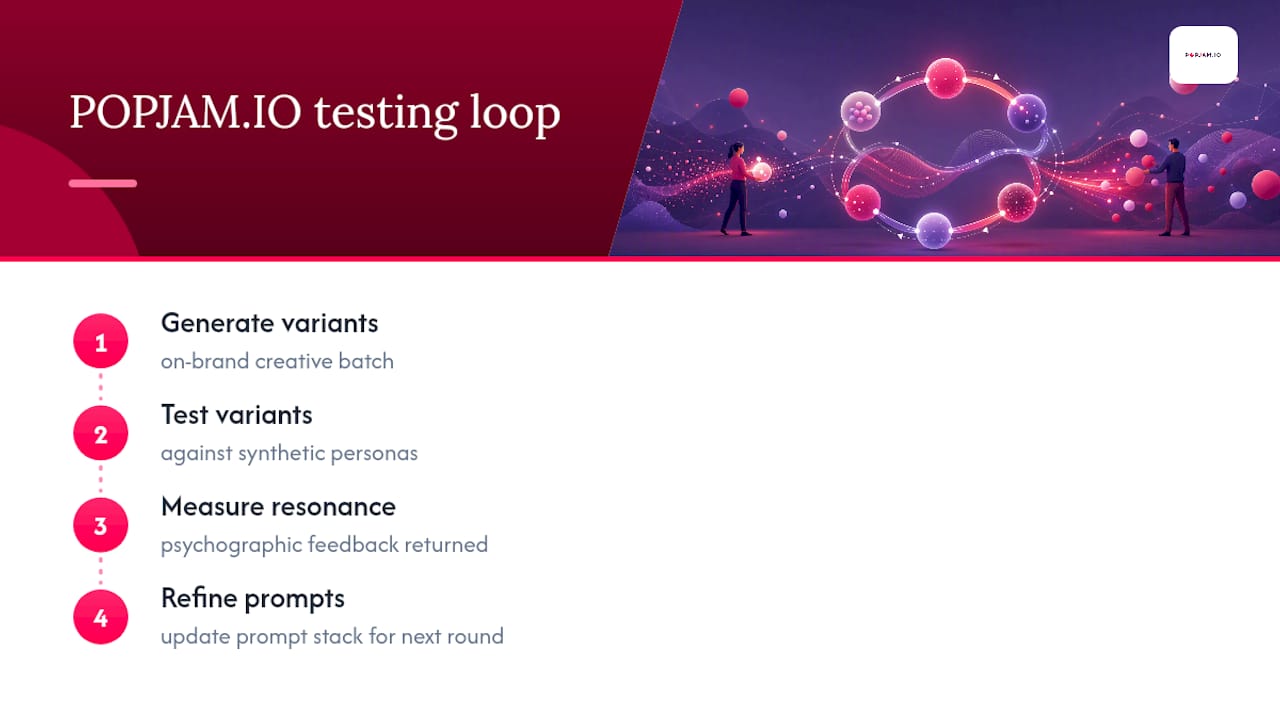
POPJAM.IO builds the testing layer this whole framework depends on. Instead of guessing whether an AI-generated ad matches your voice, the platform runs creative variants against synthetic personas and returns psychographic feedback before a dollar of spend goes out the door. That’s the QA rubric made operational: voice match and audience fit get measured, not assumed.
It fits the pilot workflow directly. Generate a batch of on-brand variants, test them against buyer personas, then feed the resonance data back into your prompt stack for the next round. Case studies and proof points on the platform show this iteration cycle in practice, and Doruk’s take on where AI brand voice is heading builds directly on what teams are already learning from running these pilots.
POPJAM.IO: Generate and Test On-Brand Creative Before You Spend
POPJAM.IO is the answer for teams tired of publishing a brand voice guide and hoping AI output actually follows it. Instead of waiting for a campaign to underperform to learn your ad copy missed the mark, POPJAM.IO tests it first, generating ad variants and running them against synthetic buyer personas that give real psychographic feedback before you spend a single dollar on media.
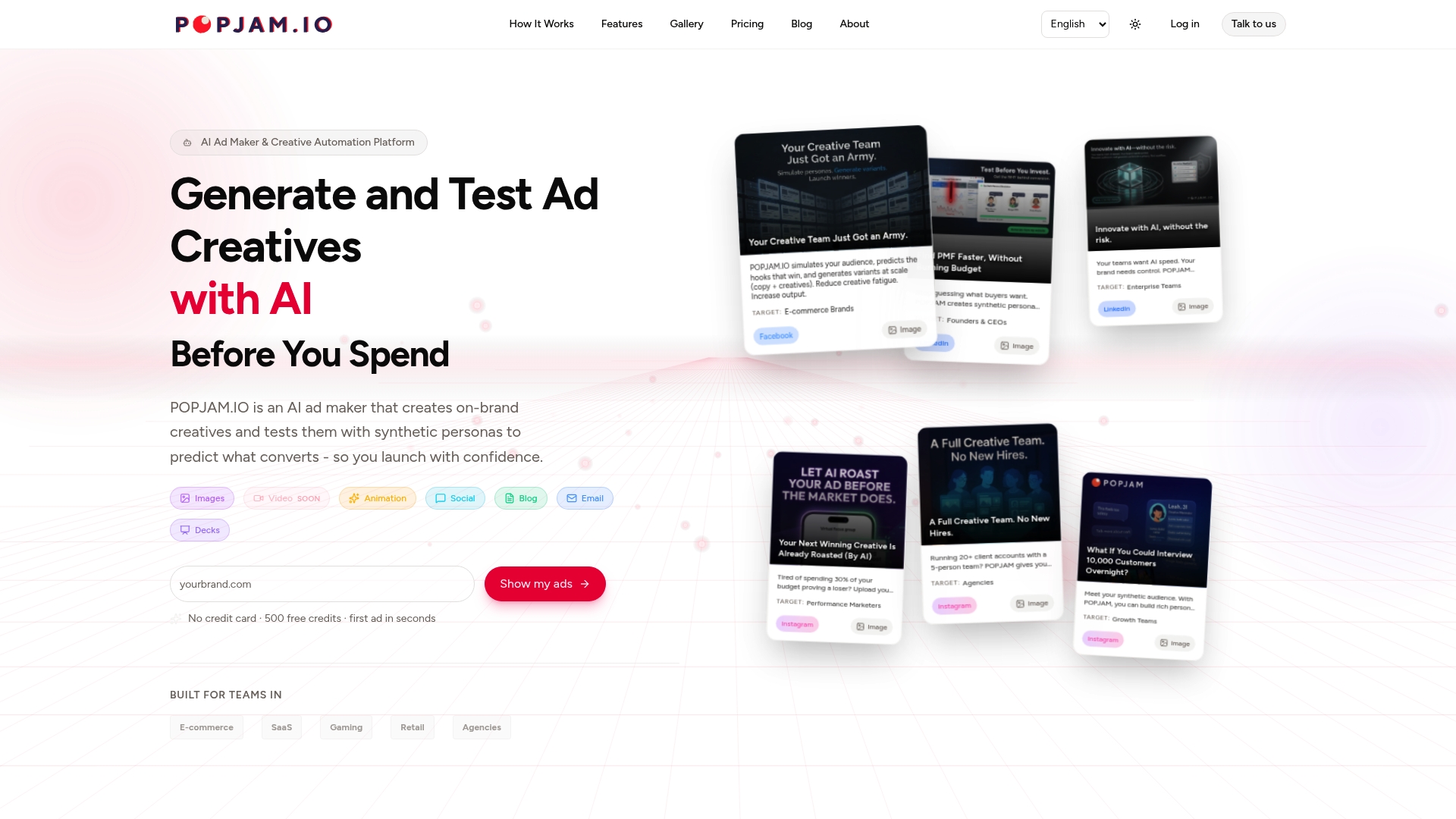
Say you’ve built your behavioral rules, your tone scales, your prompt stacks, the whole system this article just walked through. The next question is whether the output actually resonates with your audience, and that’s exactly where most teams are still guessing. POPJAM.IO closes that gap by simulating audience reactions at the creative stage, so you catch a brand-voice mismatch before it reaches Meta, Google, TikTok, LinkedIn, or Reddit, not after. Agencies managing multiple client voices at once get a dedicated workflow built for exactly that complexity. If you’re ready to see how your own brand voice performs against real audience personas, start testing your ad creatives before your next campaign goes live.
Sources
- AI shouldn’t feel like it’s creating for you: Inside Leonardo.Ai’s human-led branding | Creative Bloq
- How to create a brand voice guide for AI tools
- Brand identity design with generative AI: Between automation and authorship (IASDR paper)
- Using AI for a strong brand voice: Dos and don’ts
- Suzy: Brand design with bots in mind | Territorial
FAQ
What Is a Brand Voice Example?
A brand voice example is a written sample annotated to show the rule behind it, such as a customer email marked to demonstrate “always lead with the resolution, not the apology.” Annotated samples like these are what let an AI tool learn the pattern instead of guessing at a vague adjective.
What Is “Brandvoice”?
“BrandVoice” was originally a Forbes advertising label for sponsored content written to match a specific advertiser’s tone. In the AI context, “brand voice” more broadly refers to the codified rules, vocabulary, and tone scales a company uses to keep messaging consistent across writers, channels, and now AI systems.
Can AI Actually Sound Like a Specific Brand?
AI can match a brand’s voice closely when it’s given behavioral rules, annotated examples, and prompt stacks rather than vague descriptions, though human review remains necessary to catch drift and factual errors. Tools like POPJAM.IO add a testing layer that measures whether the output actually resonates with target audiences before it publishes.
How Do You Keep AI Brand Voice Consistent Over Time?
Consistency depends on versioning the voice guide, sampling output on a regular cadence, and tracking a brand-match failure rate so drift gets caught early. Treat the guide as a living document that gets updated whenever a new content type or channel is added, not a one-time setup task.
Is There a Famous or Most Popular AI Voice?
There’s no single AI voice recognized as the industry standard the way there might be a famous human narrator; AI voice tools instead compete on customization and natural-sounding output across dozens of options. For brand voice specifically, the goal isn’t picking a famous AI voice but building rules specific enough that any AI tool can execute your brand’s own voice.