

Top 6 AI Ad Creative Generator Alternatives 2026
Creating platform-ready ad creatives for multiple channels drains marketing team time and budget when tools can’t validate concepts before launch. Most ad creative generators automate production but skip pre-launch audience simulation, which leads to wasted ad spend and untested creative assets. This comparison covers features, pricing, and integrations across six ad creative platforms so marketing teams can match a substitute to their workflow and campaign goals.
Table of Contents
POPJAM
At a Glance
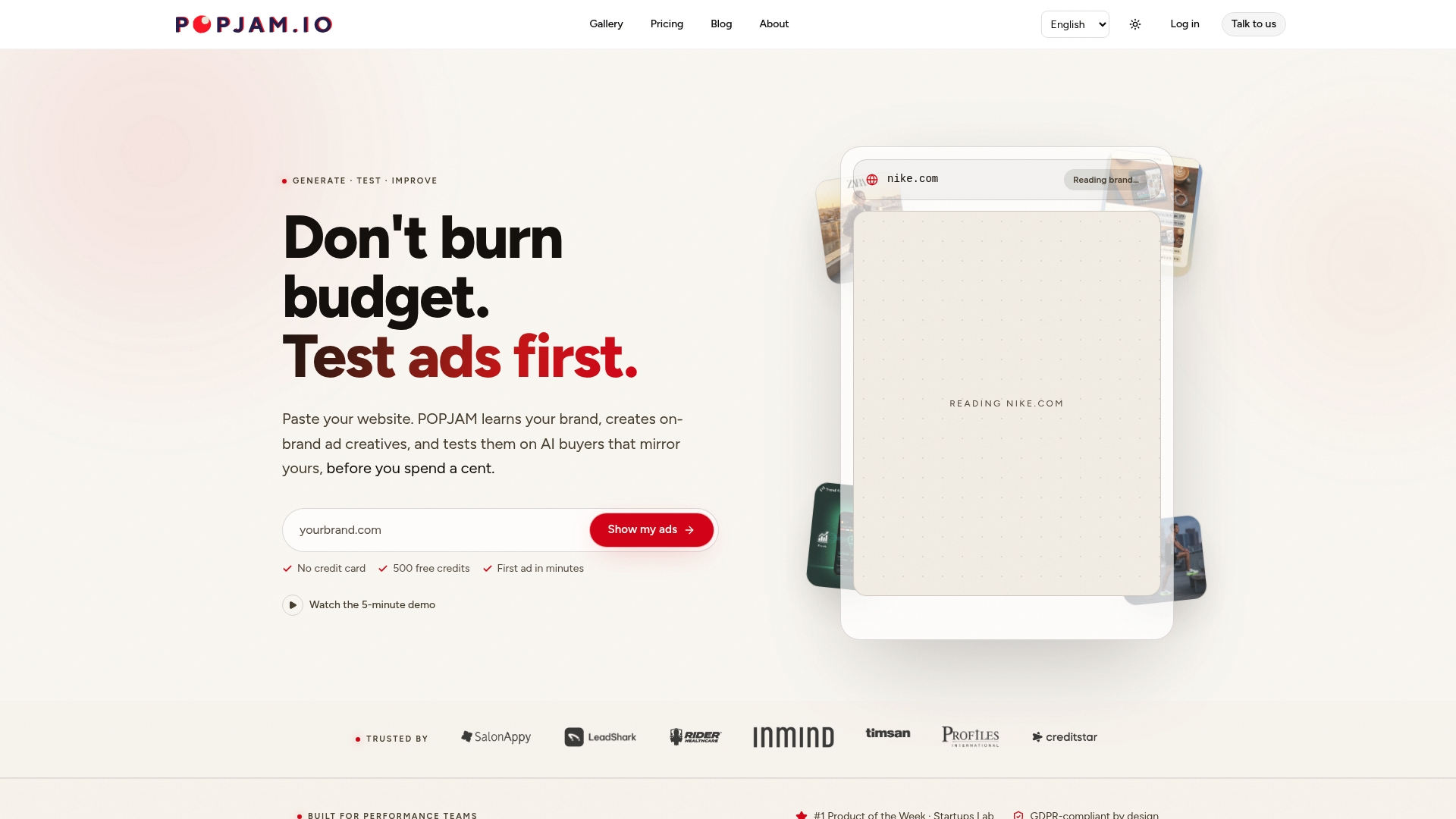
500 starter credits let you generate and validate creatives without an upfront payment. It functions as an ai ad creative generator and pre-launch tester for e-commerce brands, SaaS companies, and agencies. The platform exports validated winners in native formats for Meta, Google, TikTok, LinkedIn, and Reddit so launches match each channel’s specs.
Core Features
POPJAM automates ad creative generation across static images, video, animation, social posts, email campaigns, and presentation decks while applying native formatting for each platform. It builds customized synthetic buyer personas and runs pre-launch tests with AI audience simulators that provide detailed feedback and reasoning. The system offers multi-channel export of validated creatives and a free tier with starter credits for initial experiments.
Key Differentiator
According to the company, POPJAM is the only platform that both generates ad creatives and validates them against AI audience personas in one seamless workflow. That combined workflow removes a handoff step between creative production and pre-launch testing. For teams tired of posting and praying, that claim means fewer wasted ad dollars and faster iteration on what actually resonates.
Pros
The platform consolidates creative production and validation into a single automated workflow, which shortens the path from concept to launch. POPJAM avoids the need for real customer data by using GDPR-compliant synthetic personas, so privacy concerns do not block testing. Native exports for major ad platforms, plus free starter credits, let small teams prove concepts before committing budget.
Cons
- AI-generated creatives often need manual finetuning to match a brand’s exact visual tone and messaging.
Notable Integrations
- Meta Ad Manager
- Google Ads
- TikTok For Business
- LinkedIn Campaign Manager
- Reddit Ads
Who It’s For
Marketing teams and performance marketers running paid channels who want to cut wasted ad spend before launch. Creative agencies and startups that need fast multi-platform mockups and validation will also benefit. E-commerce merchants testing product ads across channels get the clearest cost savings.
Unique Value Proposition
Pre-launch validation against GDPR-compliant synthetic buyer personas lets teams test audience reaction without collecting customer data. That setup reduces the guesswork that normally happens after launch and lowers the cost of creative failure. For agencies, the workflow shortens client review cycles and increases confidence in which variations move to paid spend.
Real World Use Case
A fashion e-commerce brand used POPJAM to generate dozens of ad variations for Facebook, Instagram, and TikTok. The team ran synthetic audience tests to find the top performers and exported winners in platform-native formats. They launched only validated creatives and reduced the number of unsuccessful creative rounds.
Pricing
Free plan with 500 credits to start for low cost testing. Essential tier is €99/mo with 10,000 credits, and Business is €399/mo with 50,000 credits. Enterprise pricing is custom for larger teams and integrations.
Website: https://popjam.io
Sivi
At a Glance
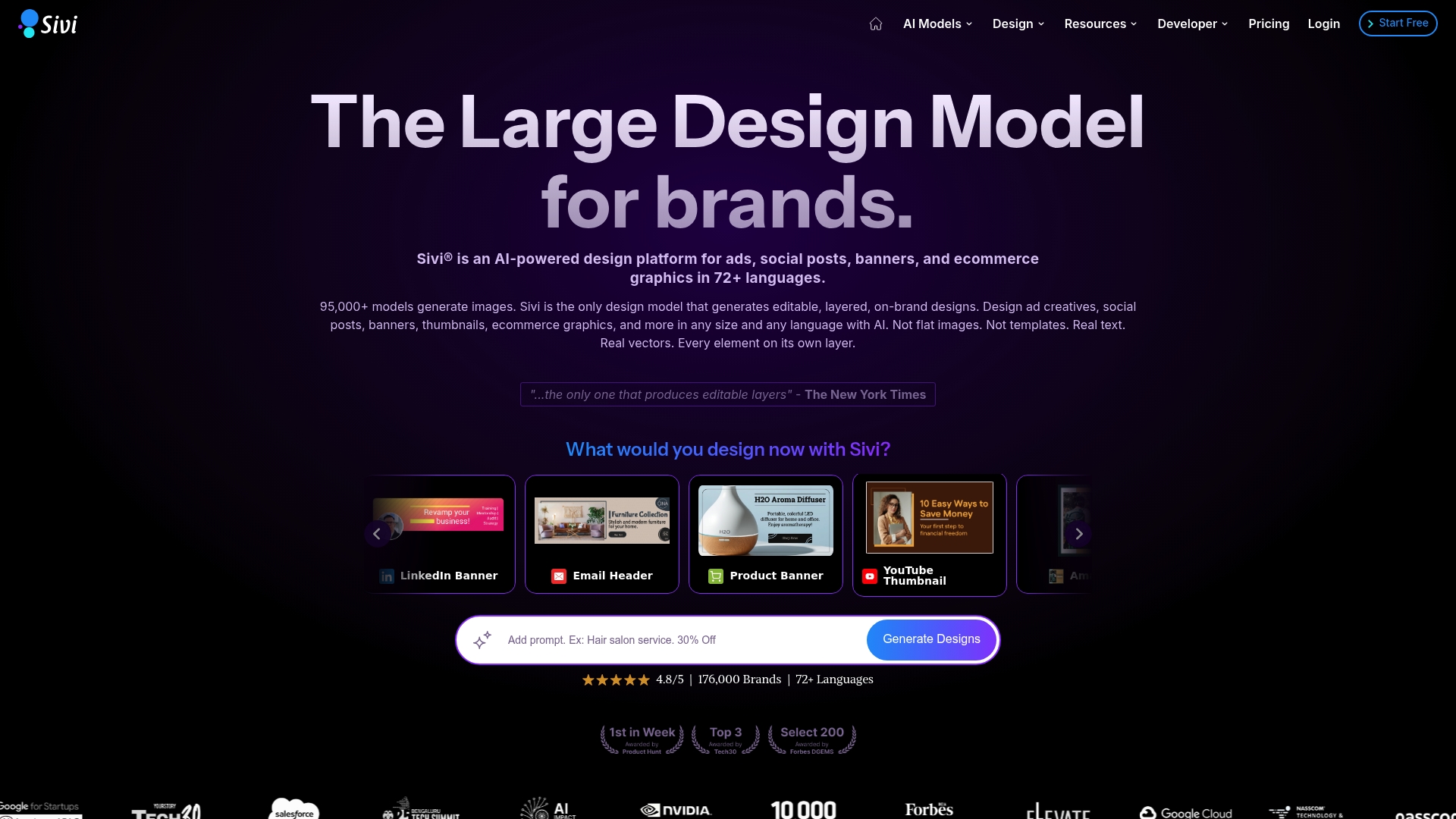
Creates layered, editable designs that preserve separate text, vector, and image elements and exports them in over 72 languages. The outputs are original compositions rather than flattened templates, so each asset arrives ready for editing. This approach cuts back on back and forth with designers while keeping file structure intact for ad ops.
Core Features
Sivi uses a Large Design Model that maps design hierarchy and applies brand rules across formats. It generates multi sized artwork and returns editable layers, text blocks, vectors, and images you can tweak in a UI or via code. The product also offers an API and UI SDK to automate generation and to embed the editor in existing production flows.
Key Differentiator
Generates layered, editable multi element designs directly from a brief or prompt, not static templates. That output keeps each component editable so marketing teams can change copy, swap images, or adjust vectors without rebuilding. The model also enforces brand hierarchy so type scale, focal points, and logo placement follow the brand rules.
Pros
The platform speeds iteration because every design comes with separate layers and editable text. It supports global campaigns by generating assets in multiple languages and custom sizes, which reduces localization bottlenecks. Brand control arrives through a brand kit and the LDM, and programmatic access via the API enables high volume production and integration with creative pipelines.
Cons
-
Premium features may require paid plans for higher volume usage. This can raise costs for large campaign runs.
-
The documentation offers limited specifics about the AI style preferences. Some brands may need trial runs to confirm fit.
-
As a newer service, the user community and tutorial library are still growing. Onboarding may take longer without peer examples.
When It May Not Fit
Teams that must run offline creative tooling will find Sivi unsuitable because programmatic and collaborative features rely on internet access. Projects with highly bespoke brand systems may still need manual adjustment after generation. Very large volume workflows should budget for higher plan tiers since scale can increase costs.
Notable Integrations
-
API for programmatic design generation and bulk automation.
-
UI SDK for embedding the editor and export flows into existing tools.
-
MCP server for AI agent workflows and orchestration.
Who It’s For
Marketing teams, content creators, and agencies that need fast, original visuals that match brand rules without hiring a designer for every asset. It works well for teams that run frequent campaigns across channels and languages and that can route exports into ad operations or content management systems.
Real World Use Case
An ecommerce brand uses Sivi to produce product launch banners and social posts. The team generates multiple size variants and language versions from a single brief. That reduces manual layout time and keeps campaigns consistent across platforms.
Pricing
A free plan is available for light use. Paid plans start at $16/month when billed yearly and at $20/month when billed monthly. Enterprise and higher volume tiers are available for teams needing API quotas and governance controls.
Website: https://sivi.ai
AdPipe
At a Glance
Real-time performance insights at the scene, hook, and visual level show which moments drive viewer response in video campaigns. AdPipe pairs that visual analysis with performance data to explain why certain creative elements move metrics. The platform targets enterprise video workflows and prioritizes rapid versioning and localization for global campaigns.
Core Features
AdPipe performs AI-powered analysis of creative content using computer vision and ties those signals to campaign metrics. It provides scene level reporting, tools for personalization and versioning, and a searchable footage library for reuse and repurposing. The product also integrates with ad platforms, DAMs, CRMs, and common workflow tools to keep creative and data in sync.
Key Differentiator
AdPipe focuses on diagnosing why content works and then turning that diagnosis into new, testable versions at scale. The platform automates element-level analysis and supports automated versioning so teams can act on creative signals quickly. That emphasis on explainable creative analytics suits enterprise teams with complex video inventories rather than groups seeking lightweight creative generation.
Pros
AdPipe moves creative analysis from intuition to measurable signals by linking visual attributes to performance. The searchable footage library speeds reuse and cuts time spent locating assets. Integrations with major ad platforms and DAMs let teams keep data flowing into existing martech stacks. The platform helps justify creative choices with empirical evidence that can feed brief updates or new localized variants.
Cons
- Third-party reviews suggest the platform may lack depth in a few niche features, requiring workarounds for specific enterprise needs.
- Results depend on the quality of input footage and an ongoing connection to performance data. Poor source material weakens the output.
- Integrating with varied legacy systems can be complex and may demand engineering time or contractor support.
When It May Not Fit
AdPipe is not the best pick for small teams without large video libraries or continuous campaign data. Organizations that lack engineering support for integrations may find setup slow. Brands focused mostly on static image ads or short social-only workflows will get less value from the video-first feature set.
Notable Integrations
- ad platforms (Meta, etc.)
- DAMs
- CRMs
- workflow tools
Who It’s For
Large enterprises, global brands, and creative agencies that manage extensive video catalogs will gain the most. Teams that must prove creative ROI and run localized versions at scale get clear benefits. Marketing ops and production leads who coordinate assets across many markets will find the platform useful.
Real World Use Case
A global retail brand uses AdPipe to analyze TV and digital video ads to identify the hooks that raise engagement. The team then creates localized variants from the searchable footage library and tests those variants quickly. This workflow shortens launch cycles and gives marketing leaders evidence they can present to stakeholders.
Pricing
Pricing is not explicitly stated and appears to follow enterprise SaaS models with custom quotes and contract terms. Prospective buyers should request a demo and a tailored proposal that reflects integration scope and usage levels.
Website: https://adpipe.com
Bannerwise
At a Glance
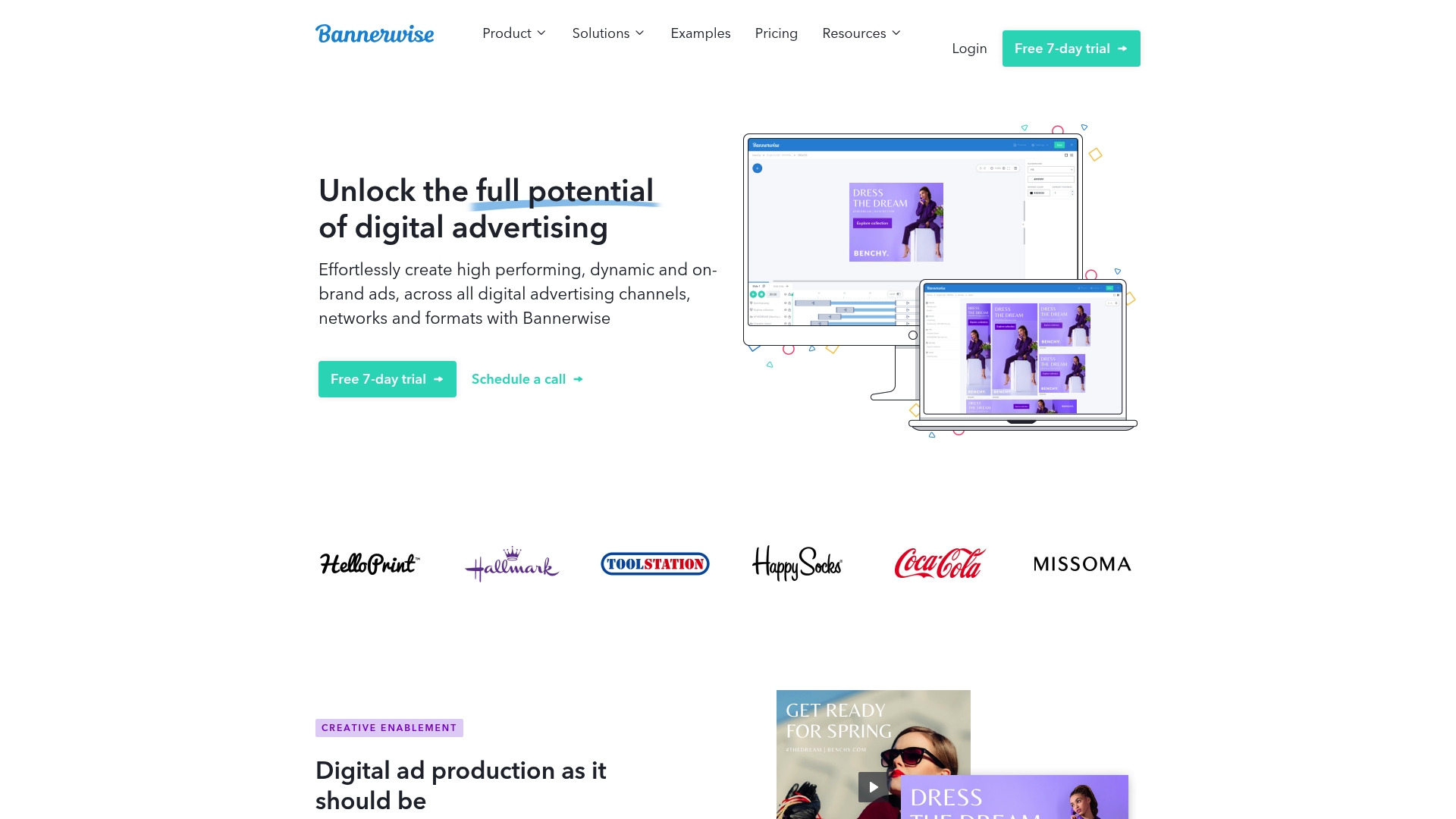
Starts at €275/month for standard plans. Bannerwise’s marketing materials state it is trusted by leading brands and agencies. The platform centers on no coding creative production for HTML5, dynamic product, and display ads across social and premium DSPs.
Core Features
Bannerwise offers a drag and drop builder that lets teams design and manage creatives without coding. It adds creative automation to scale high volumes of ads and personalization rules to change messaging by audience segment. The platform supports multiple channels and ad networks so teams can export campaign-ready assets for several placements.
Key Differentiator
Bannerwise positions itself as an all in one creative management platform that covers every major ad format without coding required. That emphasis on production and format coverage makes it focused on creative teams that must push large creative volumes. Unlike POPJAM, which simulates psychographic reactions before launch, Bannerwise concentrates on creating, automating, and personalizing the actual ad inventory.
Pros
The drag and drop interface reduces handoffs between designers and publishers and lowers the need for developer resources. Automation features let teams produce many variants quickly and apply personalization rules across feed driven or catalog ads. The vendor advertises strong support and ease of use, and the platform includes API options for connecting to ad servers and ad networks.
Cons
-
Some capabilities such as feed syncing and advanced localization require additional add ons, which adds cost.
-
Enterprise features and deeper customizations sit behind higher pricing and typically require contract negotiation.
-
Bannerwise runs in the cloud and depends on a stable internet connection for production and upload workflows.
When It May Not Fit
If you need integrated audience simulation or psychographic testing before creative hits media, Bannerwise does not provide that functionality. Teams that lack reliable internet will struggle with the cloud based workflow. Small teams with minimal volume may find the add ons and enterprise pricing too large for their needs.
Who It’s For
Marketing teams, creative agencies, and digital marketers who need to speed up ad production and deliver personalized, format specific creatives without writing code. It fits teams that must maintain brand consistency across many placements and want direct export paths to major ad platforms.
Real World Use Case
A fashion retailer used Bannerwise to create and personalize hundreds of dynamic banner ads for different products and audience segments. The vendor reports the work improved campaign efficiency and return on ad spend for that client.
Pricing
Plans start at €275/month for standard tiers, with custom enterprise options and pricing available for larger accounts and extra features.
Website: https://bannerwise.io
AdsGPT
At a Glance
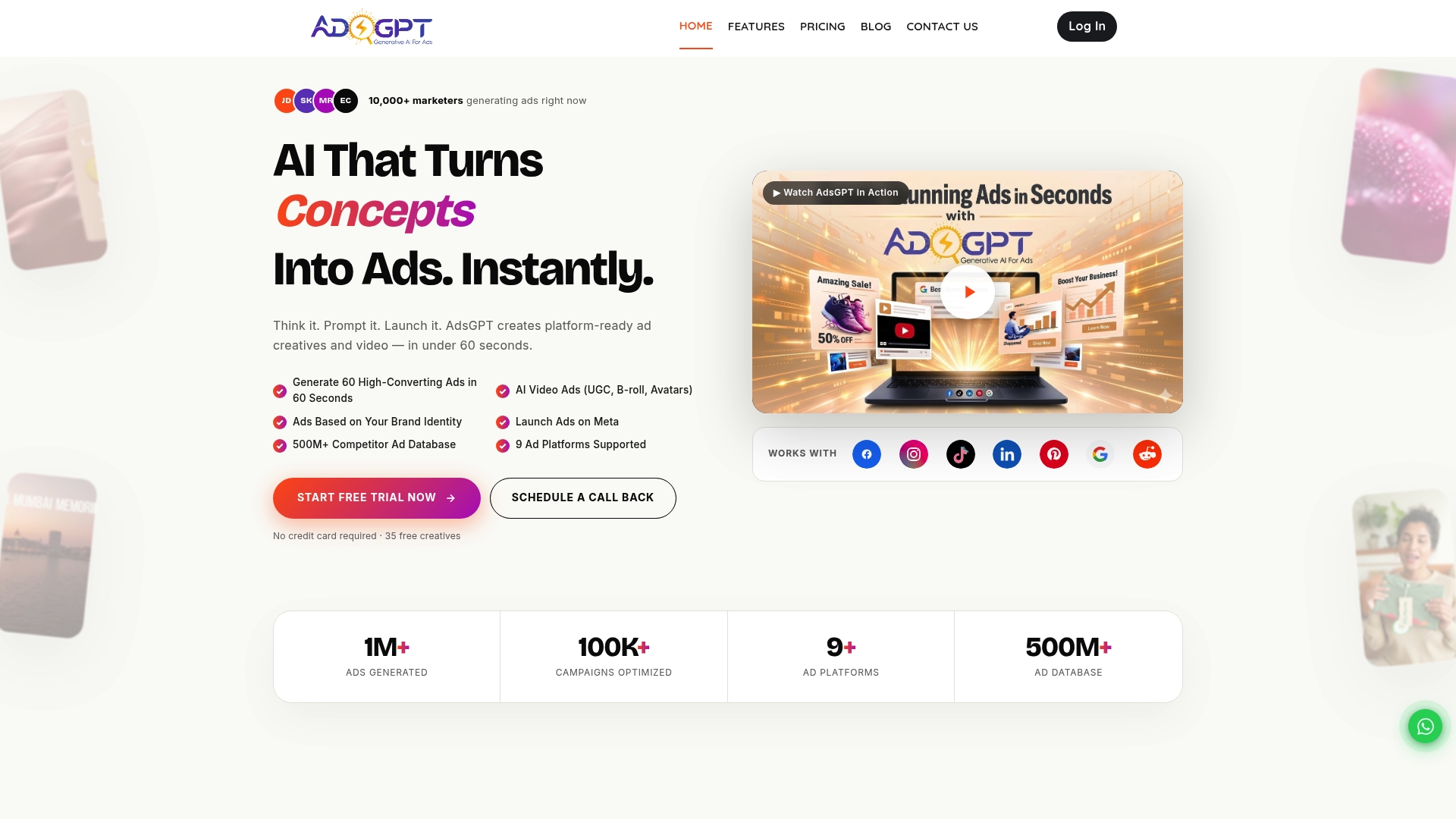
AdsGPT reports access to a 500M+ competitor ad database and can generate platform-ready creatives and videos in under 60 seconds. That combination aims to cut creative research and production time for performance marketers. The speed and dataset make it useful for fast A/B testing at scale.
Core Features
AdsGPT creates image ads, video ads, user-generated content style clips, avatar ads, and product shots. It offers an Ad Factory for unlimited bulk generation and a built-in Meta Ads Manager for campaign setup and analytics. Automation features labeled Autopilot handle routine optimization and one-click publishing across major platforms.
Key Differentiator
The product pairs a very large competitor ad repository with multi-format AI generation and direct publishing tools. That pairing helps teams remix high-performing concepts, adapt formats per platform, and push variations live without toggling between separate tools. For agencies juggling many clients, the integration between asset generation and channel publishing reduces handoffs.
Pros
AdsGPT produces many ad formats quickly, which frees creative teams from manual video editing and templating. The large ad database speeds competitive research and gives concrete examples to remix. Integrated campaign management shortens the time from idea to live test, and the bulk generation capability supports scale for agencies managing multiple clients.
Cons
- May be too broad for teams that only need a single ad format. Some teams want a specialist tool instead.
- Pricing for higher-tier plans can be expensive for small businesses. The base plan is affordable, but advanced automation requires higher tiers.
- Compared to single-focus analytics platforms, in-depth metrics could be limited. Complex attribution may still need an external analytics tool.
When It May Not Fit
If your work includes offline advertising, AdsGPT focuses on digital channels and offers limited support for traditional formats. Enterprise-scale automation and advanced brand controls require higher-tier plans. Complex campaigns that need fine-grained manual optimization will still need human oversight.
Notable Integrations
- Meta Ads Manager for direct campaign publishing and reporting.
- Google Ads and YouTube Ads for search and video campaign rollout.
- TikTok Ads, LinkedIn Ads, Pinterest Ads, and Reddit Ads for native platform publishing.
Who It’s For
Digital marketers, performance agencies, and brand managers who need fast creative output and competitor insights will get the most value. Small teams that run frequent tests across multiple channels will benefit from the bulk generation and publishing workflow. Solo marketers can use the lower-tier plan for occasional campaigns.
Real World Use Case
A social media agency uses AdsGPT to generate hundreds of localized ad variants for Facebook, TikTok, and Google. The team pulls examples from that database to match competitors, runs bulk tests, and then publishes winners through the integrated campaign manager. The workflow cuts production cycles and increases the volume of tested creatives.
Pricing
AdsGPT offers a free allowance for 35 creatives and paid plans starting at $24/month for the Starter plan. Higher tiers add bulk generation, brand controls, and enterprise automation features. Specific enterprise pricing is available on request.
Website: https://adsgpt.io
Hawky
At a Glance
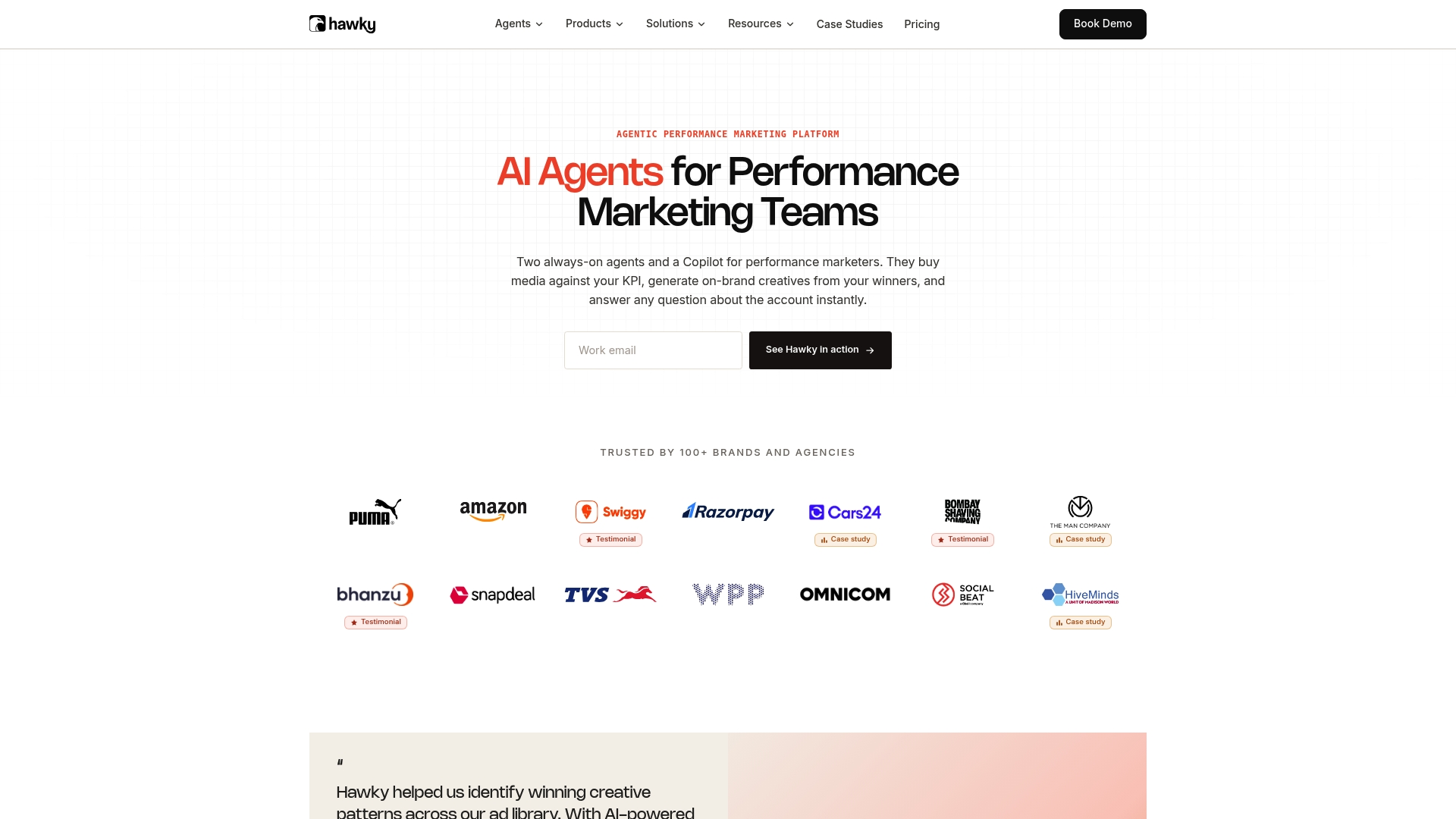
AI agents buy and optimize media campaigns 24/7, then convert winning creative variants into ready-to-run assets and conversational recommendations. The system stores decisions in shared memory so future campaigns learn from past outcomes. A plain-language Copilot answers campaign questions and suggests actions you can run without deep reporting work.
Core Features
AI agents handle bidding, budget allocation, and campaign optimization across Meta Ads, Google Ads, and YouTube while generating creatives from top performers. The platform records outcomes in shared memory to refine agent behavior and offers a plain-language conversational Copilot for insights and commands. Competitor monitoring and GA4 signals feed decisions for ongoing adjustment.
Key Differentiator
Hawky centers on autonomous agents that both buy media and produce creatives, closing the loop between performance signals and creative output in real time. That combination lets the system react to KPI shifts and push revised ads without manual handoffs, so creative testing and budget moves happen inside the same operational flow.
Pros
Automation removes repetitive campaign tasks and reduces the number of manual adjustments your team makes each day. The Copilot turns complex telemetry into clear answers so you can act faster without parsing dashboards. Shared memory helps campaigns improve over time by keeping contextual rules and learnings available across accounts and teams.
Cons
- Setup can be complex. Integration with existing ad accounts and CRM systems may require engineering support and time.
- Some teams will want stricter manual controls. Full agent autonomy demands governance and change to approval workflows.
- Pricing mixes a subscription minimum with KPI-tied upside, which can be harder to forecast than fixed-tier plans.
When It May Not Fit
If your team requires tight step-by-step manual control over bidding and creative rotation, Hawky’s agent-first model may feel too hands-off. Small teams with limited engineering bandwidth should account for integration work. Organizations that need predictable fixed pricing may prefer a vendor with clear tiered plans instead of outcome-linked fees.
Notable Integrations
- Meta Ads
- Google Ads
- YouTube
- GA4 Web Analytics
- CRM systems (upon integration)
- Slack and Teams
Who It’s For
Performance marketing teams and digital agencies managing multi-platform spend on Meta, Google, and YouTube that want to reduce day-to-day campaign work. Ideal buyers run frequent tests, rely on rapid bid adjustments, and can allocate time to govern autonomous agents. Teams with an existing analytics implementation will get faster value.
Real World Use Case
A brand hands social ad buying to Hawky’s agents and lets them update bids and swap creatives as KPI signals change. The team spends fewer hours on manual optimization and uses the Copilot to ask why conversions dipped. Creative winners flow automatically into new variants for follow-up testing.
Pricing
The vendor bills a subscription minimum plus KPI-tied upside and offers a pilot phase for initial setup and calibration. Exact figures are tailored to usage scale and are not listed publicly.
Website: https://hawky.ai
Comparison of alternatives
Collaborative ad creative platforms differ significantly by how they address specific aspects of campaign production and management.
Where audience validation adds to campaign precision
PopJam sets itself apart by offering synthetic audience simulation, providing detailed feedback on creative effectiveness before launch. This feature is uniquely powerful for teams aiming to avoid guesswork during campaign setups. Sivi supplies editable components tailored for multilanguage campaigns, but this differs in focus from PopJam’s pre-launch validation strengths.
Where video-first workflows drive impact
AdPipe excels in supporting extensive video-oriented campaigns for enterprises. With features for scene-by-scene analytics and media asset management, AdPipe enables rapid iterations tailored for large-scale visual projects. Agencies coordinating high volumes of video ads can leverage this expertise effectively.
Best fit
- Performance marketers seeking to understand and preempt audience reactions without requiring live tests should consider PopJam.
- Teams focusing on layered visual design outputs and global campaign versions will appreciate Sivi for its sophisticated file structures and multilanguage capabilities.
- Agencies handling expansive multimedia campaigns, including personalized video experiences, should evaluate AdPipe.
- Small teams preferring in-application tools and accessible pricing plans may find ADSgpt advantageous.
Our pick
PopJam remains our top choice for digital marketers and brands prioritizing ad validation efficiency due to its unique capability to combine creative material generation with reliable synthetic audience testing. While it outshines others in this regard, teams requiring extensive design customizability or video-detailed analytics might prefer Sivi or AdPipe, respectively.
Here is a comparison of the leading AI-based ad creative generation platforms to help identify the most suitable solution for your needs.
| Product | Key Differentiator | Best For | Pricing | Notable Limitation |
|---|---|---|---|---|
| POPJAM | Integrates creative generation with AI audience validation workflow | E-commerce merchants, SaaS companies, agencies | Free-€399/mo, Enterprise custom pricing | Requires manual fine-tuning for exact brand tone |
| Sivi | Generates multi-language, editable, layered formats | Marketing teams running global multi-language ads | Free-$16/mo, higher tiers available | API features may require higher-tier plans |
| AdPipe | Links scene-level video content analysis with performance metrics | Global brands, enterprise video-focused workflows | Price not published | Requires quality input footage for best results |
| Bannerwise | Focuses on no-code creation of HTML5 and display ad formats | Teams creating high-volume ad variations | Starting at €275/mo | Advanced localization features are add-ons, increasing cost |
| AdsGPT | Utilizes extensive competitor ad database for generative strategies | Performance-oriented agencies, frequent campaigners | Free-$24/mo, custom for enterprise | Limited depth in attribution metrics |
| Hawky | Employs autonomous agents for marketing and creative adjustments | Cross-platform performance marketers, large agencies | Price not published | May require engineering input for initial integration setup |
Overcoming Ad Creative Uncertainty With AI-Powered Testing
Many marketing teams face wasted ad spend because launching creatives without understanding audience reaction feels like posting and praying. This challenge blocks performance marketers, agencies, and e-commerce merchants from confidently scaling campaigns. POPJAM tackles this head-on by combining AI ad creative generation with synthetic buyer persona testing. With 500 free starter credits, you can generate multiple ad variants and validate them against psychographic profiles before launch.
- Generate on-brand visuals for Facebook, Google, TikTok, LinkedIn, and Reddit
- Avoid privacy concerns using GDPR-compliant synthetic personas
- Export validated winners in platform-ready formats
See how POPJAM cuts creative fatigue and sharpens campaign focus through data-driven validation. Visit POPJAM to test your creatives with AI-powered audience simulation and reduce costly trial and error today.
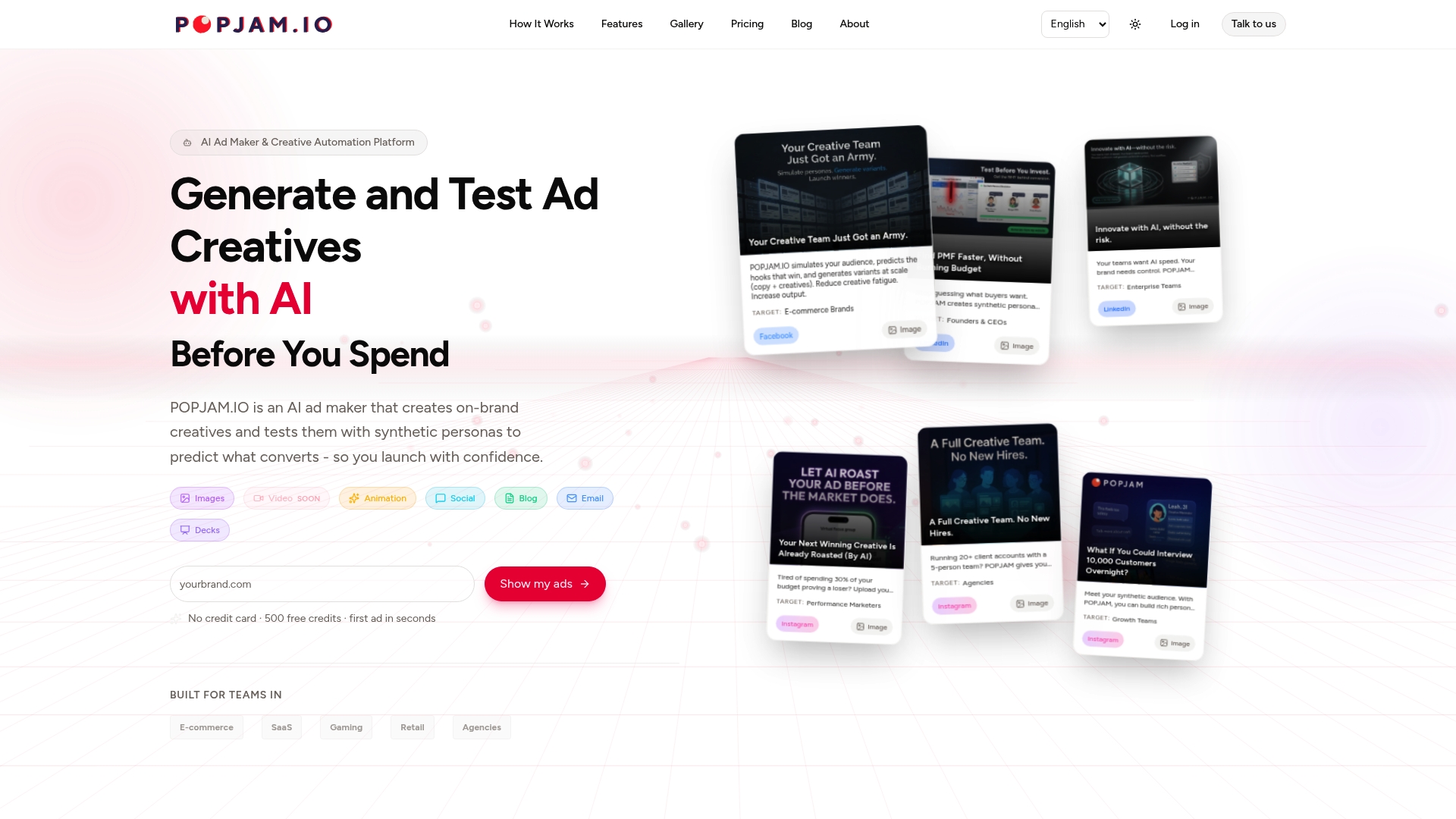
Get started with POPJAM and run your next campaign using AI-driven audience feedback to pick winning creative variants.
FAQ
How does POPJAM support multi-channel ad creation?
POPJAM automates ad creative generation for multiple platforms, including Meta, Google, TikTok, LinkedIn, and Reddit. It exports validated winners in native formats, ensuring proper adherence to each platform’s specifications. This capability streamlines the launch process for marketing teams across various channels.
What is the difference between POPJAM and Sivi?
Sivi excels at producing layered, editable designs that maintain separate text, vector, and image elements, making it ideal for teams needing high levels of customization. In contrast, POPJAM focuses on generating and validating ad creatives using synthetic personas, which is a more efficient workflow for pre-launch testing in paid media campaigns.
Can I use POPJAM if I need to test different ad variations quickly?
Yes, POPJAM’s automated workflow significantly shortens the path from concept to launch while validating ad creatives against AI audience personas. This means that marketing teams can quickly iterate on ads based on real-time feedback, making it easier to identify winning variations without manual effort.
How does POPJAM ensure compliance with privacy regulations?
POPJAM utilizes GDPR-compliant synthetic buyer personas for audience testing, allowing marketing teams to validate creatives without collecting direct customer data. This setup reduces privacy concerns while enabling effective testing before launch.
What pricing tiers does POPJAM offer for small teams?
POPJAM features a free plan with 500 starter credits, which allows teams to experiment with ad creation at no initial cost. This makes it accessible for smaller teams looking to test concepts before committing to a paid tier.