

Performance Creative Strategy: A Playbook That Ships Winners
Performance creative strategy turns creative assets into measurable growth levers by treating every ad, video, and image as testable, optimizable inventory rather than a one-off design project. It works when five things are in place before a single asset gets built: a defined objective, a real audience insight, a testable hypothesis, a rigorous test structure, and a clean way to measure what actually moved.
Here’s the short version of what you need to know before you build anything:
- Objective: one primary metric (CTR, conversion rate, ROAS) that decides winners
- Audience insight: something specific and true about the buyer, not a demographic guess
- Creative hypothesis: a single-minded proposition you can prove or kill in a test
- Testing structure: A/B, holdout, or incrementality design matched to your budget and traffic
- Measurement plan: a KPI hierarchy that separates real lift from noise
The rest of this guide walks through the full playbook, including a creative brief template, an experiment design cheat sheet, and the pre-launch validation methods that catch bad creative before it burns media budget.
Key Takeaways
Performance creative strategy works when objectives, audience insight, and a testing framework are locked in before production starts, not adjusted after the fact.
| Point | Details |
|---|---|
| Define one metric first | Every creative test needs a single primary KPI agreed before scripting begins. |
| Mine internal data | Reviews, support tickets, and sales calls surface real tension points scripts alone miss. |
| Batch variants for power | Test five to eight variants per cycle instead of one at a time to reach significance faster. |
| Separate signal from noise | Confirm early wins with a second read before scaling budget on any single variant. |
| Validate before spending | Tools like POPJAM.IO simulate audience reactions with synthetic personas to catch weak creative before media dollars go out. |
Table of Contents
- What Is Performance Creative Strategy and How Does It Differ From Brand Creative?
- Why Performance Creative Matters: The Business Case
- What Are the Core Components of a Performance Creative System?
- How Do You Build a Performance Creative Strategy Step by Step?
- What Measurement and KPIs Actually Matter for Performance Creative?
- What Tools and Workflows Support a Performance Creative Stack?
- Does Pre-Launch Persona Testing Actually Reduce Wasted Spend?
- What Are the Biggest Risks in Performance Creative Strategy?
- What Does a Complete Creative Brief Look Like in Practice?
- What Do Marketing Teams Consistently Get Wrong About Performance Creative?
- How POPJAM.IO Helps Implement Performance Creative
- Sources
- FAQ
What Is Performance Creative Strategy and How Does It Differ From Brand Creative?
Performance creative is built to be measured and killed fast. Brand creative is built to be remembered over months or years. That single distinction changes everything downstream, from who signs off on the work to how you judge whether it succeeded.
Traditional brand creative optimizes for recall, sentiment, and long-arc association. A beer brand running a Super Bowl spot isn’t expecting someone to buy a six-pack in the next ten minutes. Performance creative optimizes for an action, usually within a defined attribution window, and it treats every variant as disposable if it doesn’t move the metric. Storyflow’s framing of creative strategy as a “Spine” connecting objective, insight, and idea applies to both worlds, but performance creative shortens that spine dramatically and adds a scoreboard.
The operational difference shows up in three places:
- Speed of iteration: performance teams ship new variants weekly or daily; brand teams ship quarterly or annually.
- Success criteria: performance work lives or dies by a number; brand work often relies on qualitative or delayed signals like brand lift studies.
- Team structure: performance creative usually sits closer to media buying and analytics, while brand creative sits closer to strategy and design leadership.
“A strong creative strategy makes the right idea obvious and the wrong idea hard to justify.” That’s the core function of the constraint, whether you’re building a Super Bowl spot or a Meta carousel ad.
Example callout: Imagine a skincare brand with the idea “clear skin gives you confidence.” As brand creative, that becomes a 60-second film with a model walking into a room with new self-assurance, no product close-up needed for 40 seconds. As performance creative, the same insight becomes a 6-second UGC-style clip: a woman touching her face in a mirror, a text overlay reading “3 weeks, no filter,” and a product shot by second two. Same insight, completely different execution logic.
Pro Tip: If your team can’t agree on whether a creative brief is for performance or brand work, ask one question: what single number decides if this succeeded? If nobody can answer in five seconds, you’re not ready to produce.
Use performance creative when you have a direct-response goal, a testable budget, and traffic volume that can reach statistical confidence within a reasonable window. Use brand creative when the goal is awareness, sentiment, or category association that won’t show up in a 7-day attribution window no matter how good the creative is.
Why Performance Creative Matters: The Business Case
Performance creative work drives measurably higher click-through rates, better conversion rates, and less wasted media spend than creative built without a testing discipline. That’s the pitch marketing leaders use when they want budget reallocated toward creative testing instead of just media optimization.
The evidence for this isn’t marginal. Research cited in Storyflow’s creative strategy guide points to Nielsen and IPA analyses attributing roughly half of a campaign’s sales impact to the creative itself, not the targeting or the media buy. That number should reframe how budget gets split between “who we show it to” and “what we actually show them.” Media targeting has gotten more commoditized across platforms; creative differentiation has become the lever marketers actually control.
Concrete outcomes teams see when they run a real performance creative process:
- Higher CTR from hooks tested against multiple audience angles instead of a single guess
- Improved ROAS because underperforming variants get killed before they burn spend
- Reduced creative fatigue because a testing pipeline keeps fresh variants entering rotation
- Faster time-to-signal because hypotheses are structured to be provable or disprovable within days, not weeks
The campaigns that see the biggest gains from this shift are usually the ones running on platforms with fast feedback loops and large enough audiences to reach significance quickly, think Meta and TikTok direct-response campaigns, versus long sales-cycle B2B campaigns where the feedback loop is inherently slower.
What Are the Core Components of a Performance Creative System?
A performance creative system is built from six connected parts: objectives and KPIs, audience insight, creative constraints, variant production, a testing framework, and a decision engine that turns results into action. Miss any one of these and the system breaks down somewhere between “we made some ads” and “we know why they worked.”
- Objectives & KPIs: the single metric that defines a win, plus guardrail metrics that catch unintended damage (brand sentiment, frequency, cost per acquisition creeping up even as CTR looks good)
- Audience insight and synthetic personas: real signals about what your buyer actually cares about, sourced from reviews, support tickets, and sales calls, sometimes modeled through synthetic personas that simulate reactions before spend goes live
- Creative constraints: the boundaries that turn a broad insight into a specific, testable proposition. Constraints are what separate strategy from a mood board.
- Variant production: the actual assets, built in batches so you can test multiple hooks, formats, and angles without a full production cycle for each one
- Testing framework: the structure (A/B, holdout, bandit) that decides which variants get more budget and which get killed
- Analytics and governance: the reporting layer and the sign-off process that keeps decisions consistent across a team
Ownership matters more than most teams admit. Someone needs to own the objective (usually a growth or performance marketing lead), someone needs to own the creative constraint (often a creative strategist or brand manager), and someone needs to own the optimization calls once data starts coming in. When those three roles collapse into one overworked person, or worse, into nobody, testing programs stall out within a quarter.
How Do You Build a Performance Creative Strategy Step by Step?
The playbook runs in six stages: define objectives, mine data for insight, turn insight into testable hypotheses, produce variants in batches, run structured experiments, and scale the winners while preserving the constraint that made them work.
Step 1: Define objectives and guardrails
- Pick one primary metric (CTR, CVR, ROAS, cost per action)
- Set a SMART target tied to a business outcome, not a vanity benchmark
- Add one or two guardrail metrics that catch damage the primary metric might hide
Step 2: Mine internal data and build synthetic personas
- Pull recurring language from customer reviews, support tickets, and sales call notes
- Identify the specific tension or objection that shows up again and again
- Build synthetic personas that model how different buyer segments might react to a given angle before you spend a dollar on media
This research phase is the most skipped step in the entire process, and it’s usually the reason a “creative testing program” produces ten variants of the same idea instead of ten genuinely different hypotheses. Mining real customer language, not marketer assumptions, is where the actual signal lives.
Step 3: Turn insight into a single-minded proposition
- State the insight in one sentence a customer would actually say
- Write a single-minded proposition: one idea, provable or killable in one test
- Define the creative constraint that keeps every variant tied to that proposition
| Approach | Best for | Speed to signal |
|---|---|---|
| Single hero ad, no variants | Small budgets, brand-safe launches | Slow, no comparative data |
| 3 to 5 hook variants, same offer | Direct-response with moderate budget | Fast, within days on paid social |
| Full matrix: hook x format x CTA | Scaled programs with strong traffic | Fastest, but needs volume for significance |
“The strategy is the structured argument and constraints. The brief maps those constraints into execution.” Teams that confuse the two end up producing beautiful ads that never had a hypothesis to prove.
Step 4: Produce variants in batches
- Script multiple hooks against the same core proposition instead of one script per concept
- Batch formats (6-second cut, 15-second cut, static, carousel) from the same shoot or generation session
- Tag every variant with the hypothesis it’s testing, not just a creative name
Pro Tip: Batch at least five to eight variants per test cycle. Testing one variant at a time doesn’t give you statistical power, and it burns your test budget on sequential learning instead of parallel learning.
Step 5: Launch experiments and monitor early signals
- Choose your test structure: A/B split, holdout group, or geo-based incrementality test
- Set a minimum spend or impression threshold before you look at results
- Watch for early signal without pulling the plug too soon; pause clear losers, let borderline performers run to significance
- Confirm the winner with a second read before you commit budget
Step 6: Scale winners without losing the constraint
- Increase budget on the winning variant in controlled increments, not all at once
- Preserve the exact creative constraint that produced the win when you build follow-up variants
- Retire the format once frequency and fatigue signals start climbing, even if performance still looks decent
Compact creative brief template:
| Field | What goes here |
|---|---|
| Objective | The one metric this creative needs to move |
| Audience insight | The specific tension, in the customer’s own words |
| Single-minded proposition | One sentence, one idea |
| Mandatories | Brand, legal, and platform requirements |
| Measurement | KPI, test structure, and minimum spend threshold |
Smartsheet’s creative strategy templates offer a solid starting structure if you want to build this out further inside your existing project management tool, and Asana’s creative strategy guide covers how to run this as a structured project with checkpoints instead of an open-ended creative sprint.
What Measurement and KPIs Actually Matter for Performance Creative?
Measurement design is the real limiter of a performance creative program. A brilliant hypothesis tested with a broken measurement setup produces a false winner, and false winners are more expensive than no winner at all because you scale the wrong thing.
Build a KPI hierarchy with three tiers. The north star is the business outcome you actually care about, usually revenue or profitable customer acquisition. Activation metrics sit one level down: CTR, conversion rate, ROAS, the numbers that predict the north star reasonably well and update fast enough to act on. Diagnostic metrics explain why something worked: hook retention rate, thumbstop rate, scroll depth, video completion at key seconds. Tie each diagnostic metric back to a specific creative element (the hook, the CTA placement, the pacing) so a win or loss tells you something reusable.
Match your experiment design to your traffic and budget:
- A/B tests work well when you have enough volume to reach significance within days and only need to compare two or three variants
- Multi-armed bandits fit high-volume, high-variant-count situations where you want the system to shift budget toward winners automatically instead of waiting for a clean split test to finish
- Holdout groups answer the incrementality question directly: would this outcome have happened anyway without the creative or campaign
- Geo holdouts work when platform-level holdouts aren’t available or reliable, letting you compare matched regions with and without exposure
Attribution pitfalls trip up even experienced teams. A creative that spikes CTR but tanks downstream conversion rate isn’t a winner, it’s a clickbait problem wearing a winner’s costume. Early signal within the first 24 to 48 hours often reflects novelty rather than durable performance, so resist scaling a variant off day-one numbers alone. Nielsen and IPA analysis referenced by Storyflow backs the broader point here: creative quality drives a meaningful share of sales impact, which means the temptation to over-index on short-term click metrics at the expense of actual conversion and retention data is one of the costliest habits in performance marketing.
What Tools and Workflows Support a Performance Creative Stack?
A performance creative stack needs six tool categories working together: analytics, creative generation, production, media activation, creative analytics, and an identity or privacy layer that keeps testing compliant. Missing any one of these creates a gap where good data dies before it reaches a creative decision.
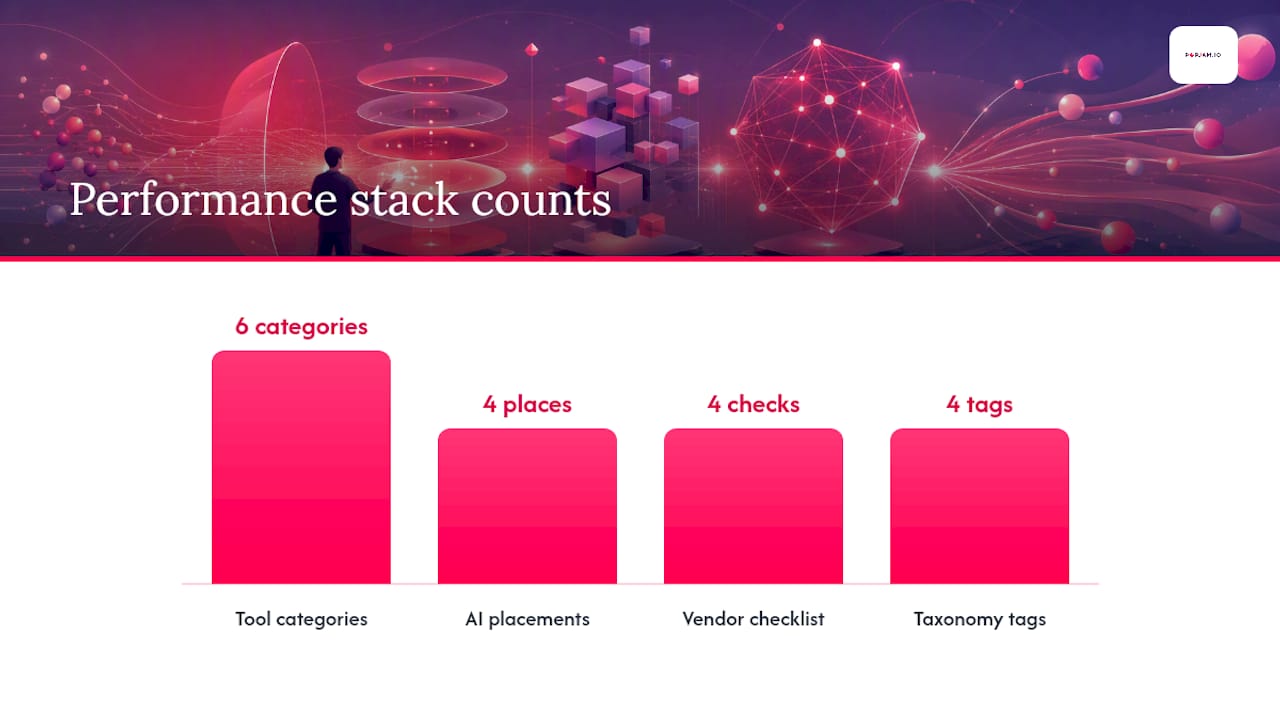
AI fits into this stack in four specific places right now: ideation (generating hook and angle variations fast), persona simulation (modeling how different segments might react before spend), creative scoring (predicting performance signals from the asset itself), and automated variant generation (producing format and length variations from a single source asset). Industry reporting on AI-powered creative science points to a broader trend here: vendors are increasingly pairing AI-generated creative with unified data layers and real-time decisioning, moving well past last-click attribution as the only signal that matters.
When you’re evaluating vendors and building your integration priorities, check for:
- Data orchestration that connects creative metadata to your existing analytics stack, not a walled-off dashboard
- Sub-second decisioning if you’re running CTV or live environments where budget shifts need to happen in real time
- Creative score APIs that let you pull predictive scores into your own reporting instead of logging into another platform
- Clean naming standards and metadata tagging so every variant carries its hypothesis, format, and hook type as searchable fields
Instrumentation is the boring part everyone skips and everyone regrets skipping. A creative taxonomy that tags hook type, format, offer, and persona target turns your test history into a searchable library instead of a graveyard of file names like “final_v3_USE_THIS.mp4.” Teams that build this discipline early can answer “what hook types work best for this audience” a year later. Teams that don’t are re-litigating the same tests every quarter. Creative automation platforms that handle this tagging automatically save real time here versus manual spreadsheet tracking.
Does Pre-Launch Persona Testing Actually Reduce Wasted Spend?
Simulated persona validation catches weak creative before it reaches a real audience, which means less media budget spent learning what a five-minute simulation could have told you for free. This is the step most performance teams skip entirely, mostly because until recently there wasn’t a practical way to do it without running the actual test live.

Building a synthetic persona starts with the same internal data you’d use for creative insight: reviews, support tickets, sales call transcripts, and any public signal about how your buyer segments talk and think. From there, you construct psychographic profiles that reflect not just demographics but motivations, objections, and language patterns. A well-built synthetic persona should react to a proposed creative angle roughly the way a real member of that segment would, flagging confusion, disinterest, or genuine resonance before you spend a dollar on media.
A simplified version of what this mapping looks like in practice:
| Persona | Predicted reaction to price-led hook | Predicted reaction to social-proof hook | Early KPI threshold to watch |
|---|---|---|---|
| Value-driven first-time buyer | Strong positive | Neutral | CTR above account average |
| Repeat customer, brand-loyal | Neutral to negative | Strong positive | Conversion rate, not CTR |
| Price-sensitive comparison shopper | Strong positive | Weak positive | Cost per click ceiling |
Case study callout: A direct-to-consumer brand testing a new supplement line ran synthetic persona simulations against three creative angles before launch. The price-led angle scored well with the comparison-shopper persona but flagged confusion with the brand-loyal segment, exactly the kind of mismatch that would have shown up as a confusing mixed result three days into a live test. The team adjusted the brief to split the angles by audience segment before spend went live, which meant the first real test cycle produced a clean read instead of a muddled one.
Pro Tip: Bias control matters here. If your synthetic personas are built entirely from your best customers’ reviews, you’ll get an optimistic echo chamber. Pull in support tickets and lost-deal notes too, so the personas reflect friction as well as enthusiasm.
Pre-launch simulation doesn’t replace live testing. It filters out the obviously weak hypotheses so your live test budget goes toward genuinely close calls instead of predictable losses.
One tight sentence to carry forward: synthetic persona testing shortens the distance between “we have an idea” and “we know if it’s worth spending on,” which is the entire point of a performance creative system.
What Are the Biggest Risks in Performance Creative Strategy?
Three risks account for most of the damage in performance creative programs: privacy and personalization tradeoffs, overfitting to short-term signals, and creative fatigue from audience saturation. Each one has a specific fix, and none of them require abandoning the testing discipline itself.
Privacy and personalization tradeoffs: Platforms have tightened targeting options, and consumers are more aware of how their data gets used. Keep first-party data collection transparent, minimize the personal data you actually need for a given campaign, and build personas from aggregated behavioral patterns rather than individually identifiable records. If your program touches EU or UK audiences, GDPR-compliant data handling isn’t optional, confirm your synthetic persona and testing tools handle audience data lawfully before you scale a program on top of them.
Overfitting to short-term signals: Chasing a 24-hour CTR spike without confirming downstream conversion leads teams to scale creative that looks good and performs poorly. Fix this by requiring a minimum observation window before declaring a winner and by tying scaling decisions to the north star metric, not the fastest-moving diagnostic one.
Creative fatigue and audience saturation: Frequency creep is the quiet killer of otherwise good creative. Fixes here are mostly operational:
- Set a frequency cap threshold that triggers a creative refresh review, not just a media adjustment
- Track a freshness metric (click-through decay rate over time) alongside performance metrics
- Build a creative retirement rule into your governance process so winning variants get rotated out before performance visibly collapses
- Keep a pipeline of new variants entering rotation on a fixed cadence, not just reactively when performance drops
What Does a Complete Creative Brief Look Like in Practice?
A working creative brief maps five things in order: objective, insight, single-minded proposition, mandatories, and measurement. Everything else, tone, visual style, talent, gets decided downstream of those five, not before them.
Creative brief template:
- Objective: the one metric this creative needs to move
- Audience insight: the specific tension, stated in the customer’s own words
- Single-minded proposition: one sentence, one idea
- Mandatories: brand, legal, and platform requirements
- Measurement: KPI, test structure, minimum spend threshold, and decision deadline
Pro Tip: Keep the brief itself under one page. If the single-minded proposition needs a paragraph to explain, it isn’t single-minded yet.
“A strong creative strategy makes the right idea obvious.” A one-page brief either does that job or it doesn’t, and a bloated brief is usually a sign the strategy step got skipped.
Three short examples show how the same brief structure produces different executions depending on the constraint:
Commerce example:
- Objective: ROAS on paid social
- Insight: shoppers abandon carts over shipping cost uncertainty, not price itself
- Proposition: “free shipping, no minimum, shown before checkout”
Lead-gen example:
- Objective: cost per qualified lead
- Insight: buyers distrust vague “book a demo” CTAs without a clear value preview
- Proposition: “see your custom quote in 60 seconds, no call required”
Brand-response example:
- Objective: branded search lift plus direct conversion
- Insight: category skepticism runs high due to past bad experiences with competitors
- Proposition: “we guarantee it works, or your money back, no fine print”
| Format | Derived from | Length |
|---|---|---|
| Social cut | Commerce brief, shipping proposition | 6 seconds |
| Full video variant | Same commerce brief, expanded proof points | 30 seconds |
The 6-second cut leads straight with the shipping claim and a product shot. The 30-second version adds a customer testimonial style scene, a price comparison, and a slower reveal of the same shipping guarantee. Same brief, same proposition, two completely different paces because the format demands it.
What Do Marketing Teams Consistently Get Wrong About Performance Creative?
The most common mistakes are vague objectives, confusing the brief with the strategy, and skipping pre-production research entirely. All three are fixable in a week, and none of them require new tools or bigger budgets, just discipline about sequencing.
Vague objectives show up constantly: “drive engagement” or “boost brand awareness” without a single measurable target attached. The fix is blunt: define one metric before anyone opens a script document. If a team can’t name that metric in the kickoff meeting, the project isn’t ready to move forward.
Confusing the brief with the strategy is subtler and more damaging. A brief is a document; a strategy is an argument, the connected chain from objective to insight to proposition that makes the brief’s instructions make sense. Teams that skip straight to writing a brief without doing the strategic work upstream end up with beautifully executed ads built on nothing. The fix is procedural: no brief gets written until the objective, insight, and proposition are agreed and written down first.
Skipping pre-production research is the most expensive mistake because it’s invisible until the results come in flat. Teams that mine reviews, support tickets, and sales call notes before scripting consistently uncover tension points that generic brainstorming misses entirely. This is unglamorous work, and it’s usually the first thing cut when a deadline tightens, which is exactly backward. Quick fixes worth enforcing immediately:
- Define one metric per creative test, written down before kickoff
- Mine at least one internal data source (reviews, tickets, calls) before writing any script
- Enforce the creative constraint in review, kill variants that drift from the single-minded proposition
- Standardize metadata and naming across every variant so test history is searchable later
None of these fixes require new headcount. They require a team willing to slow down for one week at the start of a program so the next twelve weeks of testing actually produce learnings instead of noise.
How POPJAM.IO Helps Implement Performance Creative
POPJAM.IO reduces wasted ad spend and accelerates winner discovery by combining AI-assisted creative generation with synthetic persona testing and creative performance analytics, all before a dollar goes to media. Instead of guessing which hook, angle, or format will land, you get a data-driven read on how different buyer segments are likely to react, right at the point where changes are cheap.
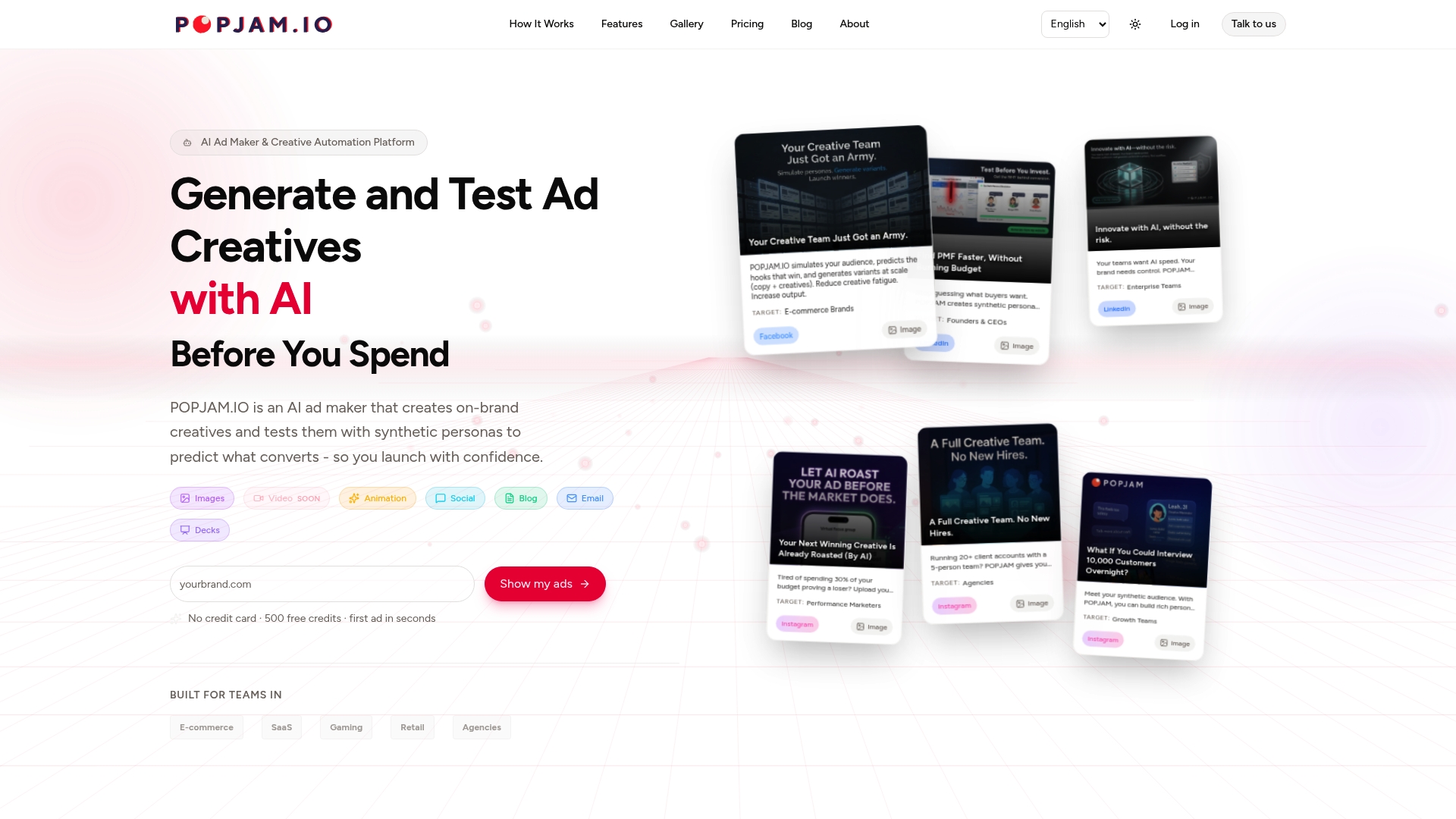
The platform generates on-brand ad creatives across images, video, animation, social posts, email, and presentations, then runs them against synthetic buyer personas built to reflect real psychographic profiles rather than broad demographics. That gives you qualitative and quantitative feedback before launch, plus creative performance analytics once assets go live across Meta, TikTok, YouTube, and programmatic flows.
Here’s what that looks like inside the playbook covered above: you build your single-minded proposition, generate five to eight variants through POPJAM, run each one against relevant synthetic personas to catch weak hooks early, then push only the strongest candidates into a live A/B test on your ad platform of choice. The step that used to cost you three days and real media budget now happens before launch.
If you’re responsible for creative output on a performance team and tired of finding out a hook doesn’t work only after the invoice arrives, start testing your ad creatives with POPJAM’s AI ad generator and see how a pre-launch read changes what you scale.
Sources
These sources back the frameworks used throughout this guide, and each one goes deeper into a specific piece of the playbook worth studying further.
- What Is Creative Strategy? The Complete Guide (2026) | Storyflow
- Creative Strategy guide | Smartsheet
- A Guide to Creative Strategy | Asana
If you only have time to read one of these before your next planning meeting, read Storyflow’s guide first. It’s the piece that explains why a creative strategy has to function as a constraint, and that idea underpins nearly every other section of this playbook.
FAQ
What is a performance creative strategist?
A performance creative strategist is the person responsible for connecting business objectives to testable creative hypotheses, usually owning the brief, the testing framework, and the read on which variants scale. The role sits between creative production and performance marketing, translating data into creative constraints.
What is the 3-3-3 rule in marketing?
Definitions of the 3-3-3 rule vary by source and context, so there’s no single agreed version worth stating as fact here; if you’ve seen it referenced for a specific platform or campaign type, confirm the definition with that source directly.
What is an example of a creative strategy?
A skincare brand building its strategy around the insight “customers don’t trust before-and-after photos anymore” and the proposition “show the routine, not just the result” is a working example. Every execution, from a 6-second social cut to a 30-second video, stays tied to that single proposition.
What is the average salary of a creative strategist?
Creative strategist salaries vary widely by market, company size, and seniority, and no single reliable figure applies across the board. Check current listings on a source like LinkedIn or a salary aggregator for your specific market and role level rather than relying on a general estimate.
How does synthetic persona testing fit into a performance creative strategy?
Synthetic persona testing lets you simulate how different audience segments might react to a creative angle before spending media budget, catching weak hypotheses early. Platforms like POPJAM.IO build these personas from psychographic data to flag confusion or disinterest before a variant ever reaches a live test.
Recommended
- Pre-Launch Creative Testing: 2026 Playbook for Small Teams | POPJAM | POPJAM.IO Blog
- Pre-Launch Creative Scorecard: 5 Checks Before You Spend | POPJAM | POPJAM.IO Blog
- Ad Creative: A Practical Guide for Marketers | POPJAM.IO Blog
- Creative Automation: The Complete Guide for Performance Marketers (2026) | POPJAM.IO Blog