

Screen Google Display Ads With Synthetic Personas First
If you want fewer losing variants and higher CTR and CVR on the ads that survive, run every Google Display concept through synthetic persona pre-testing before it touches live budget. This is the practical fix for “post and pray” creative launches: you generate variants, simulate audience reactions with a platform like Popjam, and only send validated winners to real A/B tests. Validation research on synthetic audiences shows 70 to 85 percent agreement with real survey results on directional questions, which is enough signal to cut weak creative before it burns impressions.
What success looks like:
- Fewer duds reach live testing, so your A/B budget goes further
- Ranked variants give you a defensible shortlist instead of a guess
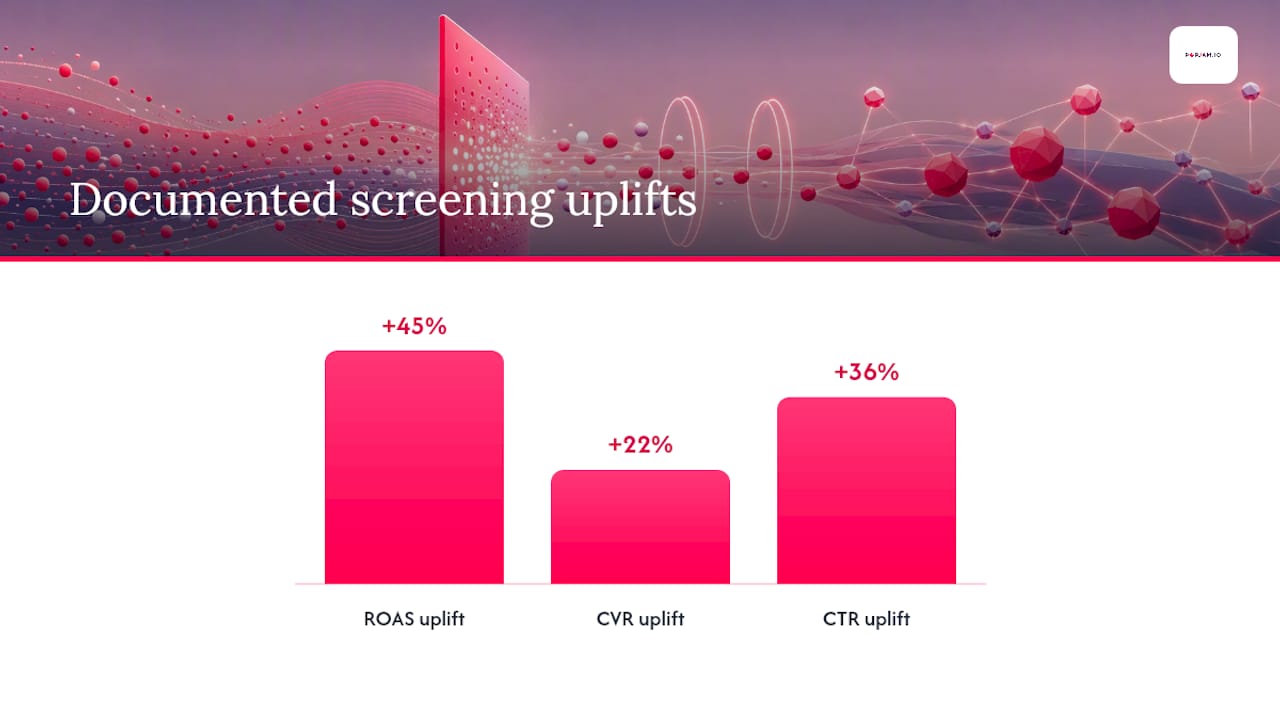
- Documented case studies report lifts as high as +36% CTR and +22% CVR when synthetic screening feeds disciplined live tests
Key Takeaways
Synthetic persona pre-testing filters weak Google Display creative before launch, using directional accuracy of 70 to 85 percent to protect live ad budget.
| Point | Details |
|---|---|
| Screen before you spend | Run 8 to 20 variants through synthetic personas before committing any Google Display budget. |
| Follow the five-step cycle | Define segments, brief the tool, present variants, query reactions, then rank and select survivors. |
| Change one variable at a time | Isolate headline, CTA, or imagery tests so you know exactly what moved a variant’s ranking. |
| Trust direction, not precision | Treat synthetic scores as rank-order signals within a 70 to 85 percent accuracy band, not exact forecasts. |
| Use POPJAM to execute the workflow | POPJAM.IO generates on-brand variants and runs synthetic persona simulation to shortlist winners before live A/B testing. |
Table of Contents
- Why Build a Synthetic Pre-Testing Step for Display Ads?
- What Is the Five-Step Workflow for Synthetic Display Ad Testing?
- What Should You Test in Google Display Creative?
- How Do You Turn Synthetic Results Into Live A/B Test Candidates?
- When Should You Validate With Real Human Research?
- What Do Real Google Display Testing Wins Look Like?
- Run Your First Google Display Pre-Test With POPJAM
- Sources
Why Build a Synthetic Pre-Testing Step for Display Ads?
Here’s the uncomfortable truth about most display campaigns: teams launch six variants, watch four of them flop, and call it “learning.” That’s expensive learning. Industry surveys find that about 40 percent of marketers want to test creative before spending money on it but skip the step because it costs too much time or cash. Synthetic persona testing removes that excuse.
The time compression alone changes how teams plan sprints. A screening round that used to take weeks of focus-group scheduling now runs in under 24 hours, start to finish. That means:
- You can test messaging angles on a Tuesday and have a live A/B test running by Thursday
- Creative teams get feedback before deadline pressure forces a “ship it and see” decision
- Agencies can screen client concepts without billing for a formal research phase
The value shows up in what you eliminate, not just what you launch. Synthetic panels are especially good at killing the bottom of the pack early, so the pool that reaches live traffic is already stronger. Case studies pairing synthetic screening with real validation report +45% ROAS in documented examples. Treat that as directional evidence of what disciplined testing can achieve, not a guarantee for your account. The predictive parity numbers above are averages across many campaigns, and your results will move around that range depending on category and creative quality.
What Is the Five-Step Workflow for Synthetic Display Ad Testing?
You don’t need a research department to run this. A practical five-step cycle fits inside a single afternoon once your team has done it twice.
- Define your segments with real psychographic detail. Skip “women 25 to 34” and build personas around values, buying triggers, and objections. A persona for a budget-conscious first-time SaaS buyer behaves nothing like one for an enterprise buyer evaluating vendor risk, and your synthetic panel needs that distinction to say anything useful.
- Brief the tool with brand context and the campaign goal. Tell it what “winning” means for this campaign: is it click-through, sign-up intent, or brand recall? Vague briefs produce vague rankings.
- Present 8 to 20 controlled creative variants, including a control. Keep the control identical to what’s currently running or what you’d default to, so every comparison has a baseline.
- Query the personas for comprehension, objections, and intent proxies. Ask what the ad is offering, what would stop them from clicking, and how likely they’d be to act. Confusion at this stage predicts confusion in the wild.
- Rank outputs, select your top 3 to 5 survivors, and push them into live A/B tests. This is the handoff point where synthetic data becomes real experimentation.
Pro Tip: Run your control variant through the synthetic panel even when you’re confident it will win. If a persona flags issues with your “safe” baseline, that’s often the most useful finding of the entire round.
Experts point to three pillars behind predictive accuracy here: comprehensive consumer data, detailed persona psychographics, and a rigorous testing method. Skip any one of those and your rankings get noisier.
What Should You Test in Google Display Creative?
Message clarity beats micro-design every time. Before you tweak a button color or swap a stock photo, make sure the headline and CTA actually communicate the offer. A synthetic panel that can’t tell what you’re selling will flag that immediately, and that’s a far bigger problem than font size.
Prioritize testing in this order:
- Headline and primary copy — does the value proposition land in the first five words?
- CTA phrasing — “Get Started Free” behaves differently than “Learn More” or “Shop Now”
- Hero imagery — test one visual concept against another, not five at once
- One visual treatment at a time — layout, color scheme, or product angle, isolated so you know what moved the needle
Change one variable per test round when you can. Stack three changes into a single variant and you’ll have a winner with no idea why it won.
Static versus animated display formats deserve different treatment. Synthetic personas read static creative reliably for message comprehension, but motion, pacing, and interaction design are harder for synthetic tools to evaluate fully. Use synthetic testing to validate the message and offer inside an animated ad, then reserve final motion and timing decisions for live sessions or a small human panel.

Pro Tip: Build your test matrix before you generate creative: one control, 8 to 12 exploratory variants, and clearly labeled persona segments. It keeps you from accidentally testing the same idea twice under different names.
How Do You Turn Synthetic Results Into Live A/B Test Candidates?
Three signals matter more than the rest: comprehension (did the persona understand the offer?), a purchase intent proxy (how likely are they to act?), and objection frequency (what’s stopping them?). A variant that scores high on intent but keeps triggering the same objection across personas needs a copy fix, not a launch.
Convert rankings into action with a simple rule: take your top 3 to 5 variants by combined comprehension and intent score, but only include a variant if it isn’t hitting a repeated objection more than a third of the time. That keeps you from launching something that “wins” on paper but confuses real buyers.
Watch for these pitfalls:
- Overreading precise-looking scores. A synthetic model returning “72% positive” doesn’t mean your live CTR will hit 72 percent. Predictive parity for synthetic audiences runs 70 to 85 percent on directional calls, and that’s a rank-order signal, not a forecast.
- Novelty effects. Personas sometimes reward the newest, flashiest variant simply because it’s different, not because it converts better.
- Experiential gaps. No synthetic panel has clicked your landing page or felt your checkout flow, so intent proxies are estimates, not lived reactions.
When Should You Validate With Real Human Research?
Synthetic testing is a filter, not a finish line. Reserve human panels for niche audiences your training data may underrepresent, culturally specific messaging, and any creative tied to a high-budget launch where a wrong call is expensive. Industry guidance is consistent here: use synthetic testing to filter fast, and save human research for final validation on your highest-stakes campaigns.
On accuracy, expect 70 to 85 percent directional parity as your baseline, with some calibrated, survey-trained tools performing toward the higher end of that range. A 90-day pilot keeps expectations realistic:
- Weeks 1 to 2: map your top three use cases (new campaign launch, creative refresh, seasonal push)
- Weeks 3 to 6: run synthetic trials alongside your existing process, not instead of it
- Weeks 7 to 10: build handoff rules for what graduates to live testing
- Weeks 11 to 13: review outcomes and fold learnings into your standard creative brief
Read more on when synthetic personas outperform focus groups before deciding your validation mix.
What Do Real Google Display Testing Wins Look Like?
The pattern in documented case studies is consistent: teams that pair synthetic screening with disciplined live validation see measurable lifts, not just faster decisions. One documented set of case studies shows results including +45% ROAS, +22% CVR, and +36% CTR when synthetic pre-testing feeds directly into live A/B rounds rather than replacing them.
The mechanism behind those numbers is simple. Synthetic panels catch the obvious losers, the confusing headline, the CTA nobody understands, the offer that doesn’t land, before they ever see an impression. That means the variants that reach your live test are already a stronger group than an unscreened batch would be. Your A/B test isn’t choosing between “good and terrible” anymore; it’s choosing between “good and better,” which raises the floor on every launch.
Display advertisers running seasonal or high-volume campaigns benefit most, since they generate enough creative variants to make screening worthwhile. A team launching one static banner a quarter has less to gain than a growth team iterating weekly across multiple audience segments. If you want a broader view of what strong Google Display creative looks like across formats, Google Ads example galleries are a useful reference point for structure and layout before you start generating variants.
Operational Tips From POPJAM
When teams adopt synthetic pre-testing, the biggest shift is where creative review happens. Instead of a Friday meeting arguing over which banner “feels right,” the debate moves earlier and gets grounded in persona-level feedback. POPJAM’s synthetic persona simulation and creative analytics were built for exactly that shift, giving teams comprehension and objection data before a single dollar hits Google’s auction. That reordering of the workflow, not any single feature, is what actually reduces creative fatigue.
Run Your First Google Display Pre-Test With POPJAM
POPJAM is the direct route to everything covered above: generate on-brand Google Display creative, simulate audience reactions against synthetic personas, and get comprehension and intent feedback before you commit ad spend. Instead of guessing which of your eight variants deserves budget, you get a ranked shortlist backed by psychographic feedback, GDPR-compliant by design, across formats including static and animated display assets.
For your first pilot, keep it simple. Pick one live or upcoming campaign, generate 8 to 12 creative variants with the AI ad maker, run two persona panels built around your actual buyer segments, and push your top three survivors into a live A/B test. That’s a full pre-launch screening cycle you can complete before your next campaign deadline. Start your first test with the free ad testing tool and see how your current creative ranks before you spend another dollar on unscreened variants.
Sources
For deeper background, see what synthetic personas are and how they’re built, how to test ad creatives before launch, and the Google ad generator built for Display and YouTube testing. External validation data comes from imarkinfotech’s synthetic audience research and neuroflash’s case-study analysis.
- How Synthetic Audiences Are Changing the Way Marketers Pre-Test Ads in 2026
- Synthetic Personas Done Right Reduce Creative Risk And Maximize Upside
FAQ
How accurate is synthetic persona testing for Google Display ads?
Validation studies show synthetic audiences agree with real survey results 70 to 85 percent of the time on directional questions, making it a strong screening tool rather than a precise forecast.
How many creative variants should I test at once?
Most workflows test 8 to 20 controlled variants including a control, then narrow to 3 to 5 survivors for live A/B testing.
Can synthetic testing replace live A/B testing entirely?
No. Synthetic testing filters out weak variants quickly, but niche audiences, culturally specific messaging, and high-budget launches still benefit from human validation before you scale spend.
Does POPJAM support Google Display ad formats specifically?
Yes, POPJAM generates and tests both static and animated creative for Google Display and other channels, using synthetic persona simulation to rank variants before launch.
How long does a synthetic pre-testing round take?
A full screening cycle, from defining personas to ranking outputs, typically runs in under 24 hours, compared to weeks for traditional focus groups.
Recommended
- What Are Synthetic Personas? AI Personas for Marketing | POPJAM | POPJAM.IO Blog
- Why Synthetic Personas Beat Real Focus Groups for Ad Testing | POPJAM.IO Blog
- AI Ad Generator for Gaming - Test Creatives Before You Spend | POPJAM.IO
- AI Ad Generator for Agencies - Test Creatives Before You Spend | POPJAM.IO