

Generative AI for Digital Marketing: 2026 Playbook
Run a 6- to 12-week pilot using generative AI to produce creative variants and synthetic audience simulations to predict lift before you spend a dollar on media. That’s the move. Industry data from 2026 shows that 96% of teams have adopted marketing automation and report an average 5x ROI when creative production is connected to closed-loop measurement. POPJAM is built exactly for this workflow: generate on-brand ad creatives, simulate audience reactions with Synthetic Personas, and take only the top-performing variants live.
Here’s what the pilot covers:
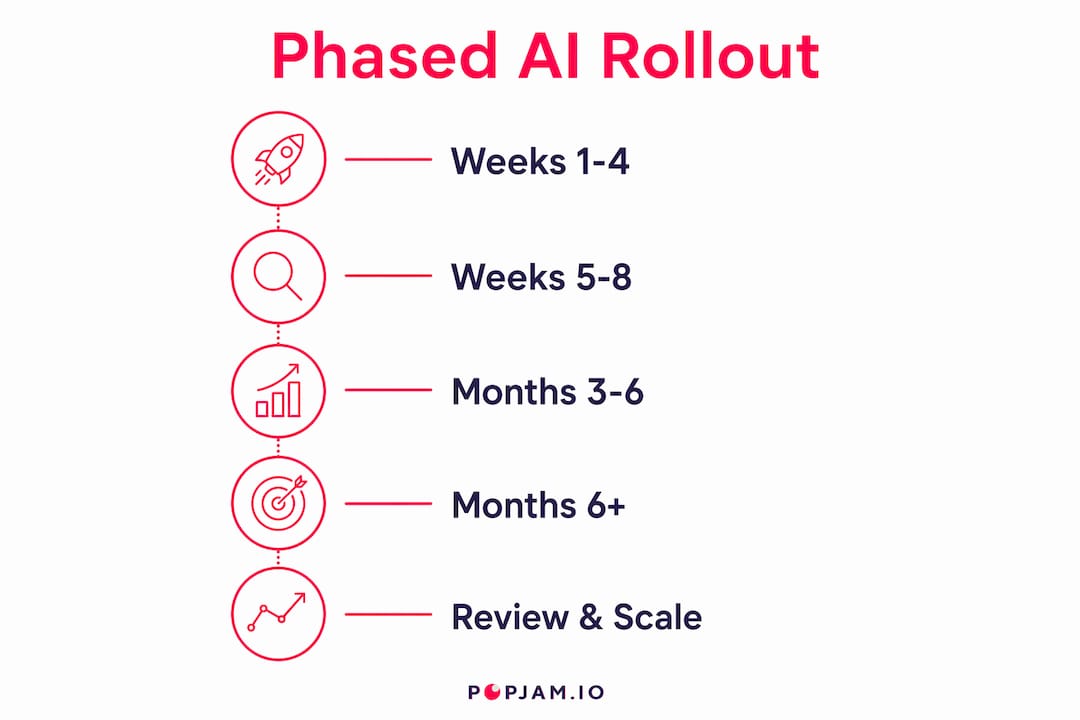
- Weeks 1–4: Unify your data and automate baseline reporting
- Weeks 5–12: Generate creative variants, build Synthetic Personas, and run simulation tests
- Months 3–6: Scale to ad optimization, automated bidding, and cross-channel orchestration
Table of Contents
- How does generative AI for digital marketing actually change creative workflows?
- What does a phased rollout actually look like, week by week?
- How do you integrate generative AI outputs into your existing workflows?
- How do you design synthetic audience simulations that give you real signal?
- What KPIs actually prove creative lift and tie it to revenue?
- What governance and privacy rules apply to AI-generated creative in the US?
- What are the most common mistakes teams make, and how do you fix them fast?
- One-page checklist: what to do, when, and what it costs
- POPJAM turns your creative ideas into tested, ready-to-launch ads
- Key Takeaways
- The part most playbooks skip
- Useful sources and next reads
- FAQ
How does generative AI for digital marketing actually change creative workflows?
The old way: produce a batch of creatives, launch them, wait two weeks for data, and kill the losers. The new way: simulate audience reactions before launch and only spend on creatives that already show signal.
Generative AI in marketing accelerates one-to-one messaging at scale, but the real unlock is pairing it with synthetic audience simulations. You get three concrete benefits:
- Speed: Iterate creative concepts in hours, not days
- Budget efficiency: Catch messaging mismatches before they burn impressions
- Better targeting decisions: Psychographic feedback tells you why a creative resonates, not just whether it did
Picture this: your team generates six headline variants for a SaaS free-trial ad. A simulation flags that Variant C uses loss-aversion framing that your “growth-minded early adopter” persona actively rejects. You cut it before launch. That’s the kind of signal that used to cost $10,000 in wasted media to discover.
What does a phased rollout actually look like, week by week?

Phase-based implementation reduces risk and speeds ROI. Here’s the roadmap:
Phase 1: Weeks 1–4 (foundation)
- Audit and unify data sources (CRM, ad platforms, analytics)
- Define baseline KPIs: CPM, CTR, conversion rate, customer acquisition cost
- Automate reporting dashboards so the team has a single source of truth
Phase 2: Weeks 5–12 (pilot)
- Build Synthetic Personas using real behavioral signals and psychographic profiles
- Generate 3–5 creative variants per ad set using generative models
- Run simulation tests and score variants against persona response models
- Identify top 2 variants per ad set and push to a small live A/B test
Phase 3: Months 3–6 (scale)
- Connect creative scoring to automated bidding rules
- Expand to cross-channel orchestration (Meta, Google, TikTok, LinkedIn)
- Introduce AI ad optimization for budget allocation and creative refresh cycles
| Phase | Objective | Owner | Success Criteria |
|---|---|---|---|
| Weeks 1–4 | Data unification + baseline reporting | Marketing Ops | Clean data pipeline; dashboard live |
| Weeks 5–12 | Creative generation + simulation pilot | Creative Lead + Analyst | 3+ variants tested; simulation scores vs. live CTR correlated |
| Months 3–6 | Scale + automation | Growth Lead | CAC down; creative refresh cycle under 2 weeks |
Effort estimates: Data unification runs 20–40 hours for a marketing ops lead. Persona design and simulation setup adds roughly 15–25 hours for an analyst. Creative production with generative models takes 5–10 hours per campaign once templates are set.
How do you integrate generative AI outputs into your existing workflows?
Integration is configuration, not replacement. Your brief-to-launch process doesn’t change structurally. You’re inserting generative steps into it.
Here’s a practical workflow:
- Brief — Creative strategist writes a campaign brief with audience, objective, and messaging pillars
- Generate — Generative model produces 3–5 copy and visual variants from the brief
- Simulate — Variants run through Synthetic Persona models; scores and qualitative feedback returned
- QA — Creative lead reviews top variants for brand voice and compliance
- Approve — Media buyer selects final ad sets and uploads to platform
- Report — Analytics pulls live performance and feeds back into the simulation model
| Role | Owns | Reviews |
|---|---|---|
| Creative Strategist | Prompts + brief | Simulation output narrative |
| Creative Lead | Brand QA + final selection | Variant scores |
| Analyst | Simulation setup + persona design | Live vs. simulated CTR delta |
| Media Buyer | Launch approval + budget | Platform performance |
Pro Tip: Lock your brand voice into a prompt template before you generate a single variant. A one-page brand voice doc — tone, vocabulary, banned phrases, visual style — fed into every generative prompt is the single fastest way to prevent creative drift at scale. POPJAM’s creative automation workflow supports brand guardrails natively.
AI decisioning with reinforcement learning adapts creative, timing, and channel selection in real time when it’s connected to unified customer profiles. That’s the long-term payoff of getting the integration right in Phase 1.
How do you design synthetic audience simulations that give you real signal?
Good simulations start with measurable hypotheses mapped to business KPIs. “Will this ad drive trial sign-ups from cost-conscious SaaS buyers?” is a testable hypothesis. “Will people like this?” is not.
Persona template:
- Demographics: Job title, company size, industry, geography
- Motivations: Primary goal this quarter, what success looks like for them
- Pain points: Top 2–3 friction points in their current workflow
- Likely channels: Where they spend time (LinkedIn, Meta, Google Search)
- Decision triggers: What moves them from awareness to action
Use real behavioral signals from your CRM and ad platform data to validate persona assumptions. Synthetic audiences are most useful when they’re built on real data and regularly checked against small live tests.
| Creative Variable | KPI Target | Minimum Sample Size |
|---|---|---|
| Headline framing (benefit vs. fear) | CTR lift vs. control | 500 simulated responses |
| Visual style (product vs. lifestyle) | Engagement score | 500 simulated responses |
| CTA copy (verb choice) | Conversion rate | — |
| Offer type (trial vs. demo) | Lead quality score | — |
Set a decision threshold before you run the simulation. For example: “We’ll only take a variant to live testing if it scores 15% above baseline on engagement and shows no negative sentiment flags from the target persona.” That threshold keeps you from chasing noise.
How to interpret results: A high engagement score with low purchase intent signals a creative that entertains but doesn’t convert. A low engagement score with high intent signals a creative that’s too direct for cold audiences. Both tell you something specific about where to iterate.
What KPIs actually prove creative lift and tie it to revenue?
Closed-loop measurement connects marketing activity to revenue. Here are the core metrics to track:
- CTR — Did the creative earn the click?
- CVR (conversion rate) — Did the landing experience convert?
- CPM — Are you paying less for the same reach as creative improves?
- Customer acquisition cost (CAC) — The number that ties creative performance to revenue
- Lead quality score — Are the leads converting downstream in the CRM?
Connect your ad platform data to your CRM so you can see which creative variants produced leads that actually closed. That’s the closed loop. Without it, you’re optimizing for CTR and ignoring whether those clicks ever became customers.
Reporting cadence:
- Daily (pilot weeks): Check CTR and CPM for anomalies; pause underperformers
- Weekly: Synthesize simulation scores vs. live performance; update persona models
- Monthly: Full ROI review; CAC trend; creative fatigue indicators
| Metric | Pilot Benchmark | Scale Benchmark |
|---|---|---|
| CTR | Establish baseline in Weeks 1–4 | 10–20% lift vs. baseline |
| CAC | Establish baseline in Weeks 1–4 | Trending down by Month 3 |
| Simulation-to-live CTR correlation | Track from first simulation | Target positive correlation by Week 12 |
What governance and privacy rules apply to AI-generated creative in the US?
The primary rule: your privacy posture and audit trail must map to your data sources and platform controls. Synthetic audiences built on real user data carry real compliance obligations.
US-focused privacy checklist:
- Confirm consent for any behavioral data used to build personas (check your privacy policy and data processing agreements)
- Avoid using sensitive attributes (race, religion, health status) in persona models unless your legal team has reviewed the use case
- Review platform policies for Meta, Google, TikTok, and LinkedIn on AI-generated creative disclosures
- Keep an audit log of which generative model produced each creative and which persona model scored it
Governance steps:
- Assign a creative compliance owner before the pilot launches
- Build an approval checklist: brand voice, legal review, platform policy check, disclosure tagging
- Run a quarterly audit of persona data sources to confirm consent status
Pro Tip: AI-generated creative governance is easier to build at pilot scale than to retrofit at production scale. Set your audit log and approval workflow in Week 1, even if it feels like overhead.
What are the most common mistakes teams make, and how do you fix them fast?
- Unclean data: Automation amplifies existing errors. Fix: audit and deduplicate your CRM and ad platform data before Week 5. This is the highest-value activity in the entire pilot.
- Over-automation: Autonomous ad agents can manage budgets across Google and Meta, but without human guardrails they’ll optimize for the wrong metric. Fix: set human review checkpoints at every budget reallocation decision.
- No brand guardrails: Generative models drift without constraints. Fix: lock brand voice into prompt templates and run every variant through a one-person brand QA step before simulation.
- Insufficient simulation sample sizes: A 50-response simulation tells you almost nothing. Fix: use the sample size minimums in the test matrix above and treat anything under 500 responses as directional only.
- Skipping the closed loop: Teams that optimize for CTR without connecting to CRM data miss the revenue signal entirely. Fix: integrate your ad platform and CRM before you scale past the pilot.
One-page checklist: what to do, when, and what it costs
Immediate (Weeks 1–4):
- [ ] Audit data sources and unify into a single reporting layer
- [ ] Define baseline KPIs and automate the dashboard
- [ ] Select generative AI platform and configure brand voice guardrails
Near-term (Weeks 5–12):
- [ ] Build 2–3 Synthetic Personas from real behavioral data
- [ ] Generate first creative batch (3–5 variants per ad set)
- [ ] Run simulations, set decision thresholds, push top variants to live A/B test
Scale (Months 3–6):
- [ ] Connect creative scoring to bidding automation
- [ ] Expand to all active channels
- [ ] Run monthly ROI review and creative fatigue audit
Cost and time bands:
| Tier | Monthly Platform Cost | Time to First Signal |
|---|---|---|
| Startup | — | 6–8 weeks |
| Growth | $500–$1,000 | 8–10 weeks |
| Enterprise | $2,000 | 10–12 weeks |
Industry data from 2026 shows that 96% of teams use marketing automation and report an average 5x ROI for these workflows. Email and reporting automations deliver the fastest measurable returns; creative and ad optimization compounds over a longer learning period.
POPJAM turns your creative ideas into tested, ready-to-launch ads
Most teams generate creatives and hope. POPJAM flips that. You generate on-brand ad creatives, run them through Synthetic Personas with real psychographic profiles, and see which variants win before you spend on media.
POPJAM is purpose-built for the playbook in this article. The platform covers synthetic persona creation, pre-launch simulation testing, creative performance analytics, and direct integrations with Meta, Google, TikTok, LinkedIn, and Reddit. E-commerce brands, SaaS companies, and agencies use it to cut creative waste and accelerate the learning cycle.
The ideal starting point: run your next campaign through POPJAM’s AI ad maker before it goes live. Generate 3–5 variants, simulate reactions across your target personas, and take only the top performers to media. That’s a pilot you can run this week.
Key Takeaways
The most effective approach to generative AI for digital marketing is a phased pilot that pairs creative generation with synthetic audience simulations and closes the loop with revenue data.
| Point | Details |
|---|---|
| Start with data, not creatives | Unify and clean your CRM and ad platform data in Weeks 1–4 before generating a single variant. |
| Simulations need real behavioral signals | Build Synthetic Personas from actual CRM and platform data; validate them against small live tests. |
| Set decision thresholds before you simulate | Define a minimum score (e.g., 15% above baseline) before running simulations to avoid chasing noise. |
| Close the loop to revenue | Connect ad platform data to your CRM so you can track which creative variants produced leads that closed. |
| POPJAM for pre-launch testing | POPJAM generates on-brand creatives, simulates audience reactions, and surfaces top variants before media spend. |
The part most playbooks skip
Here’s my honest take: the synthetic simulation step is where most teams either win big or waste the whole pilot. The teams that win treat simulations as a hypothesis-testing tool, not a prediction machine. They write a specific, measurable hypothesis before they run a single simulation. “Will loss-aversion framing outperform benefit framing for our cost-conscious buyer persona on CTR?” That’s a testable question. “Which ad is better?” is not.
The teams that struggle use simulations to confirm what they already believe. They build personas that look exactly like their best existing customers, run creatives that already feel safe, and get back scores that tell them nothing new. That’s not testing. That’s expensive validation theater.
The single tactical tip I’d give you: run your worst creative hypothesis first. The one your team argues about. The edgy headline, the unconventional visual, the offer you think is too aggressive. Simulations are cheap. Media spend is not. Use the simulation to find out if you’re wrong before the algorithm does it for you.
Useful sources and next reads
- Generative AI for Digital Marketing Specialization (IBM/Coursera) — Best for teams building foundational prompt engineering and campaign skills
- AI Marketing Automation 2026: Founder’s Guide — Best for phased implementation planning and ROI benchmarks
- Generative AI in Marketing: Academic Review (ScienceDirect) — Best for understanding personalization and content generation capabilities
- Marketing Automation Strategies (Braze) — Best for AI decisioning and cross-channel orchestration
- Digital Marketing Optimization (IBM) — Best for closed-loop measurement and connecting marketing to revenue
- POPJAM 2026 Generative AI Playbook — Best for pilots; covers phased implementation with synthetic persona workflows
- AI Customer Segments Guide (POPJAM) — Best for building and validating synthetic audience models
- AI Advertising Campaigns: 2026 Practical Guide (POPJAM) — Best for campaign-level implementation aligned with the roadmap above
FAQ
What is generative AI for digital marketing?
Generative AI for digital marketing uses large language and image models to produce ad copy, visuals, and campaign assets at scale, then pairs that output with audience simulation or A/B testing to identify top performers before media spend.
How long does a generative AI pilot take to show results?
A well-structured pilot typically shows first signal in 6–8 weeks for startup-tier teams and 10–12 weeks for enterprise teams, with the first meaningful creative lift data appearing after at least one full simulation-to-live-test cycle.
What are Synthetic Personas and how do they work?
Synthetic Personas are AI-generated audience models built from real behavioral, demographic, and psychographic data. They simulate how a defined audience segment would respond to a creative before it runs live, giving teams qualitative and quantitative feedback without spending on impressions.
How does POPJAM fit into this playbook?
POPJAM generates on-brand ad creatives, runs them through Synthetic Persona simulations, and surfaces the top-performing variants before launch. It integrates with Meta, Google, TikTok, LinkedIn, and Reddit, making it a direct fit for the Phase 2 simulation and testing steps in this roadmap.
What is the biggest risk when scaling AI-generated creative?
Over-automation without human guardrails is the most common failure point. Autonomous ad agents can optimize for the wrong metric if creative QA, brand voice checks, and budget review checkpoints aren’t built into the workflow from the start.