

Agentic Research: A Practical Guide for Marketers
Agentic research is defined as an inquiry methodology where autonomous AI agents iteratively design, execute, and refine experiments with minimal human intervention at each step. Unlike traditional research, where a human researcher controls every decision point, agentic research delegates decision formation, action execution, and outcome synthesis to coordinated agent systems. This shift matters enormously for marketing and social science researchers. Decision-level agency — the experience of originating intentions mentally — is now a distinct, measurable dimension of autonomy that AI systems directly influence. Frameworks like Arbor and Hypothesis Tree Refinement, alongside participatory methods like Participatory Action Research, show how agentic research reshapes both how we gather data and how participants experience the process.
What is the agentic perspective in research methodology?
The agentic perspective treats agency as operating across three levels: Decision, Action, and Outcome. Decision-level agency is the most upstream. It covers how intentions form before any action is taken. When AI systems influence this level, they reshape the entire research trajectory, not just the execution.
Traditional research methodology places the researcher firmly in control of the “what” question. Agentic research redistributes that control. Researchers set the problem space and constraints, while autonomous agents handle hypothesis generation, experiment selection, and result interpretation. This is not a loss of control. It is a deliberate design choice that frees researchers to focus on meaning rather than mechanics.
Participatory methods add another layer. Participatory Design enhanced by a Transformative Agency lens shifts participants from passive co-designers to proactive change agents. That shift enables broader societal impact because participants begin shaping the research direction itself, not just responding to it.
Key principles of the agentic perspective in research include:
- Participant empowerment: Participants co-create research questions rather than simply answer them.
- Iterative hypothesis testing: Agents refine hypotheses in real time based on emerging data.
- Collective agency: Participatory Action Research builds shared citizen agency, moving participants beyond data collection into democratic knowledge production.
- Autonomy at the decision level: Agents originate research intentions within defined boundaries set by human researchers.
Pro Tip: When designing an agentic study, write an explicit program brief — similar to a program.md file — that defines your research goals, constraints, and success criteria before any agent begins operating. This keeps autonomous cycles aligned with your actual research question.
How do autonomous agents operate within agentic research frameworks?
Autonomous agents in agentic research do not simply run scripts. They coordinate research strategy, generate hypotheses, select experiments, and synthesize findings across iterative cycles. The architecture matters as much as the individual agent.

The Arbor framework, built on Hypothesis Tree Refinement, is the clearest example of what this looks like at scale. Arbor reached 86.36% success on MLE-Bench Lite using GPT-5.5, a 2.5x improvement over Codex and Claude Code baselines. That result shows autonomous agents can outperform standard models on complex research benchmarks when given the right architecture.
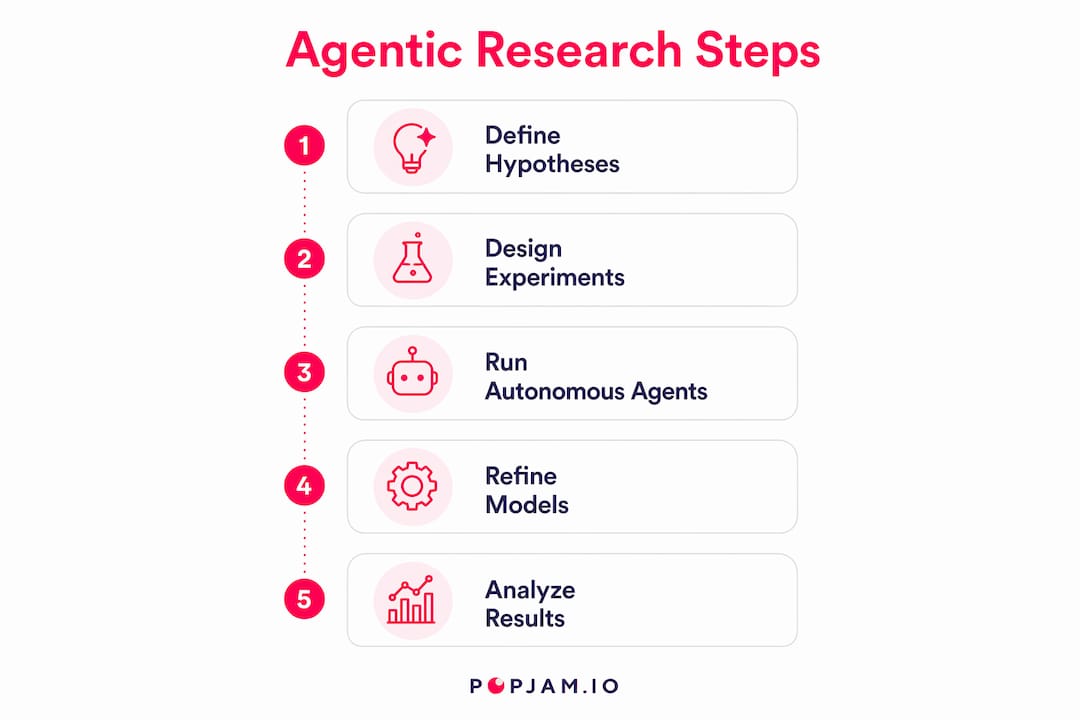
One practical design principle that makes autonomous experimentation viable is the fixed time budget. A 5-minute training loop per trial enables approximately 12 experiments per hour, or around 100 overnight. That throughput is impossible with manual research cycles. It also creates comparability across trials because each experiment runs under identical time constraints.
Advanced frameworks separate exploration and exploitation into distinct agent modules. Using adversarial Critic and Generator agents prevents hallucinated evidence and keeps retrieval aligned with the core hypothesis. The Critic agent challenges the Generator’s outputs, filtering irrelevant findings before they contaminate the research record.
Here is a practical workflow for applying autonomous agent frameworks in marketing or social science research:
- Define the hypothesis tree. Break your research question into a structured set of sub-hypotheses that agents can test independently.
- Set a fixed time budget. Standardize trial duration so results are comparable across experiments.
- Separate exploration from exploitation. Assign distinct agents to information gathering and hypothesis confirmation to prevent confirmation bias.
- Log every cycle. Treat each agent loop as a documented experiment, not a background process.
- Review and prune. Human researchers review the hypothesis tree after each major cycle and remove branches that no longer serve the research goal.
| Framework Component | Function | Benefit |
|---|---|---|
| Hypothesis Tree Refinement | Structures and prunes research hypotheses iteratively | Prevents scope drift and focuses agent effort |
| Fixed time budget (5-minute loops) | Standardizes experiment duration | Enables 100+ overnight trials with comparable results |
| Critic and Generator agents | Separates retrieval from generation | Reduces hallucinated evidence and irrelevant findings |
| Program brief (program.md) | Defines goals, constraints, and success criteria | Keeps autonomous cycles aligned with research intent |
Pro Tip: Treat your agentic research program like a research organization, not a single experiment. Write a program brief that agents can reference across cycles. This creates cumulative strategy rather than isolated runs.
What are the benefits and challenges of agentic research?
The benefits of agentic research methodology are real and measurable. Autonomous agents accelerate discovery by running experiments in parallel. They synthesize large data volumes without fatigue. They test hypotheses iteratively, which means weak ideas get eliminated early rather than consuming budget. For marketing researchers, this translates directly into faster creative testing cycles and sharper audience insights.
Participant engagement also improves when researchers apply agentic principles to study design. When participants have genuine input into research direction, they invest more in the process. Participatory Action Research builds affective solidarities that enable democratic agency, particularly in polarized or fractured social contexts. That kind of engagement produces richer qualitative data than passive survey responses ever could.
The challenges are equally real. The most significant is maintaining human oversight without undermining the autonomy that makes agentic research valuable. Researchers who intervene too frequently collapse the system back into traditional methodology. Those who intervene too rarely risk agents pursuing irrelevant hypotheses without correction.
Institutional restrictions compound this problem. Restricting “what” decisions reduces experienced agency more than any other type of restriction, with an R² of 0.66 in functional analysis. That finding means that when institutions or research protocols limit what participants or agents can investigate, the cumulative damage to experienced agency is severe.
Effective agentic research requires explicit design of agency trade-offs. Systems that implicitly limit autonomy without acknowledging the trade-off produce paternalistic research environments. Design-for-agency frameworks externalize those implicit judgments, making them visible and adjustable rather than buried in system defaults.
The ethical dimension is not optional. Researchers must decide in advance how much autonomy agents hold over participant interactions, data interpretation, and hypothesis selection. Those decisions shape the research outcomes as much as the methodology itself.
How is agentic research applied in marketing and social science practice?
Marketing researchers are the natural early adopters of agentic research. Campaign creative testing, audience segmentation, and message optimization all involve iterative hypothesis testing across large data sets. Autonomous agents handle that iteration faster and more consistently than human teams can.
Concrete applications include:
- Autonomous creative testing: Agents generate ad variations, test them against synthetic audience profiles, and refine based on psychographic feedback without waiting for manual review cycles.
- Collaborative audience research: Researchers use participatory frameworks to co-create research questions with target communities, then deploy agents to test those questions at scale.
- Iterative campaign refinement: Agents run continuous A/B experiments on messaging, visual composition, and call-to-action placement, feeding results back into the hypothesis tree in real time.
- Synthetic persona modeling: AI systems simulate audience reactions to creative assets before live deployment, reducing wasted ad spend and creative fatigue.
The generative AI for marketing space has moved quickly toward agentic principles precisely because the feedback loops are so valuable. Researchers who understand how to structure autonomous experimentation gain a significant advantage in campaign performance.
Social science applications follow a similar pattern. Researchers use agentic frameworks to run longitudinal studies where agents monitor behavioral signals and adjust data collection protocols in response. This is self-directed learning applied at the system level. The role of AI in marketing strategies mirrors what social scientists are discovering: autonomous systems produce better hypotheses when given structured freedom to explore.
Pro Tip: When applying agentic research to marketing campaigns, start with a narrow hypothesis tree. Define two or three core questions about your audience before letting agents explore. Broad starting parameters produce broad, unfocused findings.
Key Takeaways
Agentic research produces better outcomes when researchers design explicit agency trade-offs, use structured autonomous frameworks, and maintain human oversight at the hypothesis level rather than the execution level.
| Point | Details |
|---|---|
| Decision-level agency is foundational | Design your research to protect participant and agent autonomy at the intention-formation stage, not just execution. |
| Fixed time budgets enable scale | A 5-minute trial loop allows 100+ overnight experiments, making autonomous research practically viable. |
| Separate exploration from exploitation | Adversarial Critic and Generator agents prevent hallucinated evidence and keep findings hypothesis-aligned. |
| Institutional restrictions damage agency | Restricting “what” decisions has the largest negative impact on experienced agency, so design protocols that preserve investigative freedom. |
| Marketing applications are immediate | Autonomous creative testing and synthetic persona modeling apply agentic research principles directly to campaign performance. |
Why I think most researchers are applying agentic methods backwards
Here is the uncomfortable truth I keep running into: most teams adopting agentic research tools focus entirely on the automation layer and skip the agency design layer entirely. They set up autonomous agents, point them at a data problem, and expect insight. What they get is volume. Volume without a well-structured hypothesis tree is just noise at scale.
The real work in agentic research is upstream. You have to decide, explicitly, how much autonomy participants hold, how much agents hold, and where human judgment must stay in the loop. That is not a technical decision. It is a research design decision. Design-for-agency frameworks exist precisely because those implicit judgments, left unexamined, produce paternalistic systems that limit the autonomy they were supposed to expand.
I have also seen researchers underestimate participant agency as a variable. When you restrict what participants can investigate or contribute, you do not just lose their input. You change how they experience the entire study. That experience shapes the data they produce. Agentic research done well treats participant agency as a design input, not an afterthought. The teams that get this right build AI-driven marketing workflows that actually reflect how their audiences think, not just how their tools were configured.
— Doruk
POPJAM brings agentic research principles to creative testing
If you are applying agentic research insights to your marketing campaigns, the next logical step is testing your creative assets before they go live.
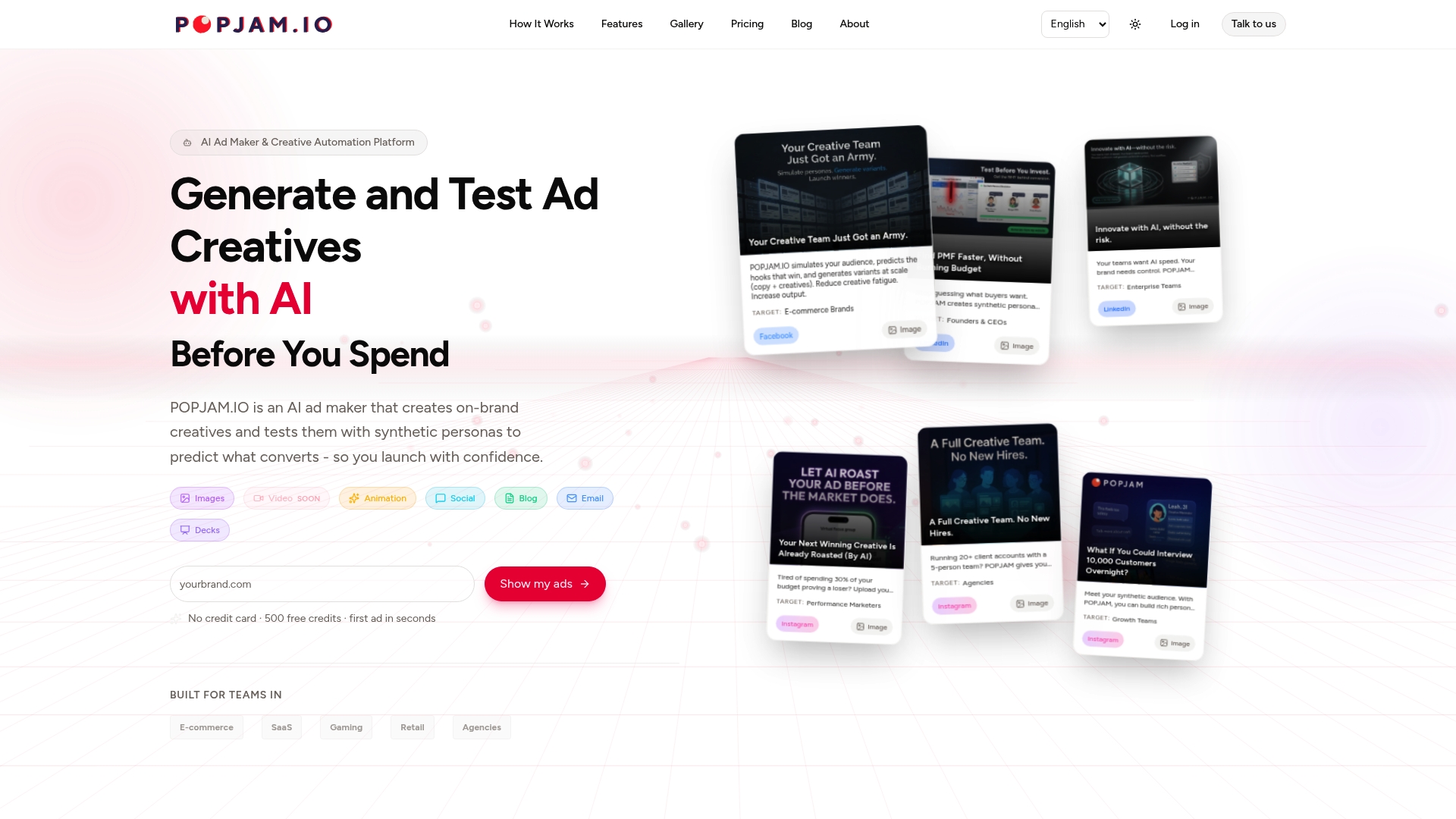
POPJAM is an AI ad maker built for exactly this workflow. It generates on-brand ad creatives and tests them against synthetic buyer personas, simulating audience reactions before you spend a dollar on media. Marketing teams use POPJAM to run iterative creative experiments, refine ad compositions based on psychographic feedback, and eliminate underperforming concepts early. That is the agentic research loop applied directly to campaign production. You can explore the full AI ad creation platform and see how autonomous creative testing fits your research-driven marketing process. For agencies managing multiple clients, the agency-focused ad generator supports creative testing at scale across campaigns.
FAQ
What is agentic research in simple terms?
Agentic research is a methodology where autonomous AI agents iteratively design and run experiments, refining hypotheses based on results with minimal human intervention at each step.
How does participant agency differ from researcher agency in agentic research?
Participant agency refers to how much control participants have over research direction and data contribution. Researcher agency covers the human researcher’s control over hypothesis framing and system oversight. Both operate alongside agent autonomy in a well-designed agentic study.
What is Hypothesis Tree Refinement and why does it matter?
Hypothesis Tree Refinement is a structured framework where agents break a research question into testable sub-hypotheses and prune weak branches iteratively. The Arbor framework using this method reached 86.36% success on MLE-Bench Lite, demonstrating its effectiveness in autonomous research contexts.
How do institutional restrictions affect agentic research outcomes?
Restricting “what” decisions, meaning what participants or agents can investigate, has the largest negative impact on experienced agency, with an R² of 0.66 in functional analysis. Researchers should design protocols that preserve investigative freedom to maintain research quality.
Can agentic research methods apply to marketing campaign testing?
Yes. Autonomous creative testing, synthetic persona modeling, and iterative A/B experimentation all apply agentic research principles directly to marketing. These methods reduce ad spend waste and accelerate the feedback loop between creative production and audience insight.