

Ads Library AI: Test Creatives Before You Spend
Ads library AI combines ad-transparency datasets like the Meta Ad Library with generative creative tools and synthetic-persona testing to produce validated ad variants before a single dollar of media spend. The recommended first move: pilot POPJAM, pull comparable ads from Meta Ad Library, and run a synthetic-persona simulation on your top three concepts. With marketing budgets having flatlined at a low share of overall company revenue (Gartner, May 2025), there’s no room for “post and pray.”
Start here:
- Sign up for a POPJAM pilot and connect your brand guidelines
- Pull active competitor creatives from Meta Ad Library using the Ad Library API
- Run a synthetic-persona test on your shortlisted variants before any budget goes live
Table of Contents
- What does “ads library AI” actually mean for agencies?
- How do marketing teams run the full ads library AI workflow?
- What should you measure before and after launch?
- What privacy and compliance rules apply to ad-transparency data?
- How do you evaluate an AI ad-creative tool that claims ads library AI?
- How does POPJAM implement ads library AI in practice?
- Key Takeaways
- Why the “more data” mindset is holding agencies back
- POPJAM fits the workflow you just read about
- Useful sources for implementation and compliance
- FAQ
What does “ads library AI” actually mean for agencies?
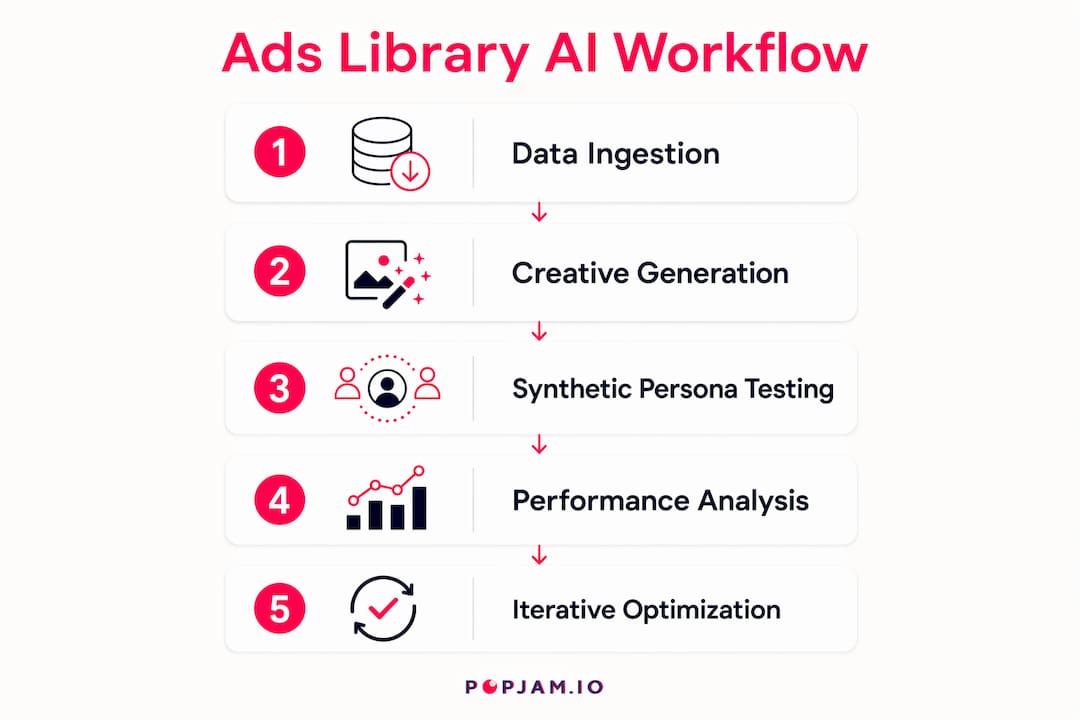
The phrase gets used loosely, so let’s be precise. A legitimate ads library AI platform has five components working together:
- Ad-transparency data ingestion — pulling creative, format, spend window, geo, and targeting metadata from sources like Meta Ad Library
- Generative creative production — AI that produces image, video, copy, and animation variants seeded by winning creative patterns
- Synthetic-persona simulation — psychographic profiles that predict how specific audience segments will respond before launch
- Incrementality-aware predictive models — not just “who will convert” but “whose behavior will actually change because of this ad”
- Platform export connectors — direct paths to Meta, Google, TikTok, LinkedIn, and Reddit with proper specs and tracking tags
What it is not: a creative generator that skips the testing layer, or a reporting dashboard that only shows you what already happened. The whole point is pre-launch validation. Under today’s budget pressure, that distinction separates agencies that scale confidently from those still running gut-feel creative tests at full media cost.
Pro Tip: When evaluating any tool that claims “ads library AI,” ask specifically whether it supports incrementality-aware scoring or only propensity-to-convert models. The latter chases high-intent users who would have converted anyway — incrementality-aware approaches find the audiences where advertising actually changes behavior.
How do marketing teams run the full ads library AI workflow?
Here’s the operational playbook, step by step.
-
Ingest and normalize ad-transparency data. Use the Meta Ad Library API and Ad Library Report to pull active and recently ended ads in your category. The fields that matter most: creative format, estimated spend window, geo targeting, and active/inactive status. Filter for ads that have run longer than 14 days — longevity is a proxy for performance.
-
Seed your generative model with winning creative elements. Feed the top-performing creative patterns (hooks, visual compositions, CTA structures) into your AI creative tool alongside your brand guidelines. POPJAM’s generative templates cover images, video, animation, social posts, and email — so you’re not rebuilding specs for each platform manually.
-
Run synthetic-persona simulations. This is where ads library AI earns its name. Upload your variants and run them against psychographic profiles that match your target segments. The output: a resonance score, predicted engagement signals, and flagged failure modes (off-brand tone, low visual salience, weak CTA). You catch the losers before they cost you anything.
-
Design your pre-launch experiment. Pick your KPIs (predicted CTR lift, simulated incremental conversion rate, brand-safety score), set up a holdout or PSA-style control group, and define your geo split if you’re running regional tests. Document the experiment metadata now — you’ll need it to validate incrementality post-launch.
-
Export approved variants with full tracking specs. Before anything goes live, run through this checklist:
- Creative specs confirmed per platform (aspect ratio, file size, duration)
- Captions and CTA copy finalized and tagged
- UTM parameters and tracking pixels attached
- Experiment metadata saved (variant ID, persona group, holdout assignment)
Pro Tip: Automate the iteration loop. Set POPJAM to regenerate low-scoring variants automatically rather than reviewing each one manually. You’ll move from 20 concepts to 3 launch-ready creatives in hours, not days. Check out the AI advertising campaigns guide for a full pilot blueprint.
What should you measure before and after launch?

Pre-launch and post-launch KPIs need to connect. If they don’t, you can’t learn anything useful.
Pre-launch KPIs (from synthetic testing):
- Predicted resonance score by persona segment
- Simulated CTR and engagement lift vs. your historical baseline
- Brand-safety flags (sensitive content, off-message claims)
- Predicted incremental conversion lift estimate
Post-launch KPIs (from live experiments):
- Holdout vs. exposed conversion lift (the real incrementality number)
- Cost per incremental conversion vs. historical baseline
- Creative fatigue signals (frequency vs. CTR degradation curve)
The goal is to close the loop: did your pre-launch resonance scores predict actual holdout lift? Over time, that feedback makes the synthetic models sharper.
| Metric | Source | Retention / Cadence |
|---|---|---|
| Meta Ad Library creative data | Meta Transparency Center | EU-delivered ads archived for a limited time after their last impression(https://socialmediatransparency.org/blog/advertising-library-transparency-comparing-the-us-and-the-eu); social/political ads retained 7 years |
| Marketing budget benchmark | Gartner CMO Survey, May 2025 | a modest share of company revenue — review quarterly against pilot ROI |
| Holdout experiment results | Live campaign data | Minimum 2-week measurement window before reading results |
| Synthetic resonance scores | POPJAM platform | Refresh persona profiles each quarter or after major audience shifts |
Measurement reality check: Minimum sample sizes matter more than most teams admit. A holdout group that’s too small produces noise, not signal. Set your minimum detectable effect before launch, not after you see the numbers.
What privacy and compliance rules apply to ad-transparency data?
Before you source or publish, check these boxes.
- Meta Ad Library retention limits: EU-delivered ads are archived for 1 year after their final impression. Social issues, elections, and politics ads are retained for 7 years. Historical analysis beyond those windows isn’t possible through the API.
- API authorization: Confirm your team has proper Meta developer credentials and is accessing the Ad Library API within Meta’s terms. Unauthorized scraping violates platform policy.
- GDPR-aware synthetic testing: Synthetic personas must be built from aggregated psychographic data, not individual PII. POPJAM’s persona simulation is designed to be GDPR-compliant by construction — no real user data enters the simulation layer.
- Image rights checks: If you’re ingesting competitor creative for inspiration, use it as a reference signal only. Don’t reproduce copyrighted assets in your own variants.
- Audit logs: Your platform should maintain logs of which creatives were tested, which persona groups were used, and when experiments ran. This matters for both internal governance and any future regulatory review.
How do you evaluate an AI ad-creative tool that claims ads library AI?
Not every tool that mentions “Ad Library” or “AI” delivers the full workflow. Here’s what to check.
Integration criteria:
- Native Meta Ad Library connector (not manual CSV upload)
- Export formats that match your active platforms (Meta, Google, TikTok, LinkedIn, Reddit)
- Tracking and tagging support built into the export flow
Methodology criteria:
- Does the tool simulate audiences with explainable psychographic signals, or is it a black box?
- Does it support holdout and control group designs, or only A/B testing?
- Does it report incrementality, or only engagement proxies?
Operational criteria:
- Onboarding time to first synthetic test (target: under one day)
- Data portability (can you export experiment metadata?)
- Audit logs for compliance
“The shift agencies need to make is from passive visualization to autonomous recommendations — tools that don’t just show you what happened, but tell you what to do next and why.” This is the standard top-tier AI marketing co-pilots are being held to in 2026.
Red flags: Black-box predictions with no experiment validation path, export formats that don’t match your live platforms, and unclear data retention policies are all reasons to walk away from a vendor during a pilot.
For a broader look at how agencies approach competitive creative research, this Google Ads competitor analysis guide covers the benchmarking logic that applies equally to creative sourcing.
How does POPJAM implement ads library AI in practice?
POPJAM is built specifically for the workflow above. Here’s what that looks like in practice.
Core features:
- Ad Library ingestion to seed creative generation with real market signals
- Generative templates for images, video, animation, social posts, and email
- Synthetic Persona testing with psychographic scoring and qualitative feedback
- Brand-safety scanning built into the pre-launch review layer
- One-click export to Meta, Google, TikTok, LinkedIn, and Reddit with proper specs
Signals of a successful POPJAM pilot:
- Creative-to-launch cycle time drops measurably (teams typically move from weeks to days)
- Low-resonance variants get flagged before any spend, not after
- Experiment decisions become clearer because you enter launch with predicted lift estimates, not hunches
POPJAM documents CTR lift and operational ROI improvements from AI creative testing across e-commerce, SaaS, and agency accounts. The AI ad testing tool is available to try before committing to a full subscription.
Pro Tip: Run your first POPJAM pilot on a campaign you already have historical data for. That way you can compare synthetic resonance scores against actual past performance and calibrate how well the model predicts your specific audience.
Key Takeaways
Ads library AI works when it connects ad-transparency data, generative creative production, synthetic-persona simulation, and incrementality-aware measurement into one pre-launch validation loop.
| Point | Details |
|---|---|
| Budget pressure is real | Gartner’s May 2025 data puts marketing budgets at 7% of revenue — pre-launch testing directly reduces wasted spend. |
| Meta Ad Library has limits | EU-delivered ads archive for 1 year after last impression; plan your historical analysis window accordingly. |
| Incrementality beats propensity | Measure holdout lift, not just CTR — that’s the metric that proves an ad changed behavior. |
| Evaluation checklist matters | Require explainable psychographic signals, holdout support, and audit logs from any vendor you trial. |
| POPJAM as your pilot tool | POPJAM covers the full workflow: Ad Library ingestion, synthetic testing, and platform export across Meta, Google, TikTok, LinkedIn, and Reddit. |
Why the “more data” mindset is holding agencies back
The agencies winning right now aren’t the ones with the biggest dashboards. They’re the ones making faster, better decisions with less manual analysis. The industry is moving toward continuous learning systems where predictive models feed real-time tests and automated budget allocation — and the gap between teams that have adopted this and teams still pulling weekly reports manually is widening fast.
The real unlock isn’t more data. It’s autonomous tools that surface causes of performance shifts and recommend specific actions, the way a sharp junior analyst would, but at machine speed. Explainability matters here: if your AI can’t tell you why a creative scored low with a specific persona, you can’t learn from it. Black-box outputs are a dead end for any agency that wants to build repeatable creative intelligence.
The teams that will look back at 2026 as a turning point are the ones that stopped treating AI as a reporting layer and started treating it as a decision layer.
POPJAM fits the workflow you just read about
If you’ve been running creative tests at full media cost and calling it “experimentation,” there’s a faster path. POPJAM lets you generate 20 ad variants, run them through Synthetic Persona simulations, and identify your top three before a single impression is served. For agencies managing multiple accounts, that means fewer wasted creative cycles and cleaner experiment designs from day one.
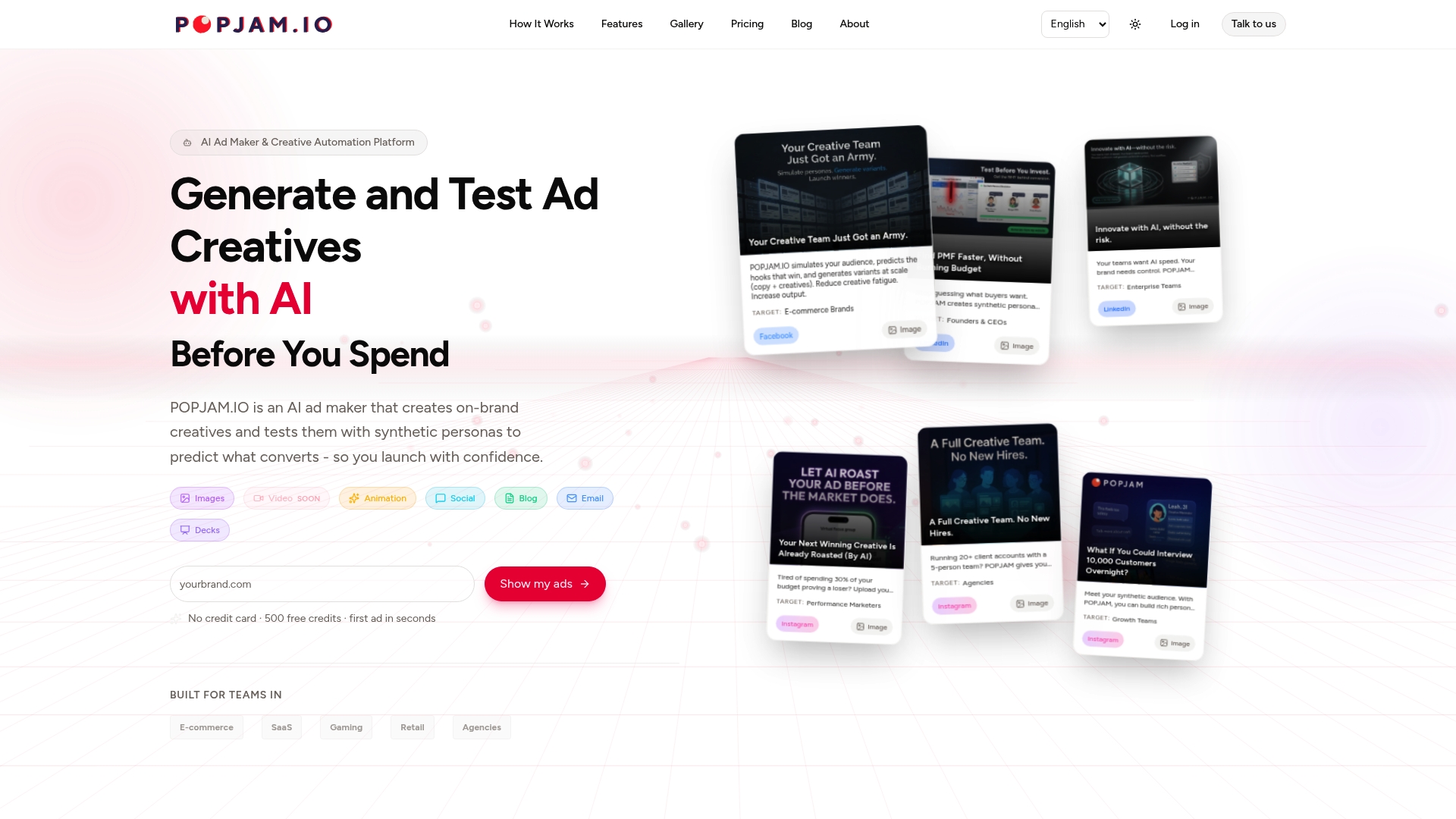
The pilot is straightforward: connect your brand guidelines, pull comparable creatives from Meta Ad Library, generate a variant set, and let POPJAM’s psychographic scoring surface the winners. You’ll enter your next campaign with predicted lift estimates instead of hunches. Start your pilot at the POPJAM AI Ad Maker and see how the workflow runs on a real campaign.
Useful sources for implementation and compliance
- Meta Ad Library Tools | Transparency Center — The primary source for API access, Ad Library Report documentation, and authorized data fields. Read the API reference before building any ingestion pipeline.
- Gartner 2025 CMO Spend Survey — The benchmark for marketing budget constraints. Use it to frame ROI conversations with clients or leadership.
- Ad Library Transparency: US vs. EU — Detailed breakdown of retention windows and archiving rules. Essential reading before planning any historical creative analysis.
- AI and Predictive Analytics in Advertising — Covers incrementality-aware modeling and continuous learning systems. Useful for teams building out measurement frameworks.
- POPJAM AI Advertising Campaigns Guide — Practical pilot blueprint for running AI-enabled campaign experiments and rapid creative iteration.
FAQ
What is ads library AI in plain terms?
Ads library AI combines ad-transparency data (like Meta Ad Library) with AI creative generation and synthetic-persona testing to validate ad variants before media spend. It’s a pre-launch workflow, not just a reporting tool.
How long does Meta Ad Library retain ad data?
Meta archives EU-delivered ads for 1 year after their final impression and retains social issues, elections, and politics ads for 7 years. US-focused historical analysis is subject to different retention rules.
What KPIs should I track in a synthetic-persona test?
Track predicted resonance score by persona segment, simulated CTR lift vs. your historical baseline, brand-safety flags, and predicted incremental conversion lift. Post-launch, compare those predictions against actual holdout lift.
Does POPJAM connect directly to Meta Ad Library?
Yes. POPJAM supports Ad Library ingestion to seed creative generation, along with synthetic-persona testing and export to Meta, Google, TikTok, LinkedIn, and Reddit.
How do I know if a vendor’s “ads library AI” claim is real?
Ask whether the tool supports holdout experiment design, explainable psychographic scoring, and incrementality reporting. If the answer to any of those is no, it’s a creative generator with a marketing label, not a full ads library AI platform.