

Ad Copy Testing: A Practical Pre-Launch Workflow
Ad copy testing is the pre-launch process of validating messaging and creative with representative audiences using both quantitative and qualitative methods — before a single dollar of media budget is committed. The single best first step? Pick one primary KPI, build three focused variants that each test a different hypothesis, and run a small pilot with a clear sample rule before scaling anything.
Here’s the immediate plan:
- Pick your primary KPI first. CTR for awareness campaigns, CVR for performance campaigns. One metric rules the decision.
- Build three variants with distinct hypotheses. Not three versions of the same headline. Three genuinely different angles: a benefit-led hook, a proof-led hook, and an urgency-led hook.
- Set a sample rule before you start. Decide the minimum impressions or responses you need for a directional signal, and commit to it. Don’t stop early because one variant looks good on day two.
For teams that want faster, cheaper signal before any live spend, integrating a pre-launch testing platform like Popjam combines synthetic-audience simulation with early quantitative feedback so you’re not flying blind on launch day.
Key Takeaways
Pre-launch ad copy testing is the highest-leverage step a marketing team can take to reduce wasted spend and accelerate creative learning before a campaign goes live.
| Point | Details |
|---|---|
| Define the primary KPI first | Choose one metric (CTR for awareness, CVR for performance) before designing any variant. |
| Build a three-role variant portfolio | Use an Index (scaler), Alpha (high-upside), and Hedge (proof-focused) variant to cover different performance scenarios. |
| Set sample size before launch | Set a sample size beforehand depending on budget and goals to get a directional signal. |
| Validate winners across two contexts | A variant that wins in only one placement is context-dependent, not a universal scaler. |
| Use a rubric pre-filter | Score every creative on hook, message clarity, CTA, and audience fit before spending test budget on weak variants. |
| POPJAM for pre-launch validation | POPJAM.IO combines AI ad generation, synthetic persona simulation, and rubric scoring to validate creative before any media spend. |
Table of Contents
- What is ad copy testing and when should you run it?
- What ad copy testing methods are available to you?
- Which copy components should you actually test?
- How to design, run, and decide on an ad copy test
- Which KPIs should you measure and how do you interpret them?
- What types of tools support pre-launch ad copy testing?
- How do you turn test results into better copy?
- Common mistakes that break ad copy tests
- How AI expert-panel rubrics and synthetic personas improve pre-launch evaluation
- Ethical considerations and privacy concerns in ad copy testing
- Why the “find a winner” mindset is the wrong frame for copy testing
- POPJAM.IO cuts the cost of learning before you spend
- Sources
- FAQ
What is ad copy testing and when should you run it?
Ad copy testing, sometimes called copy testing or creative ad evaluation in research contexts, is the practice of exposing draft messaging to a representative audience before committing to a full media buy. It’s distinct from in-market A/B testing, where you’re spending real budget to find a winner. Pre-launch testing is cheaper, faster, and lets you kill weak variants before they cost you anything.
In-market A/B testing is still valuable, but it’s a different tool. You run it when you have enough traffic to reach statistical significance quickly, when the variants are already validated at a basic level, and when the cost of a losing variant is acceptable. Pre-launch testing is what you do when those conditions aren’t met.
Run pre-launch copy testing when:
- You’re launching a new offer and have no historical creative data to lean on
- You’re entering an unfamiliar audience segment with different psychographics
- You’re buying high-cost placements like Connected TV or premium display where a weak creative is expensive
- You’re shifting brand positioning or tone and need to know if the new voice lands
- You’re changing creative format entirely, say moving from static images to video or from long-form to short-form copy
A team launching a SaaS product into a new vertical, for example, might run a panel survey across three headline angles before spending anything on Google Ads. The survey costs a fraction of a week’s media budget and surfaces which angle resonates, which confuses, and which the audience ignores entirely. That’s the kind of pre-launch insight that compresses the learning curve from weeks to days.
What ad copy testing methods are available to you?
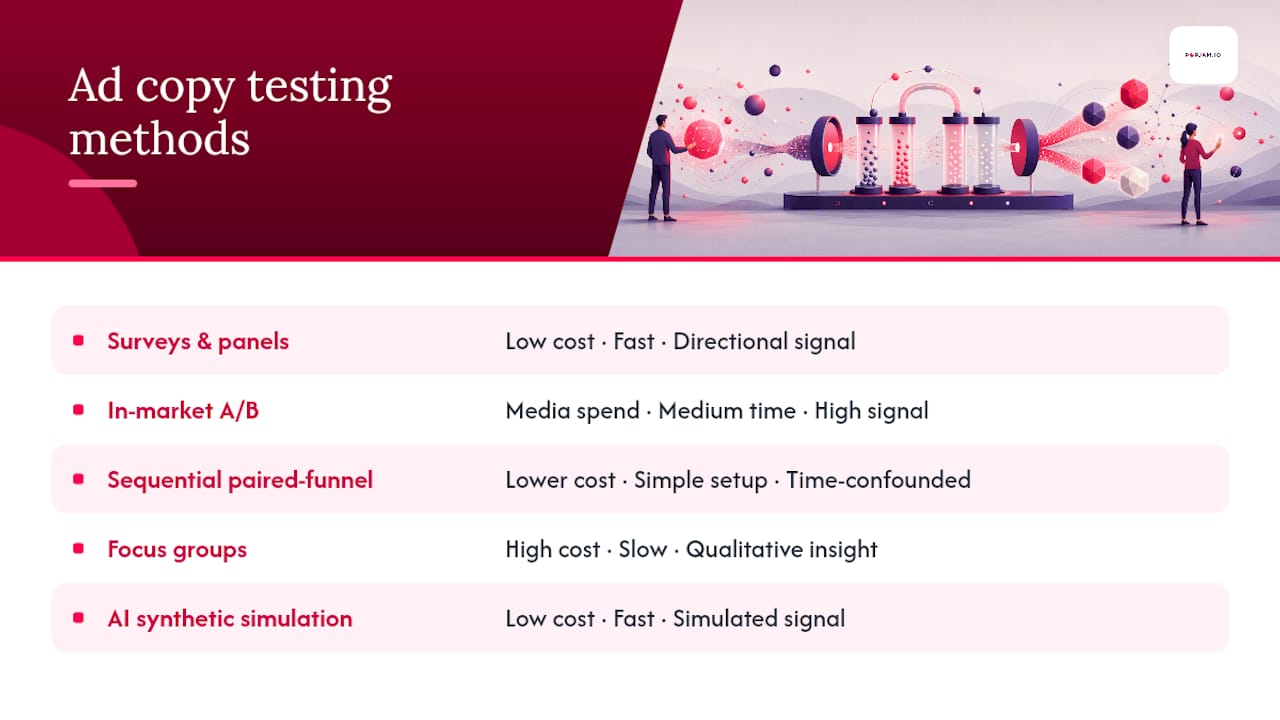
Industry guides identify five core methods: surveys and panels, in-market A/B and multivariate tests, focus groups, lab techniques like eye tracking and biometrics, and AI-driven synthetic-audience simulation. Each fits a different budget, timeline, and signal need.
Surveys and panel copy tests
A structured questionnaire exposes respondents to two or more ad variants and captures preference, comprehension, and open-text reactions. Fast, scalable, and inexpensive. The limitation is that stated preference doesn’t always predict behavior, so survey results work best as a directional filter, not a final verdict.
In-market A/B and multivariate tests
You run variants simultaneously in a live environment and measure actual behavior: clicks, conversions, time on page. High signal quality because it reflects real decisions. The cost is real media spend, and you need enough traffic volume to reach significance. Multivariate tests are powerful but require substantially larger sample sizes to isolate individual variable effects.
Sequential paired-funnel tests
Run variant A for a defined period, then variant B, then compare. Simpler to set up than true simultaneous A/B, but vulnerable to time-based confounds like seasonality or news events. Use only when simultaneous testing isn’t possible.
Focus groups
Small groups of target-audience members discuss creative in a moderated session. Excellent for uncovering the why behind reactions, especially for brand-sensitive or emotionally complex messaging. Expensive and slow, and group dynamics can suppress honest individual reactions.
Eye tracking and biometric labs
Eye tracking shows where attention lands on a static or video asset. Biometric tools like galvanic skin response and facial coding measure emotional arousal and valence. These methods produce rich psychophysiological data but require specialized equipment and participants, making them the highest-cost option. Best reserved for high-stakes campaigns or brand platform decisions.
Usability testing
Participants interact with an ad or landing page while narrating their experience. Particularly useful for catching copy that’s technically clear but practically confusing in context.
AI-driven synthetic-audience simulation
AI models simulate how defined audience personas would react to creative, scoring variants on dimensions like hook strength, message clarity, and emotional resonance, as explained in practical articles on how to use AI in design. Fast, low-cost, and GDPR-friendly since no real respondents are involved. The tradeoff: vision-language models show measurable alignment gaps versus human judgments, so AI scores should supplement human review rather than replace it entirely.

Hybrid approaches work best. Run an AI simulation to rank and filter variants, then take the top two into a panel survey for qualitative depth, then validate the winner in a small live pilot. Each layer adds signal without the full cost of jumping straight to live spend.
Which copy components should you actually test?
Most teams test the headline and stop there. That’s leaving a lot of learning on the table. The copy elements that move performance most are spread across the entire creative, and testing them in isolation produces fragile insights.
The granular elements worth isolating:
- Headline/hook: The first line or first three seconds. Does it stop the scroll?
- Value proposition framing: Are you leading with the outcome, the feature, or the relief from pain?
- Primary benefit: Which specific benefit is foregrounded? Speed, savings, status, safety?
- Proof type: Social proof (reviews, user counts), authority proof (certifications, press), or specificity proof (exact numbers, case study results)?
- CTA wording: “Start free trial” vs. “Get your free report” vs. “See how it works” each signals a different commitment level.
- Tone and voice: Conversational vs. authoritative vs. playful. Does the tone match the audience’s self-image?
- Length: Short punchy copy vs. long-form explanation. Depends heavily on placement and funnel stage.
- On-screen text vs. caption placement: For video and social, where the copy lives changes how it’s processed.
- Visual pairing: The same headline performs differently next to a product shot versus a lifestyle image versus a data visualization.
Research on novelty and usefulness shows that creative effectiveness depends on both dimensions together. An ad that’s novel enough to grab attention but unclear in its value proposition tends to fail at conversion. That finding has a direct implication for what you test: always pair attention-grabbing variants with clarity checks.
A simple test matrix looks like this:
| Headline angle | CTA | Image style |
|---|---|---|
| Benefit-led (“Cut your ad spend in half”) | “Start free” | Product UI screenshot |
| Proof-led (“Trusted by many teams”) | “See the results” | Social proof collage |
| Urgency-led (“Offer ends Friday”) | “Claim your spot” | Countdown/scarcity visual |
Three headlines, two CTAs, two image styles would give you 12 combinations in a full factorial test. That’s too many to run simultaneously on a limited budget. Instead, pick the dimension you’re most uncertain about, hold the others constant, and test one axis at a time. Test copy as a system across placements and funnel stages, not as isolated lines. A headline that wins on Meta may underperform on LinkedIn because the audience context is different.
How to design, run, and decide on an ad copy test
This is the operational part. Follow these steps in order and you’ll avoid the most common mistakes teams make.
-
Write the brief. State the campaign objective, the primary KPI, the specific hypothesis you’re testing (“We believe a benefit-led headline will outperform a proof-led headline for cold audiences”), the target audience segment, and the success threshold (e.g., “Variant B wins if it achieves a CTR lift of at least 15% with 95% confidence”).
-
Design the variant portfolio. Think in three roles: an Index variant (your current best-performing or most conservative copy, the scaler), an Alpha variant (the high-upside, more novel angle), and a Hedge variant (proof-heavy, trust-focused copy). Each has a different job. This portfolio approach treats testing as a variance strategy rather than a beauty contest.
-
Lock down non-test variables. Same audience targeting, same bid strategy, same placement, same creative dimensions. The only thing that changes is the copy element you’re testing. Changing targeting mid-run invalidates the test entirely.
-
Choose your placements and plan validation contexts. A winner in one context isn’t necessarily a winner everywhere. Plan to validate your top performer in at least two different placements or audience segments before scaling.
-
Set sample size before you start. The table below gives practical heuristics for three test scales.
A practical framework recommends testing five headline angles paired with three description types, using sequential elimination to narrow to a winner, and always validating against downstream conversion metrics, not just CTR.
-
Execute and monitor without touching it. Don’t pause underperforming variants early. Don’t change targeting. Don’t adjust bids. Platform learning windows typically need 7–14 days to stabilize, and early data is noisy.
-
Apply decision rules. Aim for 95% statistical confidence before declaring a winner. When testing multiple variants simultaneously, apply a Bonferroni correction or similar multiple-comparison adjustment to avoid false positives. If two variants are within the margin of error of each other, the practical answer is often to run the one with better qualitative feedback.
-
Budget guidance. A small pilot can run on $500–$1,500 in media spend if your CPM is reasonable. A medium test typically requires $3,000–$8,000. Large tests with downstream conversion validation can run $15,000 or more. Pre-launch simulation with a tool like POPJAM.IO can compress this significantly by filtering weak variants before any live spend.
Pro Tip: Run your top variant in two different audience contexts simultaneously. A copy that wins in both is a stable scaler. One that wins in only one context is context-dependent and should be treated as a situational tool, not a universal rollout.
Which KPIs should you measure and how do you interpret them?
The right primary metric depends entirely on the campaign goal. Here’s how to think about it by funnel stage.
Attention metrics (top of funnel)
- CTR (click-through rate): The most common signal for copy effectiveness at the awareness stage. Measures whether the headline and hook are compelling enough to earn a click.
- View rate / video completion rate: For video ads, how far viewers watch before dropping off. A high drop-off in the first three seconds usually means the hook failed.
- Thumb-stop rate: On social platforms, the percentage of users who pause on your ad. A leading indicator of hook strength.
Mid-funnel engagement
- Time on asset: How long users engage with interactive or rich media formats.
- Micro-conversions: Email sign-ups, content downloads, quiz completions. Useful when the final conversion is too rare to reach significance quickly.
- Scroll depth on landing page: If your ad drives to a long-form page, scroll depth tells you whether the copy-to-page message match is working.
Bottom-funnel metrics
- Conversion rate (CVR): The percentage of clicks that result in the desired action. The most important metric for performance campaigns.
- Cost per acquisition (CPA): Total spend divided by conversions. Tells you whether a CTR winner is actually efficient.
- Return on ad spend (ROAS): Revenue generated per dollar spent. The ultimate performance metric for e-commerce.
Brand metrics
- Ad recall: Measured via brand lift surveys. Did the audience remember seeing the ad?
- Brand favorability: Did exposure to the ad improve perception of the brand?
- Emotional resonance: Qualitative or biometric measure of how the ad made the audience feel.
Interpreting conflicting signals is where most teams get stuck. A variant with a higher CTR but lower CVR usually means the copy is attracting the wrong audience or overpromising. A variant with lower CTR but higher CVR often means the copy is self-qualifying, which is frequently the better outcome for performance campaigns. When signals conflict, the downstream metric wins for performance goals; the upstream metric wins for awareness goals.
To calculate lift: divide the difference between variant and control by the control value, then multiply by 100. That’s the number that matters for business decisions, not the absolute difference.
What types of tools support pre-launch ad copy testing?
Testing tools fall into five broad categories, each with different output formats and use cases.
Survey panels (Attest, Pollfish, Wynter): Expose draft copy to screened respondents and collect quantitative preference scores plus open-text feedback. Best for early hypothesis ranking and message clarity checks.
Lab research platforms (eye tracking vendors, biometric labs): Produce attention heatmaps, emotional arousal scores, and fixation data. High signal quality, high cost, long lead times.
Creative analytics platforms: Analyze live creative performance data and surface patterns across your existing ad library. Useful for retrospective learning but not true pre-launch testing.
AI simulation platforms: Generate synthetic-audience reactions using persona models. Fast, low-cost, and privacy-safe. Output typically includes quantitative scores by dimension and AI-summarized qualitative feedback. The alignment gap between model scores and human judgments means these platforms work best as a filter and prioritization layer, not a final decision engine.
Lightweight behavioral pilots: Small live tests on low-cost placements (Facebook Audience Network, Google Display) with tight budget caps. Real behavioral data at a fraction of the cost of a full campaign test.
What to look for in a testing platform:
- Synthetic-audience simulation with configurable persona psychographics
- Persona-based scoring across multiple creative dimensions
- Combined quantitative and qualitative reporting in a single export
- AI summarization of open-ended feedback so you’re not reading 500 individual responses
- GDPR-aware simulation that doesn’t require real respondent data
- API support for teams that want to integrate testing into their creative pipeline
POPJAM.IO covers all of these. The platform generates on-brand ad creatives, tests them against synthetic buyer personas before launch, and surfaces KPI summaries alongside AI-summarized open-ended feedback. Teams running campaigns across Meta, Google, TikTok, LinkedIn, and Reddit can validate creative across all five placements before spending a dollar. For a deeper look at how AI ad creative tools compare across the market, POPJAM’s comparison guide is a useful reference.
Example platform output:
KPI Summary: Variant B scores 78/100 on hook strength, 65/100 on message clarity, 82/100 on CTA effectiveness. Variant A scores 61/100, 71/100, and 58/100 respectively.
AI-Summarized Open Feedback: Respondents consistently describe Variant B’s opening line as “immediately relevant” and “specific to my situation.” The most common criticism of Variant A is that the benefit feels generic. Three of five personas flag the CTA in Variant A as unclear about the next step.
That’s the kind of output that tells a creative team exactly what to fix, not just which variant won.
How do you turn test results into better copy?
Raw scores and lift numbers don’t write better ads. Here’s how to translate outputs into specific edits.
When CTR wins but CVR doesn’t follow: The hook is working but the body copy or landing page isn’t delivering on the promise. Tighten the message match between the ad and the destination. If the headline says “Cut your ad spend in half,” the landing page headline should echo that exact claim.
When qualitative feedback contradicts quantitative lift: Trust the qualitative signal for diagnosis, the quantitative signal for the decision. If a variant wins on CTR but respondents describe it as “misleading” in open text, that’s a churn and refund problem waiting to happen. Fix the copy before scaling.
Micro-change examples:
- A headline reading “AI tools for marketers” becomes “See which ad wins before you spend” — moving from category description to specific outcome.
- Proof type swap: replacing a generic “trusted by thousands” with “4.8 stars across 1,200 reviews” adds specificity that tends to lift CVR.
- CTA moved from caption to on-screen text in a video ad typically increases click intent for sound-off viewers, who represent a large share of social media consumption.
Classifying outcomes and next steps:
- Stable scaler: Wins across multiple contexts. Scale it. Add it to your control baseline.
- Context-dependent winner: Wins in one placement or audience but not others. Use it situationally. Don’t retire it, but don’t treat it as universal.
- High-upside but volatile: Strong in some tests, weak in others. Worth keeping in rotation as an Alpha variant. Monitor closely.
- Loser: Underperforms consistently. Document what didn’t work and why, then retire it. The swipe file of losers is as valuable as the swipe file of winners.
Common mistakes that break ad copy tests
Most testing failures aren’t statistical. They’re operational. Here are the pitfalls that produce misleading results and how to avoid each one.
-
Testing multiple variables at once without enough sample. If you change the headline, the CTA, and the image simultaneously, you can’t know which change drove the result. Fix: change one primary variable per test, or use a full factorial design with a sample size large enough to support it.
-
Underpowered tests. Stopping a test after 500 impressions per variant because one looks better is how teams get burned. Fix: set your minimum sample size before launch and don’t touch the test until you hit it.
-
Platform-driven combination bias. Responsive ad systems on Google and Meta dynamically recombine headlines and descriptions, which means the platform is running its own optimization on top of yours. When testing on platforms that dynamically recombine assets, pin critical assets or use separate ads to avoid selection bias contaminating your results.
-
Failure to validate winners across contexts. A winner in a retargeting campaign often fails in cold prospecting. Fix: always validate your top performer in at least two contexts before treating it as a universal winner.
-
Ignoring qualitative signals. A variant that wins on CTR but generates confused or negative open-text feedback is a short-term win with long-term risk. Fix: read the open-text responses. AI summarization tools make this fast even at scale.
-
Overfitting to short-term peaks. A variant that spikes in week one often regresses as the audience fatigues. Fix: run tests long enough to see the trend flatten, not just the initial spike.
Real-world example: A team running a Google Ads test changed their audience targeting from broad match to exact match on day four because early CTR looked low. The result was a completely different audience composition in each half of the test, making the comparison meaningless. The fix is simple: freeze all non-test variables at the start and don’t touch them until the test concludes.
How AI expert-panel rubrics and synthetic personas improve pre-launch evaluation
The most reproducible pre-launch evaluation method combines a structured rubric with persona-based simulation. An open-source AI expert-panel approach implements a three-persona, eight-dimension rubric that weights hook and CTA highest and produces persona disagreement analysis to surface actionable improvements.
The eight dimensions and what each one measures:
| Dimension | What to score | Why it matters |
|---|---|---|
| Hook | Does the opening line or frame stop the scroll? | First impressions determine whether the rest of the ad gets seen |
| Message clarity | Is the core offer immediately understandable? | Confused audiences don’t click |
| Visual alignment | Does the visual reinforce or contradict the copy? | Mismatched visuals reduce message retention |
| Audience fit | Does the tone and language match the persona’s self-image? | Mismatched register signals the ad isn’t for them |
| Pacing | For video/animation, does the information density match attention span? | Too fast loses comprehension; too slow loses attention |
| CTA effectiveness | Is the next step clear and low-friction? | Weak CTAs are the most common cause of high CTR / low CVR |
| Emotional resonance | Does the ad evoke the intended emotional response? | Emotion drives memory and sharing |
| Sound-off effectiveness | Does the ad communicate its message without audio? | A large share of social video is watched muted |
Before running a formal test, using a pre-testing rubric like MOCA (Magnetic, Obvious, Congruent, Actionable) filters out weak assets before they consume test budget. Any creative that scores below threshold on Magnetic (does it grab attention?) or Obvious (is the offer clear?) shouldn’t enter a live test. Fix it first.
For video and animated assets, frame extraction analysis examines the hook frame (typically frames 1–3) and the CTA frame to check whether both communicate clearly in isolation. A hook frame that requires audio to make sense will underperform in sound-off environments.
Improvement workflow when rubric scores are low:
- Hook score below threshold: generate new opening lines or frames that lead with a more specific outcome or a stronger pattern interrupt.
- Message clarity score below threshold: simplify the value proposition to one sentence. Remove any copy that doesn’t directly support the primary benefit.
- CTA score below threshold: test a more specific CTA that names the exact next step (“Download the 2026 benchmark report” vs. “Learn more”).
- Audience fit score below threshold: adjust tone, vocabulary, and reference points to match the persona’s language. Run the revised copy through the persona simulation again before live testing.
Ethical considerations and privacy concerns in ad copy testing
Ad copy testing involves real people’s attention, data, and sometimes their personal information. That creates responsibilities that go beyond compliance checkboxes.
Informed consent in panel research. When you’re running surveys or focus groups, participants should know they’re evaluating advertising creative. Concealing the commercial purpose of research is a violation of standard research ethics guidelines and erodes trust in market research broadly.
Data minimization in behavioral pilots. Live pilots collect behavioral data from real users. Collect only what you need to answer the test question. Don’t use test campaigns as an opportunity to build audience profiles beyond the scope of the test.
Synthetic personas and GDPR. AI simulation platforms that use synthetic personas rather than real respondents sidestep many consent and data-privacy issues. POPJAM.IO’s simulation is GDPR-aware by design, since no real personal data is processed to generate persona reactions. That’s a meaningful advantage for teams operating in regulated markets or working with sensitive product categories.
Bias in AI scoring models. AI rubric tools trained on historical ad performance data can encode existing biases, favoring creative styles that performed well for dominant demographics while underscoring creative aimed at underrepresented audiences. Audit your scoring model’s outputs across different audience segments and supplement with human review for campaigns targeting diverse or minority audiences.
Transparency with audiences. Ads that are tested and refined to be maximally persuasive carry an implicit responsibility to be accurate. Copy that wins on emotional resonance but overstates product claims is both an ethical problem and a legal risk under FTC guidelines on advertising substantiation.
Why the “find a winner” mindset is the wrong frame for copy testing
Most teams run ad copy tests looking for a single winner to scale. That’s the wrong mental model, and it’s why so many “winning” ads plateau after two weeks.
The more useful frame is variance strategy. You’re not looking for the one best ad. You’re building a portfolio of copy that performs reliably across contexts, with different variants serving different jobs. A stable scaler handles your core audience. An Alpha variant pushes into new territory. A Hedge variant protects performance when the scaler fatigues.
What I’ve found from running multi-context tests is that the rubric pre-filter step is where most of the value gets created. Teams that skip the pre-filter and go straight to live testing waste a disproportionate share of their test budget on variants that a five-minute rubric review would have eliminated. The MOCA framework is a fast, reproducible way to do that review. Score every variant on Magnetic, Obvious, Congruent, and Actionable before it enters a test. Anything that fails two or more dimensions gets rewritten, not tested.
Two concrete practices that compound over time: keep a baseline control campaign running at all times so you always have a reference point for new variants, and maintain a swipe file of winning creative patterns organized by audience segment and funnel stage. The swipe file is what turns individual test results into institutional knowledge. Without it, every new campaign starts from scratch.
POPJAM.IO cuts the cost of learning before you spend
Wasted ad spend usually traces back to one decision: launching creative that was never validated. POPJAM.IO exists to close that gap. The platform generates on-brand ad creatives and tests them against synthetic buyer personas before any media budget is committed, giving performance marketers the quantitative scores and AI-summarized qualitative feedback they need to make confident launch decisions.
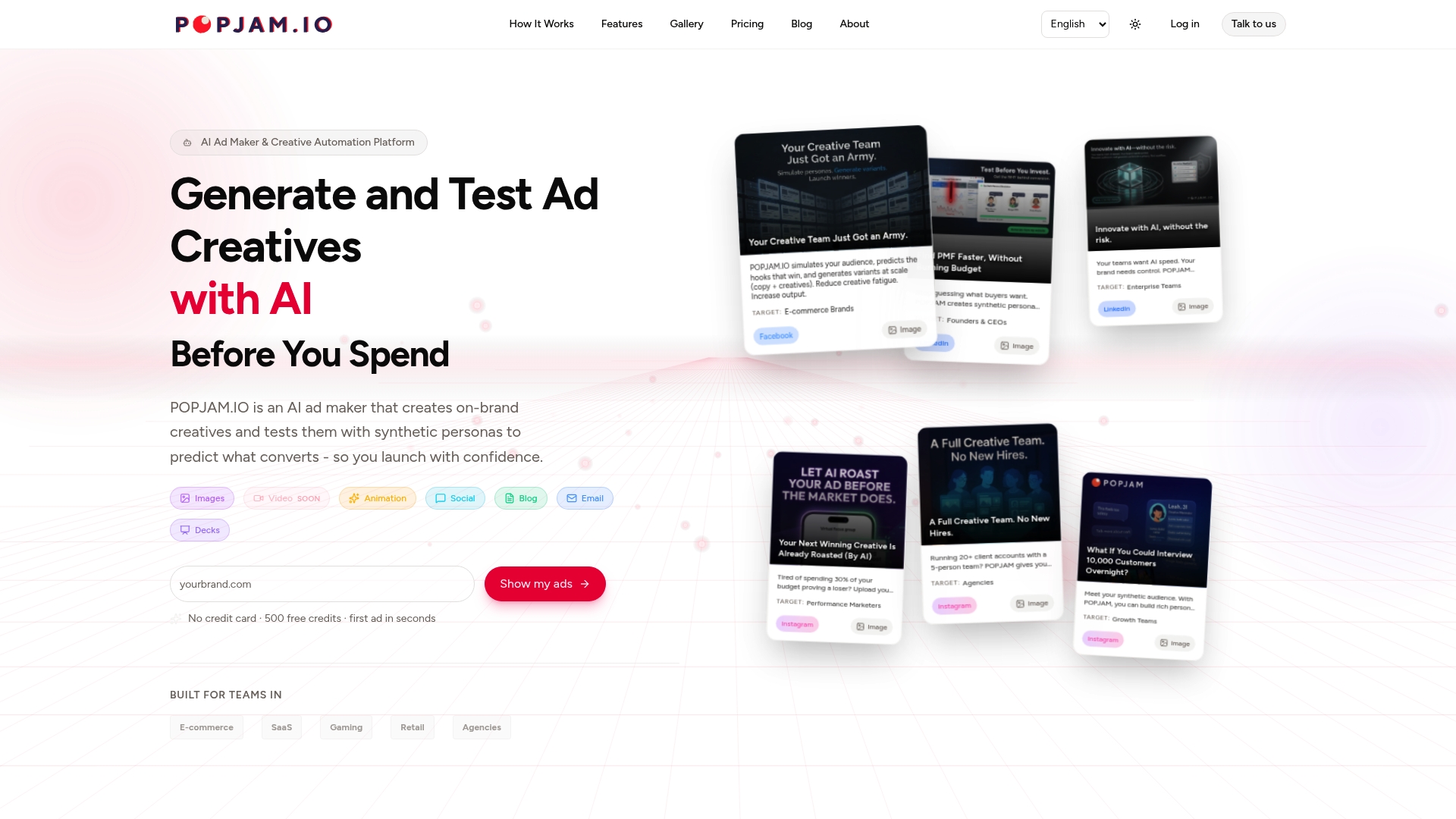
The workflow is direct. You generate variants using POPJAM’s AI ad maker, run them through synthetic persona simulation across your target segments, and receive a KPI summary with rubric scores and open-text feedback in a single exportable report. No panel recruitment, no waiting weeks for lab results, no guessing which headline resonates with your buyer. Teams at e-commerce brands, SaaS companies, and agencies use POPJAM to validate creative across Meta, Google, TikTok, LinkedIn, and Reddit before spending a dollar on placement. The result is fewer wasted impressions, faster iteration cycles, and creative that enters the market already validated against real psychographic profiles. Start your free trial at Popjam and run your first pre-launch test today.
Sources
- Research on novelty and usefulness in creative evaluation (Nature)
- Leveraging Large Models to Evaluate Novel Content: a case study
- 5 Ad Copy Testing Methods (+ Why They Work)
FAQ
What is ad copy testing?
Ad copy testing is the process of validating advertising messages and creative with a representative audience before launch, using quantitative metrics and qualitative feedback to identify which variants are most likely to perform.
What is an example of copy testing in advertising?
A team launching a new SaaS product runs three headline variants through a panel survey before buying Google Ads placements. Respondents rate each on clarity and appeal, and open-text responses reveal which benefit framing resonates most with the target segment.
What is a B test in ad copy?
A B test (or A/B test) in ad copy compares two variants of a message, typically a control (A) and a challenger (B), to measure which drives better performance on a defined KPI like CTR or CVR. The variant with statistically significant improvement wins.
What is the purpose of ad copy?
Ad copy communicates a specific message to a defined audience with the goal of driving a measurable action, whether that’s a click, a sign-up, or a purchase. Effective copy balances attention-grabbing novelty with clear, useful information about the offer.
How does POPJAM.IO fit into a pre-launch testing workflow?
POPJAM.IO generates ad creative variants and tests them against synthetic buyer personas before any media spend, producing rubric scores and AI-summarized qualitative feedback that teams can use to select and refine the strongest variants before launch.