

Persona Validation: A Practical Playbook for Growth Teams
Persona validation means testing whether a synthetic or buyer persona reliably predicts real creative performance before you scale spend. Run it in three moves: set up a two-arm A/B test with persona-labeled creative arms, run a synthetic persona simulation pre-launch inside a tool like POPJAM, and lock in baseline KPIs so your decision rules have a number to beat.
- Run a two-arm persona A/B test. Pit Persona A creative against Persona B creative with identical budgets and targeting logic.
- Simulate pre-launch. Feed both creative variants through a synthetic persona simulation to catch tone or cultural misfires before live spend.
- Record baseline KPIs. Conversion rate, cost per acquisition (CPA), and click-through rate (CTR) are your anchors. No baseline means no decision rule.
The PbOAO (Persona-Based Online Advertising Optimization) model frames this as a full-funnel loop: persona creation, ad creation, campaign creation, results analysis, and re-optimization. That loop is what this guide walks you through.
Key Takeaways
Persona validation is most effective when it combines pre-launch synthetic simulation with a live A/B test, anchored to baseline KPIs and governed by clear decision rules.
| Point | Details |
|---|---|
| Simulate before you spend | Run synthetic persona simulation to catch tone and creative risks before live budget is committed. |
| Use the PbOAO loop | Treat validation as a continuous cycle: create, test, analyze, and re-optimize rather than a one-time gate. |
| Primary KPIs decide | Conversion rate and CPA are your go/no-go metrics; CTR and engagement explain results but don’t decide them. |
| Guard against platform leakage | Lock ad set-level budgets and use audience exclusions to prevent algorithmic reallocation from skewing results. |
| POPJAM accelerates the loop | POPJAM generates persona-specific creatives, simulates reactions, and exports validated variants to Meta, TikTok, and Google. |
Table of Contents
- Before you test: the pre-experiment checklist
- Which validation method fits your situation?
- A copyable experiment blueprint you can run this week
- Which KPIs actually tell you if a persona is working?
- Common validity threats and how to avoid them
- How POPJAM fits into a real validation workflow
- When persona validation is worth the effort (and when it isn’t)
- POPJAM turns pre-launch testing into a competitive edge
- Sources
- FAQ
Before you test: the pre-experiment checklist
Wasted experiments almost always trace back to one missing ingredient. Check these before you launch anything.
Signals that mean you should validate now:
- You’re entering a new audience segment you’ve never targeted before.
- You’re working with a synthetic persona built from modeled data rather than first-party CRM records.
- You’re testing a new creative concept or messaging angle that hasn’t run before.
Minimum data you need:
- First-party event data (pixel fires, purchase events, or form completions) covering at least the last 30 days.
- A baseline conversion rate from a recent comparable campaign.
- At least two representative creative variants mapped to each persona.
- Platform targeting options that can isolate each persona’s audience without overlap.
Operational checklist before launch:
- Tracking confirmed: pixel, UTM parameters, and conversion events all firing correctly.
- Experiment naming convention set so you can filter results cleanly in your analytics platform.
- Hypothesis written in the template format (see Section 4).
- Privacy and data compliance reviewed, especially if you’re using AI persona generators that enrich first-party data with public signals.
Pro Tip: Write your testable buyer persona before you touch the ad platform. A persona without specific psychographic and behavioral attributes is just a demographic label, and demographic labels don’t generate hypotheses.
Which validation method fits your situation?
Three methods do the heavy lifting. Each has a different risk profile and a different time-to-signal.
A/B testing by persona
You create two (or more) creative arms, each built for a specific persona, and run them against seeded audiences that match each persona’s profile. The platform delivers impressions, you collect conversion data, and the persona with the higher conversion rate wins. A/B testing personas is strongest when you have enough budget to reach statistical significance and when your personas are distinct enough that the creative differences are meaningful. The main pitfall: platform algorithms will reallocate budget toward the better-performing arm before you’ve collected enough data, which contaminates the test.
Synthetic persona simulation
Before any live spend, you run your creative through an AI-powered simulation that scores it against psychographic profiles. Synthetic personas built with modern LLMs can flag content that risks backlash, identify tone mismatches, and surface messaging gaps. Think of it as a pre-launch safety check. It doesn’t replace a live test, but it reduces the number of risky variants you push to live, which shortens your iteration cycle.
Qualitative checks
Expert review, micro-focus groups (5–8 participants), and micro-surveys add texture that quantitative tests can’t. They’re best used to explain why a persona responded the way it did, not to decide whether it worked. Sequence them after simulation and before or alongside live A/B tests.
| Method | Time to Signal | Cost | Best For | Main Risk |
|---|---|---|---|---|
| A/B testing | 1–4 weeks | Medium to high | Confirming conversion lift | Platform optimization leakage |
| Synthetic simulation | Hours | Low | Pre-launch risk reduction | Doesn’t reflect real spend behavior |
| Qualitative checks | Days | Low to medium | Explaining results, refining copy | Small samples, confirmation bias |
The recommended sequence: simulate first, run qualitative review on flagged variants, then push the survivors to a live A/B test.
A copyable experiment blueprint you can run this week
Here’s a repeatable template. Plug in your own persona names and numbers.
Hypothesis template: “If we serve [Persona Name] creative to [Persona Name] audience, we expect [metric] to increase by [X%] compared to [control/baseline], because [reason tied to persona psychographics].”
Step-by-step:
- Select two personas. Choose personas that are meaningfully different in psychographics or purchase motivation, not just demographics.
- Map creatives to personas. Build one creative set per persona using the same template structure so copy and visual style are the only variables.
- Seed audiences. Use custom audiences or interest-based targeting that mirrors each persona’s behavioral profile. Keep audience sizes comparable.
- Allocate budget evenly. Split budget 50/50 between arms. Lock allocations manually to prevent platform auto-optimization from skewing delivery.
- Set runtime. Run for a minimum of 7 days and through at least one full platform learning window (typically 7 days on Meta, similar on Google).
- Apply stopping rules. Stop early only if one arm shows a conversion rate more than 3x the other before the minimum runtime. Otherwise, let it run.
Decision thresholds:
- Promote a persona if it beats the baseline conversion rate and the lift is practically meaningful for your unit economics.
- Pause and iterate if results are within margin of error after full runtime.
- Retire a persona if it underperforms baseline across two consecutive tests.
To avoid platform optimization leakage, use holdout groups where possible and monitor Google Ads automation settings that can override manual budget splits.
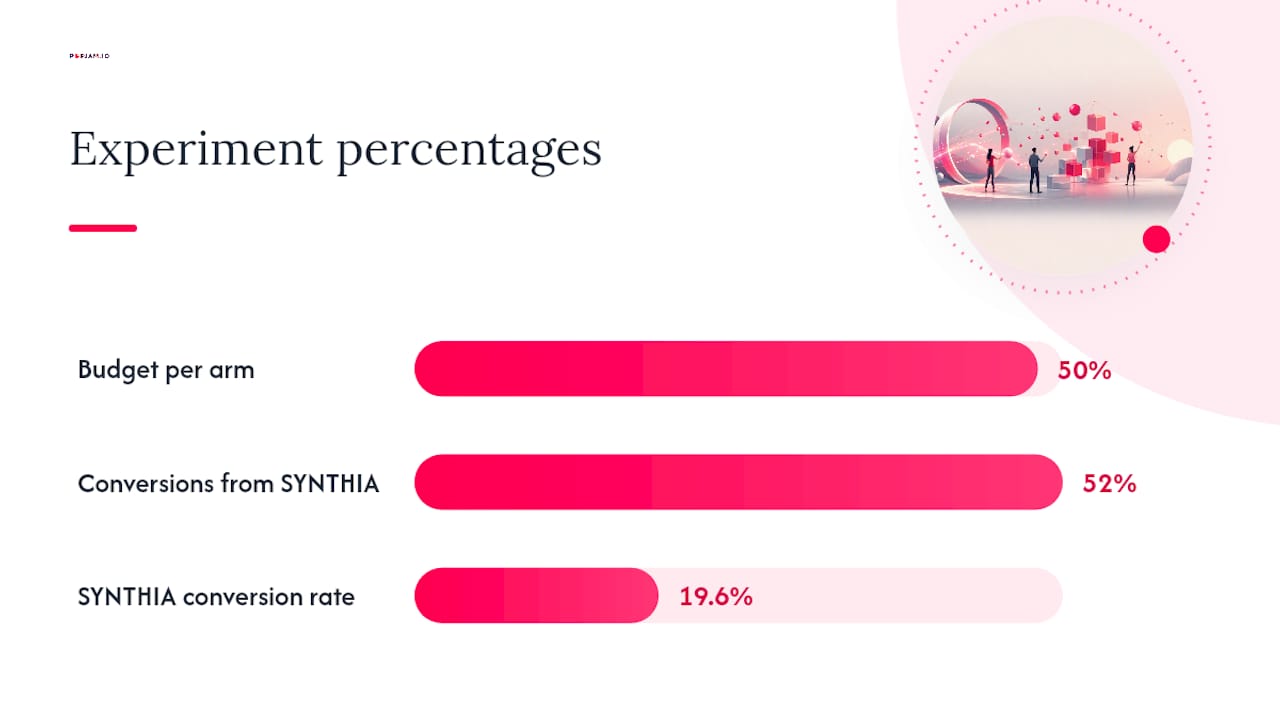
Stat to know: In one published agency case, an AI-generated persona called SYNTHIA analyzed 17.6 million data points, drove 52% of campaign conversions, and produced a 19.6% conversion rate. That’s a single-case result, not a benchmark, but it shows the upside when persona targeting is dialed in.
Which KPIs actually tell you if a persona is working?
Primary KPIs (use these for go/no-go decisions):
- Conversion rate per persona arm.
- CPA or cost per mille (CPM) relative to your target.
- Return on ad spend (ROAS) if your campaign goal is revenue.
Secondary KPIs (use these to diagnose, not decide):
- CTR tells you whether the creative is resonating at the impression level.
- Engagement rate (saves, shares, comments) signals intent quality.
- Downstream metrics like 30-day retention or lifetime value (LTV) signals confirm the persona attracts buyers, not just clickers.
Decision flow:
- Promote: Primary KPIs beat baseline AND secondary KPIs show healthy engagement. Scale budget.
- Hold: Primary KPIs are flat but secondary KPIs are strong. Run a second test with refined creative before scaling.
- Iterate: Primary KPIs miss baseline. Revisit persona attributes, creative mapping, or audience seeding before retesting.
Stat to know: The PbOAO model frames persona-based optimization as a hypothesis-driven loop, meaning a single test result is one data point in an ongoing cycle, not a final verdict.
Mixed signals (strong CTR, weak conversion) usually mean the persona is attracting attention but the landing experience or offer isn’t matching expectations. That’s a funnel problem, not a persona problem.
Common validity threats and how to avoid them
Sampling and power errors:
- Underpowered tests are the most common failure mode. If your audience is too small to detect a 10–15% lift, you’ll get noise, not signal.
- Non-representative seeding (e.g., using a broad interest category instead of a behavioral custom audience) means you’re not actually testing the persona.
Platform optimization confounds:
- Meta and Google’s algorithms will shift delivery toward the winning arm during the learning phase. Use Campaign Budget Optimization (CBO) off or set ad set-level budgets to prevent this.
- Audience overlap between persona arms inflates results for the stronger arm. Use audience exclusions.
Persona bias:
- Overly hypothetical traits (“loves adventure, values authenticity”) produce creatives that are too generic to differentiate. Personas need specific behavioral and psychographic signals.
- Confirmation bias in qualitative review: teams tend to approve creatives that match their intuition. Use blind review where possible.
Quick post-test checks: Verify delivery parity between arms, confirm no audience overlap, and check that conversion events fired correctly before reading results.
How POPJAM fits into a real validation workflow
Here’s how a team using POPJAM runs the full loop:
- Step 1: Create synthetic personas. Use POPJAM’s AI Persona Generator to build psychographic profiles enriched with behavioral signals. Human-in-the-loop review catches implausible attributes before they contaminate your test.
- Step 2: Generate persona-specific creatives. POPJAM produces creative variants mapped to each persona’s profile, images, video, and copy, across Meta, TikTok, Google, LinkedIn, and Reddit formats.
- Step 3: Run synthetic simulation. Before any live spend, POPJAM simulates audience reactions and returns psychographic feedback scores. Variants that flag as risky get revised, not launched.
- Step 4: Export to ad platforms. Export-ready creatives go directly into your Meta Ads Manager, Google Ads, or TikTok Ads account with UTM parameters pre-attached.
- Step 5: Collect and analyze feedback. Post-campaign, POPJAM aggregates quantitative performance data alongside the original psychographic scores so you can see where simulation predicted real behavior and where it didn’t.
“Synthetic personas done right reduce creative risk and maximize upside by helping teams identify the balance between clever and potentially offensive creative before live spend.” Forbes
For a Meta campaign, this means your creative is pre-scored against your persona before it enters the auction. For TikTok, the simulation flags tone and pacing issues that tend to tank completion rates. For Google, it surfaces headline relevance gaps against the persona’s search intent.
When persona validation is worth the effort (and when it isn’t)
Most teams over-test low-stakes decisions and under-test the ones that actually move the needle. Here’s my honest read on where validation ROI is highest.
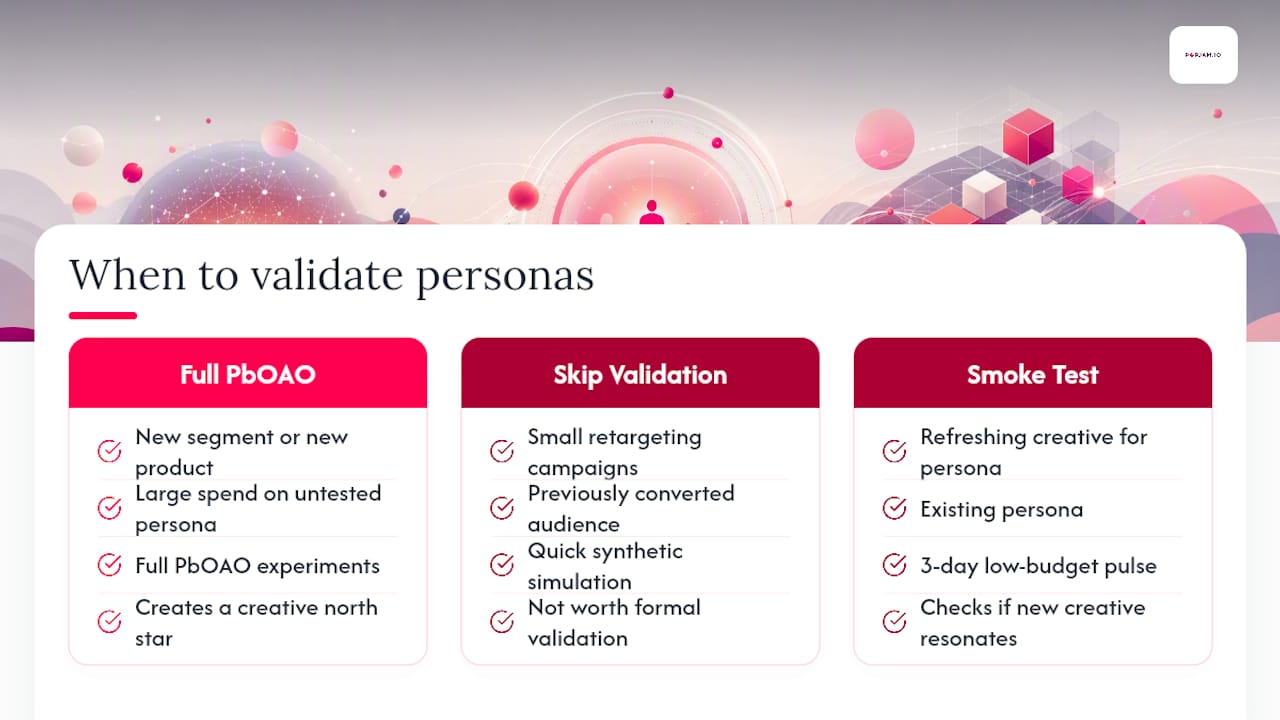
Full PbOAO experiments are worth the investment when you enter a new segment, launch a new product, or allocate significant budget to a persona you’ve never tested live. The upside is real: a validated persona gives your entire creative pipeline a reliable north star.
Skip formal validation when you’re running a small retargeting campaign against a well-established audience you’ve converted before. A quick synthetic simulation is enough.
Light smoke tests (a 3-day, low-budget pulse) make sense when you’re refreshing creative for an existing persona. You’re not validating the persona itself; you’re checking whether the new creative still resonates.
On governance: persona validation works best when one person owns it. In a cross-functional team, that’s usually the performance lead or the growth PM. When everyone owns it, no one runs the stopping rules.
POPJAM turns pre-launch testing into a competitive edge
Wasted creative spend is a solvable problem. POPJAM’s AI ad creative platform lets you generate persona-specific ad creatives and simulate audience reactions before a single dollar hits the auction. You get psychographic feedback scores, export-ready variants for Meta, TikTok, and Google, and a clear signal on which persona to back, all before launch.
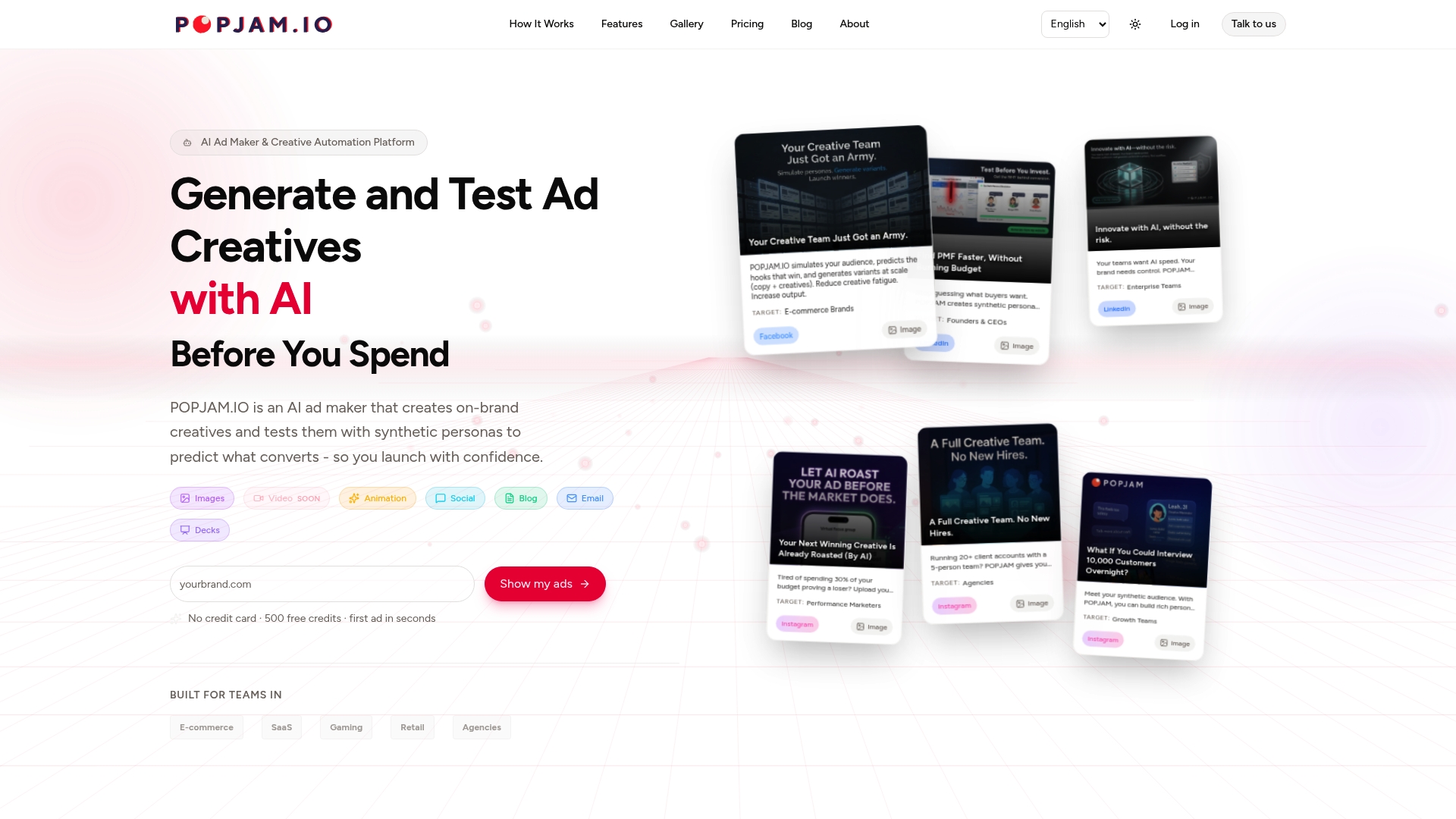
For agencies running multiple client accounts, the POPJAM agency workflow scales this across campaigns without adding headcount. Start a free trial at Popjam and run your first synthetic simulation today.
Sources
- A/B Testing Personas: Using Data-Driven Personas for A/B Testing
- How Can Personas Support Online Advertising Process? Proposing ‘Persona-Based Online Advertising Optimization’
- Synthetic Personas Done Right Reduce Creative Risk And Maximize Upside
- Ai
FAQ
What is persona validation in marketing?
Persona validation is the process of testing whether a synthetic or buyer persona accurately predicts how a real audience responds to ad creative. It uses A/B testing, synthetic simulation, and qualitative checks to confirm a persona before you scale spend behind it.
How many people do you need to validate a persona with an A/B test?
Sample size depends on your baseline conversion rate and the lift you want to detect. As a rule of thumb, aim for enough impressions to detect a 10–15% lift before reading results.
Can synthetic personas replace live A/B testing?
No. Synthetic simulation reduces the number of risky variants you push to live and shortens iteration cycles, but it doesn’t replicate real spend behavior. Use simulation first, then confirm with a live test.
How often should you revalidate a persona?
Revalidate whenever you enter a new segment, refresh creative significantly, or notice a sustained drop in campaign performance. The PbOAO model treats validation as a continuous loop, not a one-time gate.
How does POPJAM support persona validation?
POPJAM generates persona-specific creatives, runs pre-launch synthetic simulations with psychographic feedback, and exports validated variants directly to Meta, TikTok, and Google, covering the full validation workflow in one platform.