

Screen 15 CTAs With Synthetic Pretests and Live A/B, for Paid Teams
CTA testing means running targeted A/B or multivariate experiments on your call-to-action wording, design, and placement, and the winning workflow right now pairs speed with proof. Pre-test a wide pool of variants against synthetic audiences to kill the weak ones fast, then confirm your top two or three in a live A/B test measured by real downstream conversions, not clicks.
TL;DR:
- Synthetic pre-testing allows quick screening of dozens of CTA variants against modeled audiences, reducing the need for expensive live traffic testing.
- Multivariate testing is useful only when enough traffic supports testing multiple elements simultaneously, but most campaigns rely on simpler A/B tests.
- Reliable results require at least 7 to 14 days of testing to account for day-of-week effects and audience fatigue, with downstream metrics preferred over clicks.
- Consistent message match between ad copy and landing page significantly improves conversion rates and should be verified before launching tests.
- Starting with synthetic persona testing helps identify the most promising CTA angles before committing budget to live campaigns, especially for high-traffic pages.
Table of Contents
- Why CTA Testing Is a High-Leverage Move for Paid Campaigns
- A/B, Multivariate, or Synthetic Pre-Test: Picking the Right Tool
- How to Run a CTA Test This Week
- When Is a CTA Test Result Actually Reliable?
- The Preflight Checklist Nobody Skips Twice
- How Synthetic Persona Testing Fits Into a Real Workflow
- What Most Teams Get Wrong About CTA Testing
- Run Your First Synthetic Pre-Test Before Your Next Campaign
- Sources
- FAQ
Why CTA Testing Is a High-Leverage Move for Paid Campaigns
A CTA is often the cheapest thing on your page to change and one of the most consequential. You are not redesigning a funnel or rewriting a value proposition. You are testing five words on a button, and those five words decide whether the click you already paid for turns into a signup.
Every impression that lands on a weak CTA is money you already spent for nothing. That is the real cost of skipping this work: not a missed opportunity, but ad spend you cannot get back. Synthetic pre-testing closes that gap before it opens, since it can screen dozens of CTA permutations against calibrated synthetic audiences and reach 80 to 95 percent agreement with historical benchmarks, all before a single dollar hits a live campaign.
CTA testing also scales in a way most creative work does not. Once you have a workflow, it runs identically across a Meta ad, a Google search ad, and the landing page both point to, which means one testing habit compounds across your entire paid stack.
A/B, Multivariate, or Synthetic Pre-Test: Picking the Right Tool
Three testing methods cover almost every CTA question you will face, and they are not interchangeable.
A/B testing isolates one variable, typically a 50/50 traffic split between two CTA versions, and it is the right call whenever you have enough live traffic to power a real experiment. HubSpot’s own CTA testing tool works exactly this way: create variants, split traffic, then review clicks, views, and submissions before naming a winner.
Multivariate testing checks several elements at once, such as CTA copy, button color, and placement together, to catch interaction effects a simple A/B test would miss. It only makes sense when your traffic volume can support that many combinations reaching significance in a reasonable window. Most paid campaigns underestimate how much traffic that actually requires.
Synthetic pre-testing is the newest layer and the one most teams are missing. It scores CTA variants against modeled audience personas in minutes, which makes it ideal for narrowing a pool of ten or fifteen candidate CTAs down to the two or three worth spending real media dollars to confirm.
- A/B: two variants, live traffic, clean statistical read
- Multivariate: multiple elements, high traffic requirement, reveals interactions
- Synthetic pre-test: rapid screening, no live spend, hypothesis generation only
Pro Tip: Run your synthetic pre-test on a wider net than feels comfortable. It costs almost nothing to test fifteen CTA angles synthetically, and the variant that ranks last is often the one you would have shipped by default.
How to Run a CTA Test This Week
You do not need a quarter-long roadmap to get a clean result. Here is the compressed version.
- Pick one page and one primary business metric (purchase, trial start, qualified lead) before you write a single CTA variant.
- Confirm your tracking fires correctly on that goal, not just on the click. A test built on broken tracking is worse than no test at all.
- Write two to three CTA variants using distinct psychological frames: a direct command (“Start Free Trial”), a benefit statement (“Get My Free Checklist”), and a low-friction option (“See Pricing, No Signup”). This mirrors CRO guidance that specific, outcome-oriented copy consistently outperforms generic verbs like “Submit.”
- Run those variants, plus any others you’re curious about, through a synthetic pre-test to rank them fast.
- Move only the top-scoring one or two variants into an isolated live A/B test.
- Keep audiences and traffic sources cleanly separated so no other experiment is running against the same users at the same time.
That last step trips up more teams than any other. Overlapping tests contaminate your read, and you will not know it until the numbers stop making sense.
When Is a CTA Test Result Actually Reliable?
A lift that looks great on day three often evaporates by day ten. Reliable CTA testing depends on hitting real thresholds before you act.
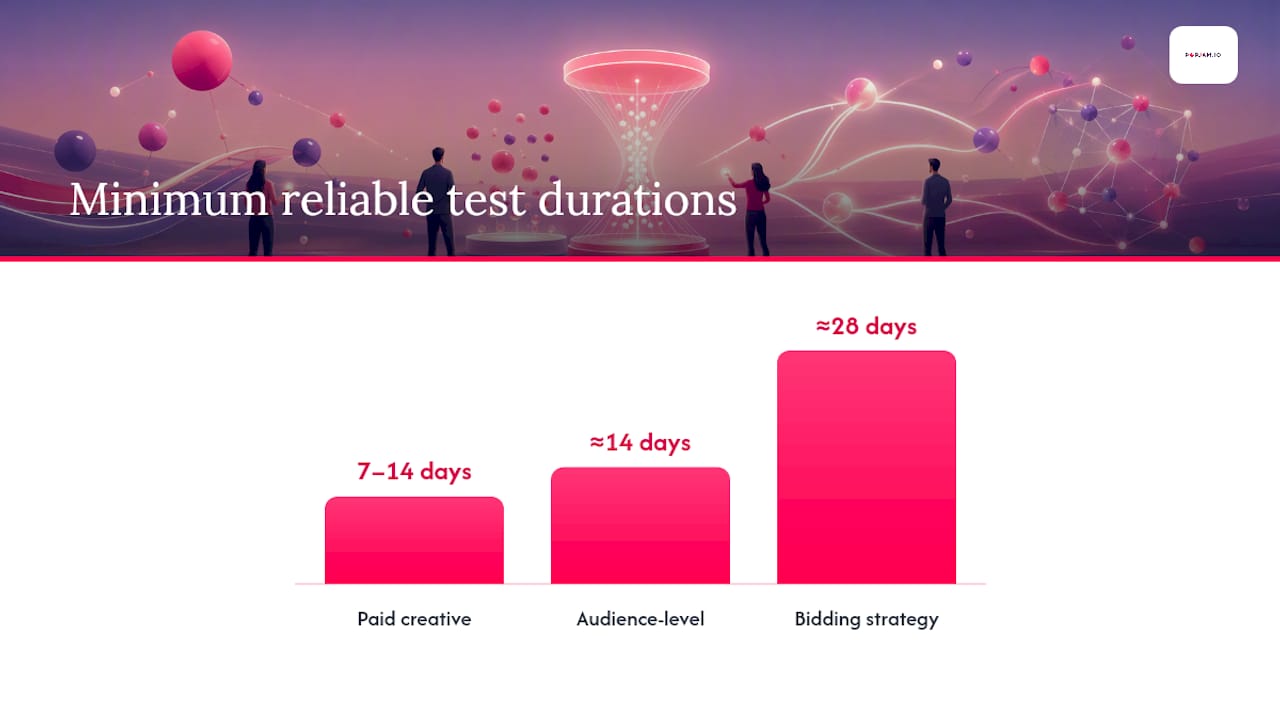
Paid creative tests generally need 7 to 14 days minimum to average out day-of-week and audience fatigue effects; audience-level tests need closer to 14 days, and bidding-strategy tests need closer to 28. Cutting a test short because one variant is “clearly winning” on day two is the single most common way teams fool themselves.
Clicks are the easiest metric to move and the least useful one to trust. Favor downstream metrics instead: trial starts, completed purchases, qualified leads. A CTA that generates more clicks but fewer purchases is not a winner, it is a distraction.
Before declaring a result, check that each variant has enough conversions to reach roughly 95 percent statistical confidence, not just a visually convincing gap. If the sample is too thin, extend the test rather than calling it. To prioritize which tests to run first, rough out expected value: multiply the traffic a page gets by the plausible lift, and rank your test backlog by that number instead of by whichever idea feels most interesting this week.
The Preflight Checklist Nobody Skips Twice
Most broken CTA tests fail before they launch, not during analysis.
- Change only the CTA. If the creative, offer, or landing destination shifts too, you no longer know what caused the result.
- Never run overlapping tests on the same audience or traffic source without explicit isolation.
- Don’t underpower a test to hit a launch date. An inconclusive test that gets called anyway is worse than a delayed one.
- Confirm the CTA promise matches the destination page. Message match between ad and landing page is one of the most reliable, repeatable levers in paid CTA testing, and mismatches quietly tax every campaign that has one.
Pro Tip: Before you launch, write down your hypothesis, your primary metric, and your minimum sample size in one line. If you can’t fill in all three, you’re not ready to launch the test yet.
Run through five checks before anything goes live: tracking confirmed, naming convention applied, duration estimate set, audience isolation verified, and downstream goal mapped to the CTA. Teams that document this consistently see compounding value, since a winning frame on one landing page often transfers to another page with similar intent.
How Synthetic Persona Testing Fits Into a Real Workflow
POPJAM is built around exactly the gap this article keeps circling back to: the cost of finding out a CTA doesn’t work only after you’ve paid to run it. The platform generates on-brand ad creative and tests it against synthetic buyer personas before anything reaches a live audience, giving performance teams a data point they didn’t have before, instead of a guess dressed up as a decision.
Synthetic personas return psychographic feedback, not just a preference score. That distinction is what lets a team see why one CTA framing lands with a self-serve buyer and another lands with an enterprise prospect, rather than just which one won.
That segment-level detail matters because CTA performance is never uniform across an audience. A first-time visitor tends to respond to low-friction language (“See Pricing”), while a returning prospect closer to a decision often responds better to outcome-focused copy (“Start Saving Today”). POPJAM’s approach, detailed in its message testing methodology, treats these synthetic scores as a screening layer. The winners still need live confirmation tied to real conversions before you scale spend behind them.
What Most Teams Get Wrong About CTA Testing
The conventional advice on CTA testing treats it like copywriting trivia: swap “Buy Now” for “Get Yours,” measure clicks, ship the winner. That framing undersells what is actually a distribution problem. You have limited live traffic and an almost unlimited number of CTA angles worth trying, and the bottleneck was never creativity. It was throughput.
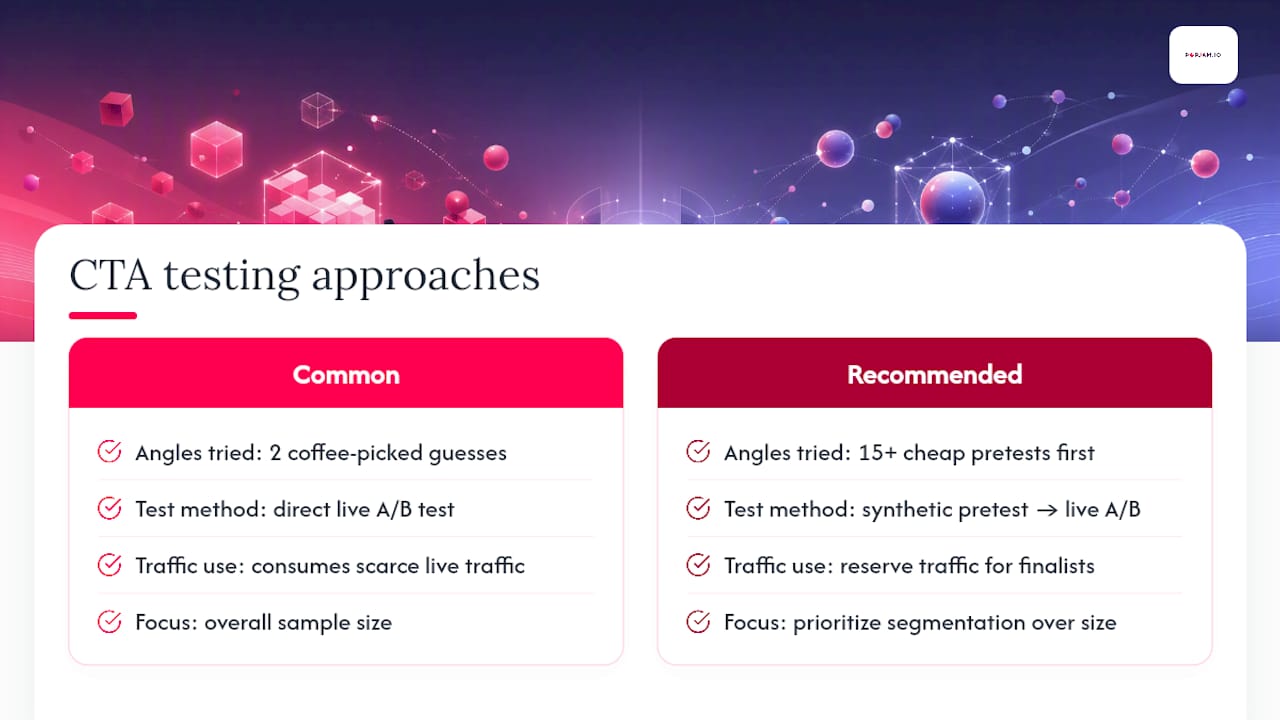
Where most teams go wrong is skipping straight to a live A/B test with two variants they liked best over coffee. That approach tests two guesses against each other instead of testing your best guess against everyone else’s. Synthetic pre-testing exists to fix exactly that: it lets you throw fifteen angles at the wall cheaply, then spend your live traffic budget confirming the one or two that actually deserve it.
If you take one thing from this, prioritize segmentation over sample size. A blended “winner” that performs well on average but badly for your highest-value segment is a worse outcome than a smaller, cleaner test that tells you the truth about who responds to what.
— Doruk
Run Your First Synthetic Pre-Test Before Your Next Campaign
The workflow this article recommends, synthetic screening followed by live A/B confirmation, is what POPJAM’s AI ad generator is built to run. Instead of guessing which two CTA angles deserve your live budget, you generate on-brand creative and test a wide pool of variants against synthetic personas first, then only spend real ad dollars confirming the ones that actually score.
Getting started takes one page and one goal. Pick the landing page or ad set with the highest spend attached to it, run its current CTA and two or three challengers through a pre-test, and see which ones a synthetic audience actually responds to before you commit media budget to any of them. If you run paid campaigns for an agency managing multiple client accounts, the agency-focused version of the tool is built for exactly that volume. Start with your highest-traffic page this week and confirm your next CTA with data instead of a coin flip.
Sources
FAQ
What is CTA testing?
CTA testing is systematic experimentation on call-to-action wording, design, placement, or offer, typically through A/B or multivariate tests, to find which version drives more conversions rather than just more clicks.
How long should a CTA test run?
Creative and CTA tests generally need a minimum of 7 to 14 days to smooth out day-of-week variation, and you should extend that window if a variant hasn’t reached enough conversions for statistical confidence.
What’s the difference between synthetic pre-testing and a live A/B test?
Synthetic pre-testing scores CTA variants against modeled audience personas in minutes with no live spend, while a live A/B test confirms the top-scoring variants with real traffic and real conversion data. Use the first to narrow options and the second to make the final call.
Should I test clicks or conversions when running CTA tests?
Favor downstream business metrics, purchases, trial starts, or qualified leads, over raw click volume, since a CTA can generate more clicks while producing fewer actual conversions.
Why does message match matter in CTA testing?
When your ad’s CTA promise doesn’t match the landing page’s CTA, visitors experience friction that lowers conversion rate, even if the individual CTA copy tested well on its own.
Can POPJAM help with CTA testing specifically?
Yes. POPJAM generates ad creative and tests CTA variants against synthetic buyer personas before launch, which helps performance teams narrow a large pool of CTA ideas down to the strongest candidates before spending on a live confirmation test.