

Message Testing for Campaign Teams: A Practical Guide
Message testing validates which words, claims, and creative elements actually connect with your audience before you spend a dollar on media. The fastest practical first step? Run a rapid monadic or AI-moderated conversational test that shows one message variant per respondent and measures four things:
- Comprehension: Does the reader understand what you’re offering without help?
- Belief: Do they find the claim credible?
- Desire: Does it create genuine interest or pull?
- Willingness to pay: Does the price framing feel fair given the promise?
If comprehension or relevance fail, stop and rewrite before moving forward. Passing all four signals a message worth scaling.
Table of Contents
- What is message testing, and how does it differ from A/B testing?
- Why skipping message testing costs more than running it
- What should you test, and when?
- Which message testing methods should you use?
- How to design a message test that actually works
- How to analyze results and turn them into creative decisions
- Real-world examples: before and after message testing
- Common pitfalls and how to avoid them
- Key Takeaways
- The case for treating message testing as always-on work
- POPJAM makes pre-launch message testing faster and more specific
- Useful sources
- FAQ
What is message testing, and how does it differ from A/B testing?
Message testing is structured research that compares message variants with real members of your target audience to measure comprehension, credibility, relevance, differentiation, and purchase intent. The goal isn’t just to find a winner. It’s to surface why one message lands and another doesn’t, so your creative team has rewrite direction, not just a score.
That distinction separates it from A/B testing. A/B testing measures behavior at scale after launch: clicks, conversions, revenue. Message testing diagnoses why a message does or does not land before you commit budget. Think of it as the diagnostic phase that makes your A/B tests more likely to produce a clear winner from the start.
The two methods are complementary, not competing. Run message testing to sharpen your copy, then run A/B tests to confirm performance at scale.
The core diagnostic question message testing answers: “Does this message mean what we think it means to the people we’re trying to reach?”
Why skipping message testing costs more than running it
The most common failure mode in campaign creative is shipping internally favored copy. Your team lives inside the product. You know the jargon, the backstory, the nuance. Your audience doesn’t. When you skip pre-launch validation, you’re betting media dollars on an assumption.
The downstream costs are real:
- Wasted media spend on ads that generate impressions but not clicks, because the value proposition didn’t land
- Brand confusion when your message communicates something different from what you intended
- Lost conversion rate from CTAs that feel vague or benefits that don’t match what the audience actually cares about
- Creative fatigue from iterating on live campaigns instead of diagnosing the problem before launch
Teams that validate messages before launch can identify specific words and lines that connect with their audience, and they can do it quickly with relatively small participant counts. A monadic test with a small panel can cost much less than continuing to run underperforming paid media for weeks.
Internal echo chambers are one of the biggest creative risks in marketing. Message testing is the corrective mechanism that surfaces market language and prevents teams from shipping messages they personally prefer over messages their audience actually responds to.

What should you test, and when?
Timing matters as much as method. Here’s a practical framework for when to run each type of test:
Pre-launch (highest ROI window): Test headlines, value propositions, and primary CTAs before any media spend. This is where a small investment in testing pays back the most.
Re-positioning: When you’re shifting your brand narrative, entering a new segment, or updating pricing, test the new message against the old one with your existing audience before rolling it out.
Continuous tightening: For active campaigns, run quarterly checks on your top-performing messages. Customer attitudes shift over time, and a message that worked 18 months ago may be losing resonance now.
Priority checklist for what to test first:
- Headline and primary value proposition (always first)
- Top three product or service benefits
- Primary CTA wording and placement
- Hero image or screenshot with caption
- Pricing message and anchoring language
- Audience segment-specific hooks (especially for B2B ICP targeting)
Timeline guidance: Rapid headline and value prop tests typically run 3–5 days. Segmentation studies or pricing message tests need 2–4 weeks to gather enough responses across cells. For mature campaigns, a monthly or quarterly cadence keeps your messaging sharp without burning the team.
Which message testing methods should you use?
Picking the right method comes down to three questions: What’s your core question? How much time do you have? What’s your budget shape? Here’s a practical catalog.
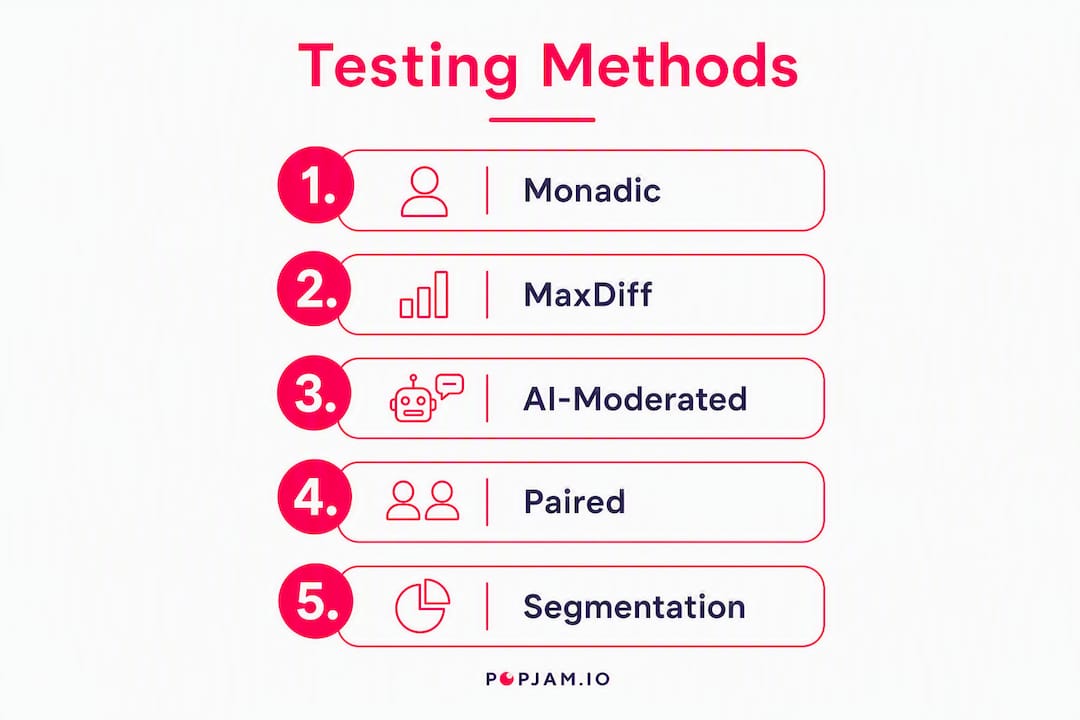
| Method | Best For | Typical Sample | Time to Insight | Cost Shape |
|---|---|---|---|---|
| Monadic test | Absolute clarity, credibility, and intent per variant | a moderate number of respondents per cell | a few days | Low–medium |
| Sequential monadic | Direct comparison with context | a moderate number of respondents per cell | under a week | Medium |
| Forced-choice paired comparison | Quick preference ranking | a moderate number of respondents | a few days | Low |
| MaxDiff | Prioritizing a long list of benefits or claims | a sizable sample | several days | Medium |
| Qualitative interviews (moderated) | Deep exploration of language and mental models | a small group | one to two weeks | High |
| AI-moderated conversational research | Probing quality at interview depth, faster turnaround | a moderate number of respondents | a few days | Low–medium |
| Card sorting | Organizing and prioritizing benefit language | a small number of respondents | a few days | Low |
| Conjoint analysis | Pricing and feature tradeoff decisions | a larger sample | a few weeks | High |
A few notes on how to choose:
Monadic testing shows each respondent exactly one message variant, which eliminates comparison bias and gives you a clean read on how that message performs on its own. It’s the most reliable design for measuring comprehension and credibility because respondents aren’t anchored to a competing option.
MaxDiff shines when you have a long list of potential benefits or claims and need to force real tradeoffs. Structured trade-off methods like MaxDiff are the right tool when you need to prioritize across many options rather than evaluate one message in isolation.
AI-moderated conversational research has changed the economics of qualitative testing. Teams can now run qualitative-led messaging tests in days instead of weeks while preserving the probing quality you’d expect from a moderated interview. For most campaign teams, this is the fastest path to understanding why a message works.
Pro Tip: Start with a monadic or AI-moderated conversational test to capture both System 1 gut reactions and System 2 explanations. Add MaxDiff only when your list of benefit claims exceeds five or six options and you need a forced-ranking output.
How to design a message test that actually works
Good test design is what separates actionable findings from noise. Work through these steps before you field anything.

Step 1: Define your objective. Are you testing comprehension, persuasion, or intent? Pick one primary metric before you write a single survey question.
Step 2: Choose your method. Use the table above. For most headline and value prop tests, monadic is the right default.
Step 3: Draft your stimuli. Show the message in context: a mock ad, a landing page header, or a product card. Naked copy on a white background tests differently than copy in its natural environment.
Step 4: Set randomization rules. Assign respondents to variants randomly. Never let respondents self-select into a condition.
Step 5: Prepare open-ended probes. Closed-scale ratings tell you how well a message performed. Open-ended probes tell you why. Interviews and open-ended questions are the right tool when you need depth on how individuals think about a message.
Step 6: Define your decision rule before you field. What score on your primary metric constitutes a pass? Set this threshold before you see results to avoid post-hoc rationalization.
Sample questionnaire sequence:
- “In your own words, what is this product or service offering?” (comprehension, open-ended)
- “How believable is this claim on a scale of 1–7?” (belief, closed)
- “How relevant is this to your current situation?” (relevance, closed)
- “How likely are you to take the next step?” (intent, closed)
- “Does the price feel fair given what’s being offered?” (willingness to pay, open or closed)
- Optional: “If you had to choose between these two options, which would you pick and why?” (forced-choice preference)
Sample size guidance by method:
| Method | Minimum per Cell | Recommended per Cell | Notes |
|---|---|---|---|
| Monadic | — | — | Each variant is a separate cell |
| Sequential monadic | 50 | — | Same respondents see both |
| MaxDiff | — | — | Needs enough for stable utility scores |
| Qualitative interviews | 6 | — | Saturation typically reached by single-digit days |
| AI-moderated conversational | — | — | Faster iteration; lower n acceptable |
Pro Tip: For B2B SaaS teams, run a quick four-check protocol with five ICP-matched respondents per check: a Stranger test for clarity, a Priority test for relevance, a Clone test for differentiation, and a Champion test for internal selling power. If Stranger or Priority fails, rewrite before scaling the study.
How to analyze results and turn them into creative decisions
Results without decision rules are just data. Here’s how to move from scores to copy changes.
Traffic-light decision framework:
- Green: Comprehension passes (respondents can accurately describe the offer) AND persuasion passes (intent score meets your pre-set threshold). Ship it.
- Yellow: Comprehension passes but persuasion lags. The message is clear but not compelling. Strengthen the benefit language or proof points and retest.
- Red: Comprehension fails. Respondents can’t describe what you’re offering. Stop. Rewrite the core message before testing anything else.
Analysis checklist:
- Preference scores by variant
- Comprehension open-ends: what language did respondents use to describe the offer?
- Thematic reasons the winner won (pull these from open-ended probes)
- Segment splits: did the winner perform differently across age, role, or purchase stage?
- Willingness-to-pay signals: did the pricing message feel fair or create friction?
One pattern worth watching: a variant that wins on preference but scores low on differentiation. Messaging tests should report both preference scores and the qualitative reasons behind variants so teams know why a winner won and what to change in losers. When a message wins on preference but feels generic, the fix is to preserve the emotional hook and rewrite the supporting line to explicitly state the customer benefit and proof points that appeared in the winning test responses.
A note on say-do gaps: Direct willingness-to-pay questions overstate actual purchase intent. Combine qualitative trade-off techniques like MaxDiff with indirect pricing probes to get a more realistic read on price sensitivity.
Real-world examples: before and after message testing
Example 1: SaaS headline clarity test
A B2B SaaS team was running paid search ads with the headline “Automate your workflow in minutes.” Click-through rates were flat. A monadic test with a moderate number of ICP-matched respondents revealed that “workflow” was interpreted differently across segments: some thought project management, others thought data pipelines. Comprehension failed the Stranger test. The rewritten headline, “Connect your tools and cut manual work by half,” passed comprehension with a strong majority of respondents accurately describing the offer. CTR improved after launch.
Example 2: E-commerce value proposition test
An e-commerce brand tested three benefit-led headlines for a product launch using a forced-choice paired comparison with 90 respondents. The internally favored headline (“Premium quality, delivered fast”) ranked last. The winner (“Free returns, always. No questions asked”) scored highest on relevance and desire. The team had assumed quality was the primary purchase driver; the test revealed that return policy anxiety was the real barrier.
POPJAM pre-launch simulation case study
A performance marketing team used POPJAM’s synthetic persona simulation to test three ad creative variants before any media spend. Each variant was routed to a psychographic persona profile matching their target ICP. The platform returned both quantitative scores (comprehension, relevance, intent) and qualitative feedback explaining why each persona responded the way they did.
Before/after summary:
| Metric | Before Testing | After Iteration |
|---|---|---|
| Comprehension score | 54% | 81% |
| Relevance score | 61% | 79% |
| Intent to click | Low | Significantly higher |
| Creative iterations needed post-launch | 4 | 1 |
The lesson: pre-launch simulation with synthetic personas compresses the iteration cycle. Instead of discovering creative mismatches through live campaign data, the team caught them in the design phase.
Common pitfalls and how to avoid them
The most expensive mistake in message testing is testing too many variants at once. When you split your sample across six or seven options, no single cell has enough respondents to produce reliable results. Limit each study to two to four variants maximum.
Other traps to avoid:
- Ignoring comprehension entirely. Teams often jump straight to preference or intent scores. If respondents don’t understand the message, their preference data is meaningless.
- Relying solely on closed-scale surveys. Ratings tell you how a message scored. Open-ended probes tell you the language your audience actually uses, which is the raw material for your next creative iteration.
- Using A/B testing to diagnose a messaging problem. A/B tests measure behavior, not understanding. If your campaign is underperforming, a live A/B test will tell you which variant is less bad. Message testing will tell you why both variants are failing.
- Skipping segment analysis. A message that scores well overall can mask a strong performance in one segment and a weak one in another. Always cut your results by the segments that matter for your campaign.
Modern message testing blends fast System 1 measures with deeper System 2 probing to capture both gut reactions and the reasons behind them. Studies that use only one type of measure miss half the picture.
On ethics and privacy in US-based tests: Always obtain informed consent from research participants. Disclose how their responses will be used. Offer transparent incentives and honor them promptly. For any test that collects demographic data, follow applicable data privacy regulations and your organization’s IRB or ethics review process. AI-moderated platforms that use synthetic personas sidestep many of these concerns because no real participant data is collected.
Key Takeaways
Effective message testing combines pre-launch diagnostic research with a clear decision framework, so you ship copy that comprehends, convinces, and converts rather than discovering problems through wasted media spend.
| Point | Details |
|---|---|
| Start with comprehension | If respondents can’t describe your offer accurately, no other metric matters — rewrite first. |
| Use monadic design by default | Showing one variant per respondent eliminates comparison bias and gives clean absolute scores. |
| Mix System 1 and System 2 probes | Rapid ratings capture gut reactions; open-ended questions reveal the language behind them. |
| Set decision rules before fielding | Define your pass/fail threshold before you see results to avoid post-hoc rationalization. |
| POPJAM for pre-launch simulation | POPJAM’s synthetic persona platform lets teams test ad creative and messaging against ICP-matched personas before any media spend. |
The case for treating message testing as always-on work
Most teams treat message testing as a one-time pre-launch ritual. Run the test, pick a winner, ship it, move on. That’s better than nothing, but it leaves a lot of performance on the table.
The teams I see getting the most out of their creative budgets treat message testing as a continuous diagnostic practice, not a gate. They run small, fast tests at the start of every creative sprint. They use the open-ended responses to build a living library of audience language. They revisit their top-performing messages quarterly because customer attitudes shift, competitive context changes, and what resonated 12 months ago may feel stale today.
There’s also a deeper point worth making: message testing doesn’t replace creative judgment. It informs it. The best creative directors I’ve seen use test findings as a brief, not a brief-killer. They take the language that resonated in open-ends and use it as raw material for the next round of copy. The test tells them what the audience cares about; the creative team figures out how to say it memorably.
My honest recommendation: run one small experiment this week. Pick your current best-performing headline, write two alternatives, and run a 50-person monadic test. You’ll have findings in three to five days, and those findings will make your next creative sprint sharper than any internal brainstorm.
POPJAM makes pre-launch message testing faster and more specific
Most message testing workflows require you to recruit respondents, build a survey, wait for results, and then manually connect findings to creative decisions. POPJAM compresses that entire cycle by running your ad creative through synthetic buyer personas before you spend a dollar on media.
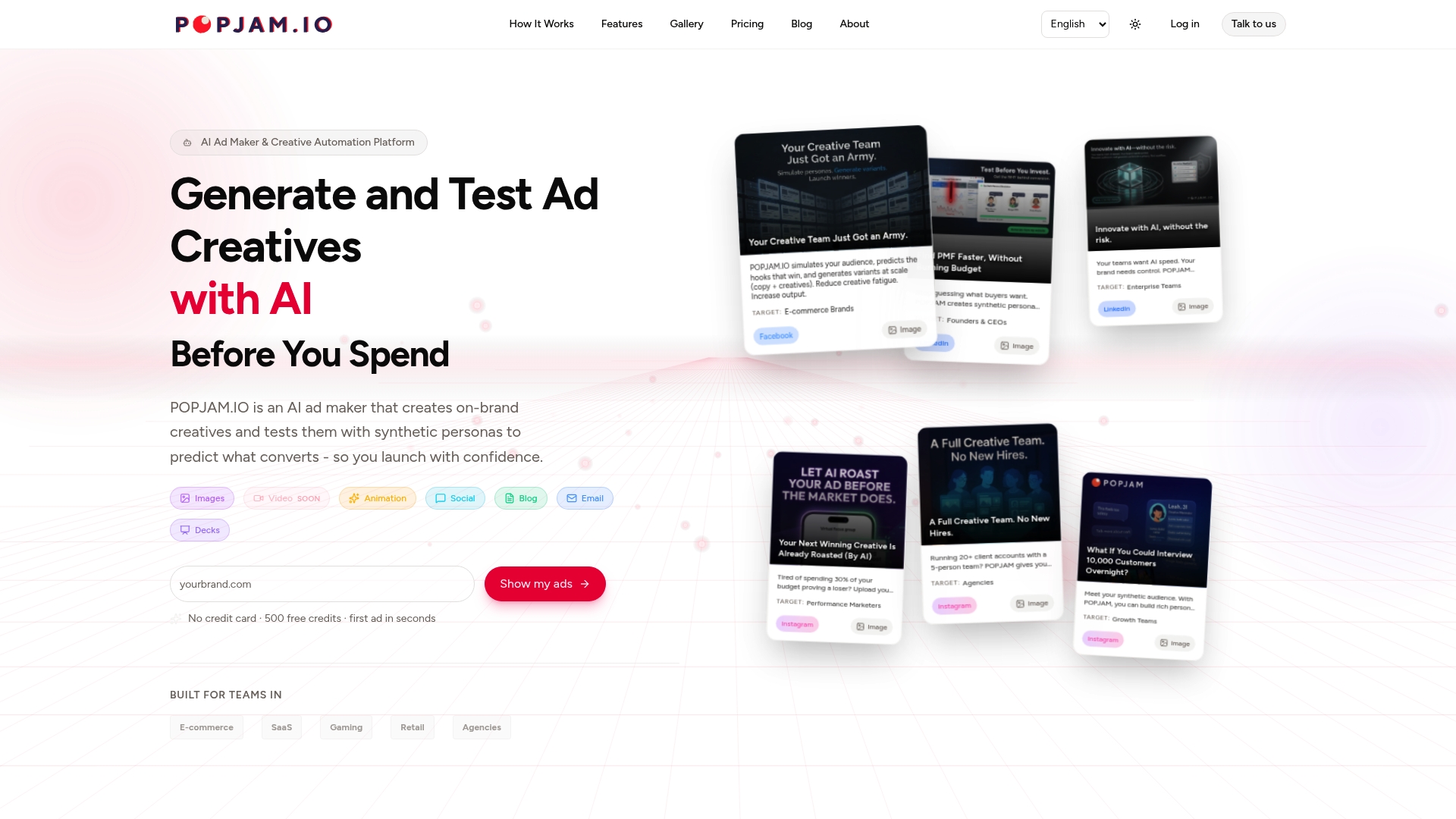
Here’s what that looks like in practice. You upload your ad creative, whether it’s a static image, a video, or a social post for Meta, TikTok, Google, LinkedIn, or Reddit. POPJAM routes it through psychographic persona profiles matched to your ICP and returns both quantitative scores (comprehension, relevance, intent) and qualitative feedback explaining the reasoning behind each reaction. You get the diagnostic depth of a moderated interview at a fraction of the time and cost.
Use cases where POPJAM fits naturally into your testing workflow:
- Rapid headline validation before paid search or social launch
- Ad visual composition tests to catch image-copy mismatches
- Price messaging simulation to identify friction before it hits your conversion rate
- Segment-specific persona routing for campaigns targeting multiple audience profiles
POPJAM’s audience simulation is GDPR-compliant, which matters for US-based teams running global campaigns. No real participant data is collected, which also means no recruitment delays and no ethics review bottlenecks.
Ready to test your next creative before it goes live? Try POPJAM’s AI ad testing platform and see what your audience actually thinks before you spend.
Useful sources
These are the primary references behind this guide. Each one is worth bookmarking for deeper reading on specific methods.
- Message Testing Redefined: How Modern Methods Drive Results (GreenBook): The clearest published treatment of blending System 1 and System 2 measures in a single study design.
- Message Testing Guide (UserIntuition): Practical walkthrough of how to run rapid pre-launch tests with small participant counts.
- Value Proposition Testing Guide (Koji): Covers AI-moderated conversational research and how it compresses study timelines without sacrificing probing quality.
- Messaging Testing Guide (Koji Docs): Explains why preference scores alone aren’t enough and how to structure deliverables that include qualitative reasoning.
- How to Test Value Propositions Like a Business Designer (IDEO U): Strong primer on MaxDiff and card-sort approaches for prioritizing benefit claims.
- How to Test Your Communications (Public Interest Research Centre): Detailed guidance on qualitative interview techniques and probing methods for message research.
- What Is Message Testing, and Why Does It Matter (GLG): Makes the case for periodic retesting as customer attitudes evolve over time.
- Message Testing Methods for Narrative Change (Commons Library): Seven tested methods from the International Center for Policy Advocacy, useful for teams working on narrative-driven campaigns.
- Anatomy of a Conversion-Optimized Website (SOSEI): Shows how message testing findings translate directly into landing page performance and conversion rate improvements.
- What Does Audience Segmentation Mean? (Growth Reach Marketing): Practical guidance on segmentation planning that helps you design tests with the right audience splits from the start.
FAQ
What does message testing mean?
Message testing is structured pre-launch research that shows message variants to members of your target audience and measures comprehension, credibility, relevance, and intent. The goal is to identify which words and claims actually connect before you commit media budget.
How do you run a message test quickly?
A rapid monadic test with 50 respondents per variant, fielded through an online panel or an AI-moderated platform like POPJAM, typically returns results in 3–5 days. Show one variant per respondent, lead with an open-ended comprehension question, and follow with closed-scale ratings for belief, relevance, and intent.
How is message testing different from A/B testing?
Message testing diagnoses why a message does or does not resonate before launch; A/B testing measures actual behavior at scale after launch. Run message testing first to sharpen your copy, then use A/B testing to confirm performance with real traffic.
What are the best practices for conducting message testing?
Limit each study to two to four variants, define your pass/fail threshold before fielding, include at least one open-ended comprehension probe, mix closed-scale ratings with qualitative probes, and segment your results by the audience dimensions that matter for your campaign.
Can synthetic personas replace real respondents in message testing?
Synthetic personas, like those used in POPJAM’s pre-launch simulation, are best used for rapid iteration and catching obvious mismatches before launch. They compress the feedback cycle significantly and work well for visual and copy composition checks. For high-stakes positioning decisions, complement synthetic testing with a study using real ICP-matched respondents.