

Search Ad Testing: The Practitioner's Playbook for 2026
The defensible minimum for search ad testing is simple: one clear hypothesis, one isolated variable, and a proper traffic split run until you hit statistical confidence. Skip any of those three and you’re not testing, you’re guessing with extra steps.
Here’s what that looks like in practice:
- Split your traffic with Google Ads Experiments for structural changes, or Ad variations for copy swaps.
- Wait for high statistical confidence before calling a winner. Peeking early is how good tests die.
- Validate creative before it goes live. Tools like POPJAM simulate audience reactions so you’re not burning budget to learn what a synthetic persona could’ve told you for free.
Your next move: open your account right now and set up one ad variation test, or spin up a custom experiment if you’re changing something structural like bid strategy.
Key Takeaways
The most reliable search ad testing method combines a single isolated variable, a proper 50/50 split run through native Google Ads tools, and pre-launch creative validation to cut wasted spend.
| Point | Details |
|---|---|
| Isolate one variable | Test headline, CTA, final URL, or bid strategy alone, never in combination. |
| Use the right native tool | Custom experiments for structural changes, Ad variations for copy testing across scope. |
| Wait for real confidence | Run tests several weeks minimum, longer for low-volume accounts, and require high statistical confidence. |
| Disable sync before launch | Turn off campaign sync to prevent base-campaign edits from contaminating your test. |
| Validate creative pre-launch | POPJAM tests variants against synthetic personas before live spend, narrowing your live test to the strongest candidates. |
Table of Contents
- What Does a Rigorous Search Ad Testing Framework Look Like?
- Which Google Ads Tools Should You Use for RSA Testing and Copy Experiments?
- How Should You Prioritize What to Test First?
- How Long Should a Search Ad Test Run and When Is It Significant?
- What Breaks Search Ad Tests and How Do You Fix It Fast?
- Why Pre-Launch Creative Validation Changes the Testing Math
- What the Industry Gets Wrong About Ad Testing
- Validate Your Ad Creative Before It Costs You a Dollar in the Auction
- Sources
- FAQ
What Does a Rigorous Search Ad Testing Framework Look Like?
A hypothesis without a number attached is not a hypothesis, it is a hunch. Before you touch anything in your account, write down three things: the metric you expect to move, the direction you expect it to move, and the minimum detectable effect that would actually matter to your business. “I think a shorter headline will do better” isn’t testable.
Here’s the part most PPC managers get wrong: they change two things at once and then try to explain the result with one story.
- Valid single-variable tests: headline wording, CTA phrasing, final URL destination, or bid strategy, tested alone.
- Invalid tests: changing the headline AND the bid strategy in the same experiment. You’ll get a result. You just won’t know what caused it.
- Pre-launch volume check: before you launch, estimate whether your ad group even gets enough impressions and conversions to reach significance in a reasonable window. Low-volume accounts need to plan for longer runs or smaller ambitions.
- Pick your metrics before launch, not after: one primary metric tied to revenue or lead quality, plus one or two supporting metrics (impression share, quality score) that would flag a side effect you didn’t anticipate.
This single-variable discipline is the backbone of any defensible PPC testing playbook, and it’s the one rule that gets broken most often under deadline pressure.
Pro Tip: Write your hypothesis and your “stop the test” criteria in a shared doc before launch. It keeps you from moving the goalposts once you see early data trending the way you hoped.
Which Google Ads Tools Should You Use for RSA Testing and Copy Experiments?
Pick the wrong tool and you’ll invalidate your own test before it starts. Here’s how to choose:
- Use a custom experiment (Google Ads Experiments) when you’re testing something structural: a new bid strategy, a landing page change, or a campaign-level setting shift. Google Ads Experiments let you split both traffic and budget between a control and a trial arm, with either cookie-based or search-based splitting.
- Use Ad variations when you’re testing copy at scale, across a campaign or an entire account. Ad variations apply find-and-replace or targeted edits and run as genuine split tests, which matters because responsive search ads make ad-by-ad comparison messy on their own.
- Cookie-based splits move faster but can leak between devices; search-based splits are cleaner for query-level isolation but take longer to accumulate volume.
- Run the Ad Preview and Diagnosis tool separately from any experiment. It tells you whether your ad is actually eligible to show for a given query, which rules out “my ad isn’t appearing” as a false positive before you blame your creative.
- Microsoft Ads runs its own experiments feature, and its documentation recommends starting with an A/A test to confirm your traffic split behaves as expected before you trust a real result.
How Should You Prioritize What to Test First?
Budget and time are finite, so test in this order:
- Check landing page conversion health first. If your page converts poorly, no amount of ad copy testing fixes that. Fix the page, then test the ad.
- Move to bid strategy and targeting once the landing page is solid. These changes touch the widest swath of traffic and often move the needle faster than copy tweaks.
- Test ad creative only when you have the volume to support it. If your ad group doesn’t generate enough impressions and conversions weekly, live copy testing will take months to resolve. This is exactly where pre-launch validation, like running variants through POPJAM before they ever hit Google Ads, earns its keep: you get directional feedback on which creative concepts resonate before spending a dollar on live traffic.
- Never stack concurrent tests that touch the same lever. Running a bid experiment and a copy experiment on the same campaign at the same time muddies both results.
Pipeline your tests one at a time, document what you learn, and only move to the next lever once the current one has a real answer.
How Long Should a Search Ad Test Run and When Is It Significant?
Ninety-five percent confidence isn’t arbitrary caution, it’s the standard that keeps you from declaring a winner based on a lucky week. A defensible PPC A/B testing approach calls for changing one variable, splitting traffic evenly, and running the test for several weeks for most standard search accounts, longer for low-volume or long-sales-cycle businesses.
Statistic Callout: Low-traffic campaigns may need more time to reach a definitive result, and some never get there at all. Forcing significance onto a test that lacks the volume to support it is worse than running no test.
Guard your test with these rules:
- Don’t peek early. Checking results daily and stopping the moment you see a lead is how false winners get promoted to your whole account.
- Disable campaign sync or queue your edits. Google Ads experiments often sync base-campaign changes into the variant by default, which quietly contaminates your control.
- Judge results on composite metrics. Conversions per impression or revenue per impression protect you from an algorithm that amplifies a creative that wins clicks but loses on actual business value. CTR alone can lie to you.
What Breaks Search Ad Tests and How Do You Fix It Fast?
Most broken tests share the same handful of root causes:
- Multiple simultaneous changes. If you touched the headline and the bid strategy together, you have two hypotheses and no way to separate them.
- Campaign sync left on. This is the single most common contamination source in Google Ads experiments, and it’s silent unless you check for it.
- Pinned RSA assets set incorrectly, which can force a single asset combination to dominate impressions regardless of performance.
- Uneven traffic splits that weren’t actually 50/50 despite the setup screen saying so.
Run an A/A test (same ad, same targeting, split traffic) before your first real experiment to confirm your split behaves as expected. If a test shows signs of contamination mid-run, abort it rather than let it finish on bad data. And if a test genuinely comes back inconclusive, write down what you learned and retest with an adjusted plan. Forcing a winner out of noise costs you more than admitting the test didn’t resolve.
Pro Tip: Keep a simple log: hypothesis, variable changed, start date, sync status, and result. Six months from now you’ll thank yourself for not re-testing something you already ruled out.

Why Pre-Launch Creative Validation Changes the Testing Math
Live testing has a floor cost: you have to spend real budget to learn which creative wins, and low-volume accounts pay that cost in weeks, not days. POPJAM changes that math by generating ad creative variants and running them against synthetic buyer personas before a single dollar hits the auction.
The workflow looks like this:
- Generate several creative variants in POPJAM based on your existing angle or a new hypothesis.
- Review the psychographic feedback POPJAM’s synthetic personas return, which flags which variants resonate and which fall flat, before you spend on distribution.
- Push the top-performing variants into Ad variations or a Google Ads custom experiment for the live confirmation round.
This matters most for accounts that don’t have the impression volume to run five live copy tests in a quarter. You get one real shot at a live test, so you want to walk in with your best two or three candidates already vetted, not your first five ideas.
Agencies managing multiple accounts get particular value from this. If you’re testing across several clients with different volume levels, pre-launch validation for agency workflows means you’re not spending client budget to discover the same creative mistake five separate times.
Pro Tip: Use pre-launch validation as a filter, not a replacement. It narrows your live test to the strongest candidates; the live experiment still gives you the real-world confirmation your CFO wants.
What the Industry Gets Wrong About Ad Testing
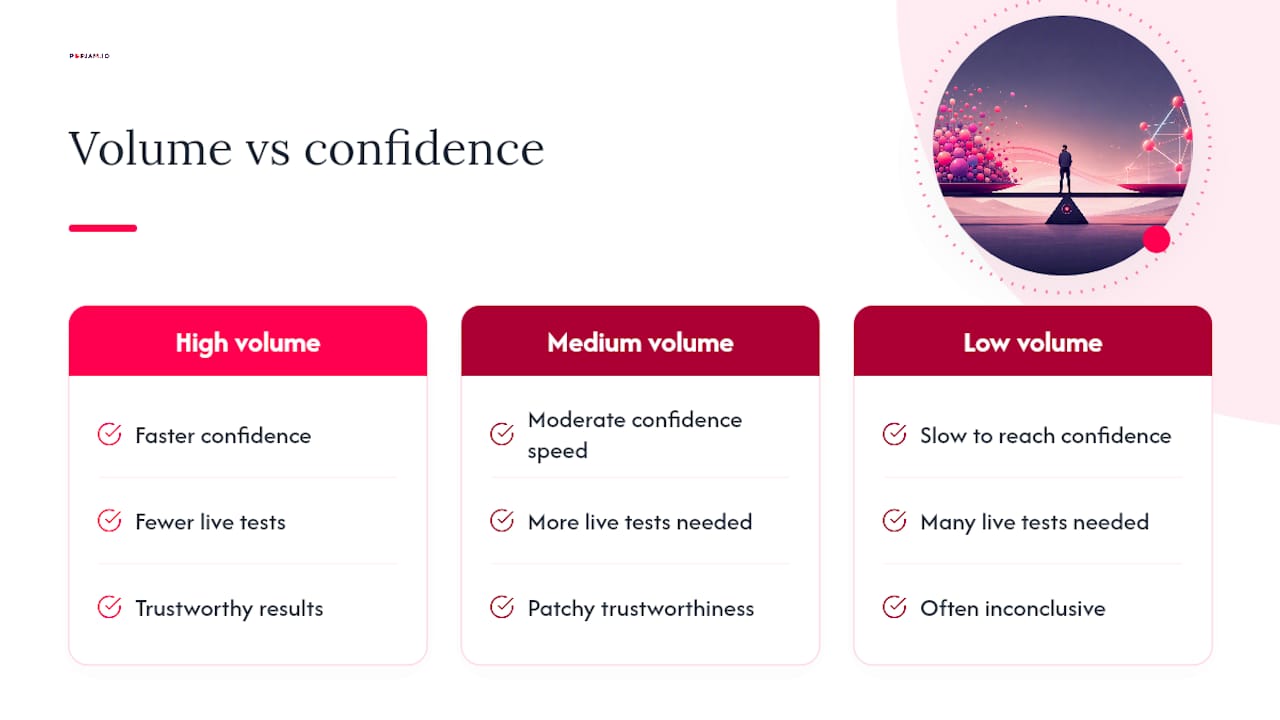
Most PPC advice treats testing like a checklist: set up an experiment, wait a few weeks, pick a winner, move on. That framing misses the actual bottleneck, which isn’t the testing mechanics, it’s volume. The math behind high statistical confidence doesn’t care how urgent your quarterly goals are. If your ad group doesn’t generate enough conversions, no amount of clever experiment design gets you a trustworthy answer in a useful timeframe.
The overlooked fix isn’t a smarter statistical trick, it’s moving the filtering step earlier. Testing five creative concepts live because you’re not sure which will win is expensive and slow when volume is thin. Testing them against synthetic personas first, then sending only the strongest two into a live experiment, respects the same statistical rules while cutting the number of live tests you need to run. That’s not a shortcut around rigor, it’s a way to reach rigor faster with less wasted spend.
The industry’s blind spot is treating “more testing” as inherently virtuous. What actually moves accounts forward is fewer, better-informed live tests, run with discipline and read honestly, even when the honest answer is inconclusive.
— Doruk
Validate Your Ad Creative Before It Costs You a Dollar in the Auction
Every strategy in this playbook assumes you can afford to wait several weeks and burn budget finding out which creative wins. POPJAM changes that equation by letting you test ad concepts against synthetic buyer personas before they ever enter a live auction, so the variants you push into Google Ads have already cleared a real filter.
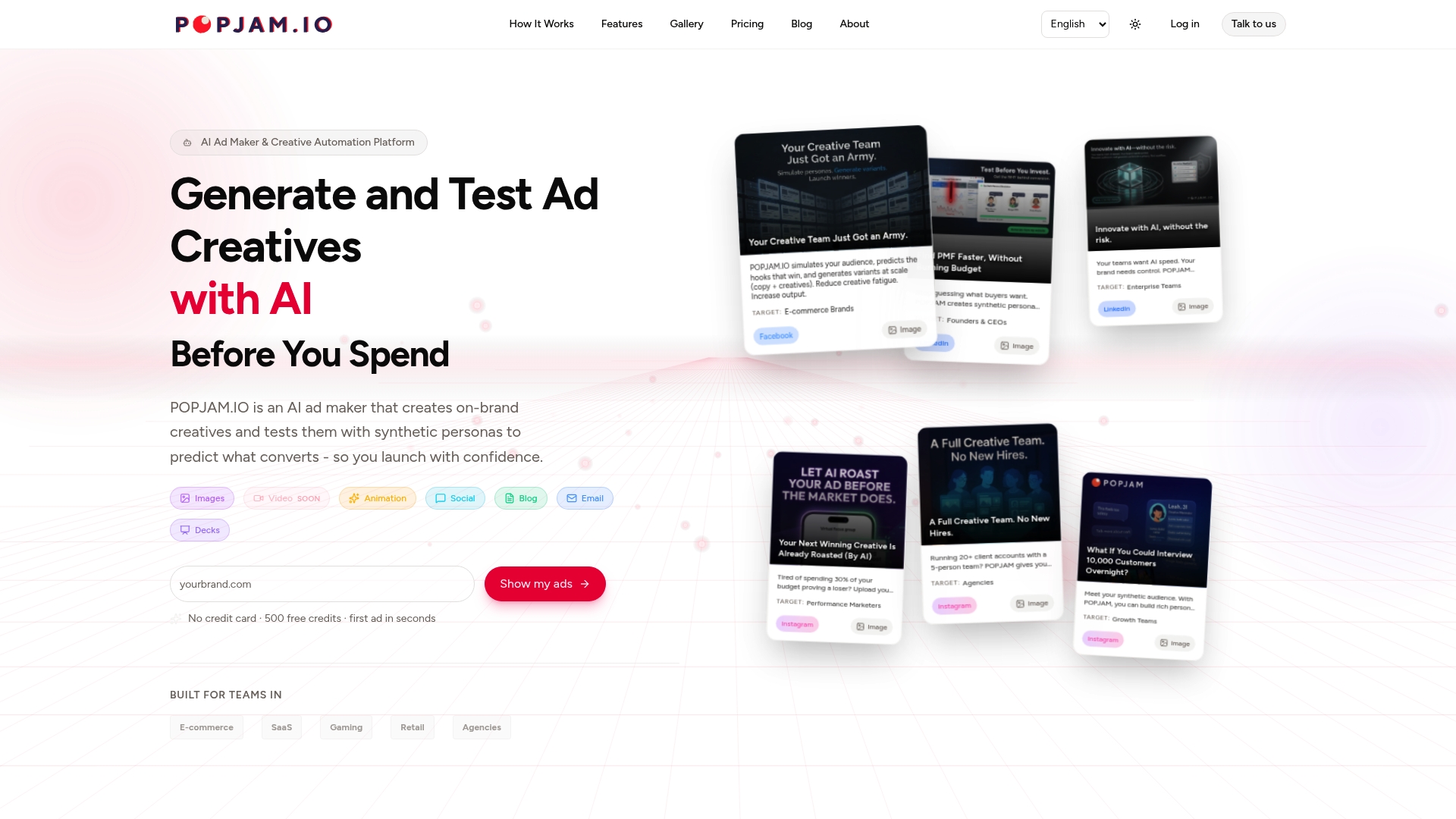
If you’re managing a low-volume account, or an agency juggling several clients with different traffic levels, this is the difference between five expensive live tests and one confident live test. Generate your variants, review the psychographic feedback, and send only your strongest candidates into an Ad variations test. Start a trial on the POPJAM AI ad maker today and see which of your creative concepts would have actually won before you spend a dollar finding out live.
Sources
- Set up a custom experiment - Google Ads Help
- Ad variations - Google Ads Help
- Statistical significance does not equal validity - CXL
FAQ
What Is Ad Testing?
Ad testing is the practice of running two or more ad variants against real traffic to measure which one performs better on a specific metric, using an isolated variable and enough volume to reach statistical confidence.
Is $20 a Day Good for Google Ads?
A daily budget that is low can work for a narrow, low-competition niche, but it rarely generates enough impressions or conversions to run a valid split test in a reasonable timeframe. Most search ad testing needs sustained volume, which is why low-budget accounts benefit more from pre-launch creative validation than from live experiments.
What Is A/B Testing in Digital Advertising?
A/B testing in digital advertising means splitting traffic evenly between two ad or landing page versions that differ by exactly one variable, then measuring which version performs better against a defined primary metric. In search ads specifically, it’s typically run through Google Ads Experiments or Ad variations rather than a third-party split tool.
How Can I Test a Google Ad?
Set up either a custom experiment for structural changes like bid strategy, or an Ad variations test for copy changes, split traffic 50/50, and let it run several weeks minimum before checking for a statistically significant winner. Confirming your ad is actually eligible to show, using the Ad Preview and Diagnosis tool, rules out visibility issues before you evaluate the results.
Should I Test Ad Copy or Landing Pages First?
Check landing page conversion health before investing in ad copy tests, since a weak landing page will undermine even a winning ad. Once the page converts well, move to bid strategy and targeting, then ad creative, testing pre-launch with tools like POPJAM when your account lacks the volume for fast live results.